Every bank that sets out to modernise commercial credit reaches the same fork. It can buy a loan origination suite that runs the request from application to booking, keep the systems it has and put better tools around them (a spreading tool here, document AI there), or build its own platform. Each path has banks that chose it well and banks that regret it. The choice depends less on technology than on three things: how different your credit process really is, where your data has to live, and who will own the result in five years.
In short
- Buy a suite when your process is close to the market’s, your current systems are due for replacement anyway, and one vendor, one roadmap and one contract matter more to you than fit.
- Extend when your origination workflow and core data are sound and the problem is the manual preparation between them: reading, spreading, reconciling, cash flow, collateral, memo and monitoring.
- Build when credit is a real source of differentiation, you have an engineering team funded to own it for years, and you can carry the validation burden for every engine yourself.
- Whatever you choose, demand the same properties: figures that cite their sources, policy you can read and change, decisions that stay with people, and a decision record you own.
What is on the market, by category
The tools a commercial lender looks at fall into a few honest categories. Most banks end up with more than one of them; the question is which one is the backbone.
The categories a commercial credit team will compare
Categories, not rankings. Products within each differ widely; ask each vendor the questions below rather than relying on a category label, including ours.
| Category | What it usually covers | What to check |
|---|---|---|
| Commercial loan origination suites | Application intake, workflow, spreading, risk rating, credit memo, approval routing, documentation and hand-off to booking, in one product | How much of your policy is settings you change versus vendor configuration work; how its spreads show their sources |
| Financial spreading tools | Turning statements and tax returns into a standard spread, ratios and cash flow, often with a template library | Whether every cell traces to a document line; how it fits the workflow and memo around it |
| Document AI and extraction services | Reading PDFs and scans into fields, often with a model, sold as a service or a component | What happens when a figure is not found (blank or guessed); whether each field keeps its source line; who validates it |
| Core banking and servicing modules | The booked loan, payments, existing exposure and sometimes covenant ticklers | Usually the system of record, rarely the place analysts prepare a request |
| In-house builds | Exactly what your team designs, on your cloud and your data platform | Who maintains it, validates it and answers for it in year five |
The three paths
| Buy a suite | Extend what you have | Build your own | |
|---|---|---|---|
| What it is | One platform for intake, spreading, rating, memo, approval and often booking | Keep the origination workflow, core and data; add preparation, checks, agents and a decision record around them | Your own services and data model, using open-source and cloud components |
| Time to first value | Depends on configuration and migration; often a programme, not a project | Short for the first product line, since existing systems stay | Long: the platform comes before the first request |
| Fit to your process | You adapt to the product, within its configuration | Your process, with preparation done before a person reviews it | Exactly your process |
| Data | Moves into the suite | Stays in your systems; the new layer reads from them | Wherever you design it |
| Model risk | Shared with the vendor; you still validate | Shared; each component validated | Entirely yours |
| Who owns it in five years | The vendor’s roadmap | You own the process; vendors own components | Your engineering team |
When buying a suite is right
A loan origination suite is a sensible choice when the bank’s commercial credit process is close to what most banks do, the systems it has are old enough that replacing them is overdue, and the organisation prefers one accountable vendor to several. Suites bring a coherent workflow from application to booking, and for a bank whose biggest problem is that nothing connects, that coherence is worth a lot.
The costs are migration, adapting procedures to the product, and depending on one roadmap for every change, including the AI capabilities that are moving fastest. Questions to ask a suite vendor:
- Can every figure in a spread be traced to the document and line it came from, and what happens when the reader cannot find one?
- Are our DSCR and leverage limits, LTV and advance rates, reconciliation tolerances, approval authorities and house limits settings we can read, change and version ourselves?
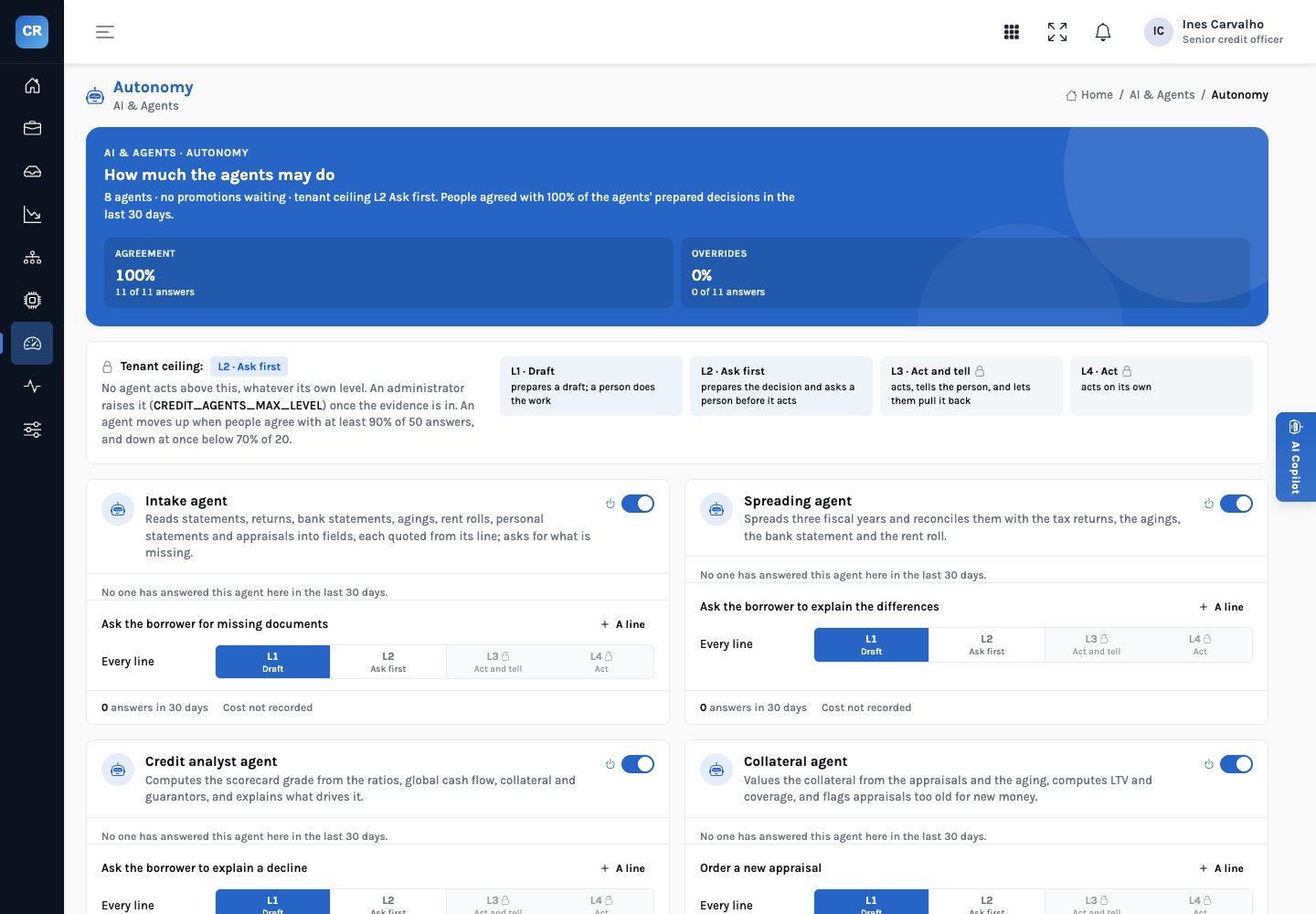
- Which actions can its AI take without a person, and can we cap that ourselves, below what the vendor allows?
- Can we export complete decision records (verdict, exceptions, mitigants, authority, who submitted, who approved) in a form we can read without the product?
When extending is right
Many banks already have an origination workflow they are reasonably happy with, borrower and loan data in core systems, and a document store. What they lack is the preparation between those systems: the reading, keying, tying out, reconciling, cash flow arithmetic and memo writing that analysts do by hand, and the quarterly covenant testing that slips when the pipeline is busy. Extending means adding that layer without replacing what works.
Extending: a new layer reads your systems and prepares each request; the decision and its record stay with your people.
The risk of extending is integration sprawl: a spreading tool, an extraction service and a memo template, each wired to the same five systems, none of them aware of the others’ results. A receivables figure read by one tool and spread by another is two places for it to go wrong. The way to avoid that is to make one layer responsible for preparing the whole request, from the document to the memo, and to let it read existing systems rather than become a second copy of them.
When building is right
Building makes sense when commercial credit is part of how the bank competes (a specialised lending niche where speed and structure win deals, say), when the process genuinely differs from the market, and when there is an engineering team that will own the platform for years. It is the path with the most control and the most responsibility. Banks that build well usually know exactly which part is differentiating and buy or extend for the rest.
What building really includes
The workflow and the screens are the visible part. The larger part is the engines behind them: a document reader that keeps the line each figure came from and refuses to guess; a spread with derived lines and ratios that each carry their formula; pro forma and global cash flow from each guarantor’s personal financial statement; reconciliations with tolerances; collateral valuation from appraisals and agings; a versioned risk rating scorecard; policy controls that block or refer; approval authority and four eyes; a decision record; covenant tests on quarterly reporting. Then the agent layer on top: prompts, grounding checks that throw away unsupported numbers, autonomy controls and monitoring. Each of these needs tests, documentation, validation evidence and someone on call.
The questions that decide
Map the steps honestly. If yours match the market’s apart from thresholds and templates, the case for building weakens sharply; thresholds and templates are settings.
A sound workflow and clean loan data argue for extending. Systems due for replacement argue for a suite.
Financial statements, tax returns and personal financial statements are sensitive. A requirement that they stay in your own cloud narrows the options quickly.
Every path needs validation. Building means producing all of it yourself, including for any AI component.
A platform nobody is funded to maintain becomes the next remediation programme.
Properties to insist on, whichever path
A spread with no sources, a grade with no factors, a memo that reads well and a recommendation. Fast to demonstrate, slow to examine, and hard to leave, because the reasoning lives inside the product.
Every figure linked to its document line, every ratio with its formula, every grade with its factors and model version, every decision recorded with the controls that fired. You can examine it, validate it and, if you have to, move it.
- Evidence: every figure on a request traceable to its source; a figure the reader could not find shown as missing, never guessed.
- People decide: agents prepare. A cap on their autonomy that the bank sets and that cannot be raised from inside the product.
- Policy as settings: limits, tolerances, advance rates, authorities and house limits readable and changeable by the bank, with versions and an owner.
- A decision record you own: exportable, complete and readable without the product.
- Read, don’t copy blindly: source systems stay the source; the platform takes what it needs from them rather than becoming a second borrower master.
Where InsightCredit fits
InsightCredit is built for the extending path. A credit request opens from an application or, for an annual review, from a loan; the borrower, guarantors, documents and collateral come from the bank’s own systems. Eight agents then prepare the work in order (intake, spreading, collateral, credit analysis, policy, the memo, a supervisor that assembles the submission, and a covenant monitor for the book), and each prepares a decision that a person accepts, rejects or asks about. People decide every request, with four eyes and an approval authority, and the decision record keeps the verdict and why.
The document reader is deterministic: patterns over the PDF’s text layer, not a model, and a
figure it cannot find is noted rather than guessed. Credit policy lives in two places the bank
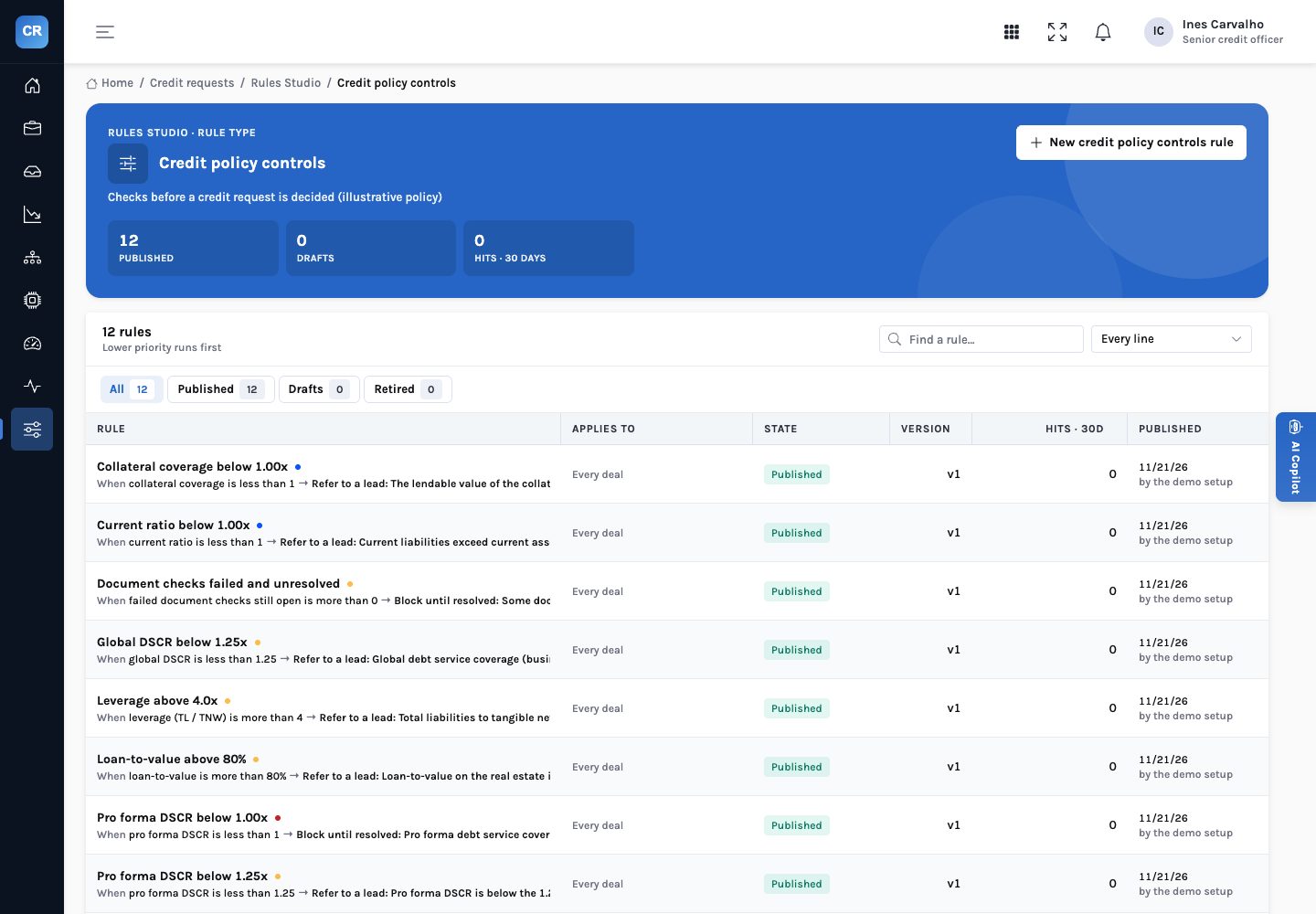
controls: twelve controls in Rules Studio that block or refer a request, and CREDIT_*
settings for tolerances, approval authorities and the house limit. Every value in our demo, which
runs on a fictional bank, is illustrative. InsightCredit stops at the decision and at monitoring;
it does not replace the core system where a loan is booked and serviced.
It can also sit beside a suite. A bank that already has a loan origination system can use InsightCredit for the preparation and monitoring it lacks, and keep the suite for workflow and booking. That is an integration question worth asking early, because it decides which system holds the decision record.
A simplified decision path. Data residency and validation capacity can override any branch.
What it means for each audience
For the chief credit officer
Whatever the path, write evidence, policy-as-settings, autonomy caps and the decision record into the selection criteria. They are what credit review and examiners will test.
Count validation effort in the comparison; it differs most between paths.
For the credit team lead
Map today’s process honestly before choosing. Teams often overestimate how different their process is, and underestimate how much time goes on preparation.
Prefer the path where analysts review prepared work with its sources one click away.
For the board
This is a five-year decision dressed as a procurement. Ask who will own the platform, how its policy is changed, and what leaving it would cost.
The cheapest option to start is rarely the cheapest to keep.
Buy, extend or build: the right path is the one whose results you can examine, change and own.
Choose on process fit, data and ownership, and refuse any option whose figures cannot show where they came from.