- contact@insightcreditai.com
InsightCredit · commercial and SME lending, prepared by agents
Every credit request prepared. Every decision yours.
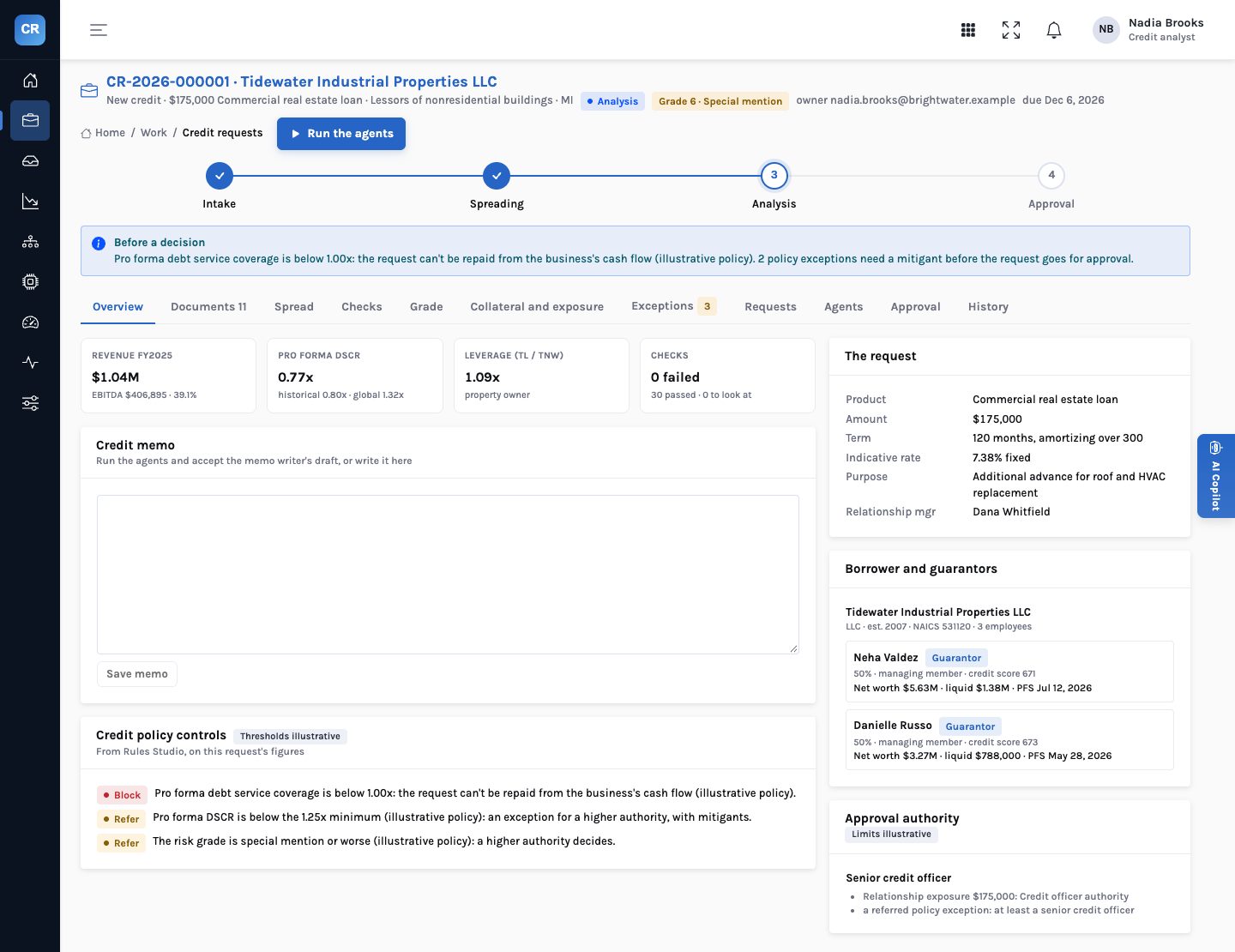
InsightCredit reads the statements, the tax returns, the agings and the personal financial statements, quoting every figure from its line. It spreads three years, reconciles them with the returns and the aging, computes coverage, leverage and global cash flow, grades the request with a reason for every point and drafts the credit memo from those figures. Then it stops, and a credit officer with the authority decides.
- Every figure traced to its line
- Ratios computed, never estimated
- Four eyes, within authority
What a credit file is built from
Income statementsBalance sheetsTax returns (1120, 1120-S, 1065)Bank statements
Receivables agingsPayables agingsRent rollsPersonal financial statements
Appraisal summariesLoans and covenantsQuarterly reportingRelated-party groupsYour credit policy
The problem
Credit teams don’t lack judgement. They lack time to use it.
Most of a credit analyst’s week is preparation: keying three years of statements into a spreadsheet, tying receivables to the aging, comparing revenue with the tax return, building global cash flow from each guarantor’s statement, then retyping the same figures into a memo. The judgement an approver pays for gets whatever time is left, and the file an examiner reads later has to be reconstructed.
Preparation
The same numbers, typed four times
Into the spread, into the ratio sheet, into global cash flow, into the memo. Each copy is a chance for a transposed digit, and nobody can say which line a figure came from.
Reconciliation
The difference nobody tied out
Receivables a third higher than the aging. Revenue a fifth higher than the return. A guarantor who owes more than she owns. Each sits in a document already in the file.
Evidence
“Who approved this, and on what?”
When a credit goes wrong, the question is what the bank knew and who had the authority. A memo alone doesn’t answer it. A record of the figures, the exceptions, the mitigants and the approver does.
How it works
Intake → Spread → Analyze → Decide → Monitor
One case for every new credit, increase, renewal and annual review. Seven agents prepare each stage of the request and an eighth watches the loan book. A person accepts, rejects or asks about what they prepared, and makes every decision that matters.
1
Intake
A case opens from an application or, for an annual review, from a loan. The borrower, guarantors, documents and collateral come across from the bank’s systems. Every document is read into fields, each quoted from its line.
2
Spread and reconcile
Three fiscal years side by side, built only from what was read. The statements are tied out and checked against the returns, the agings, the bank statement and the rent roll.
3
Analyze
DSCR historical, pro forma and global; leverage; liquidity. Collateral valued from the appraisals. Exposure for the relationship and its related group. A points grade with every factor shown.
4
Decide
Credit policy controls block or refer. Each exception carries a mitigant a person recorded. The memo is drafted from the engines’ figures. Four eyes and delegated authority by exposure.
5
Monitor
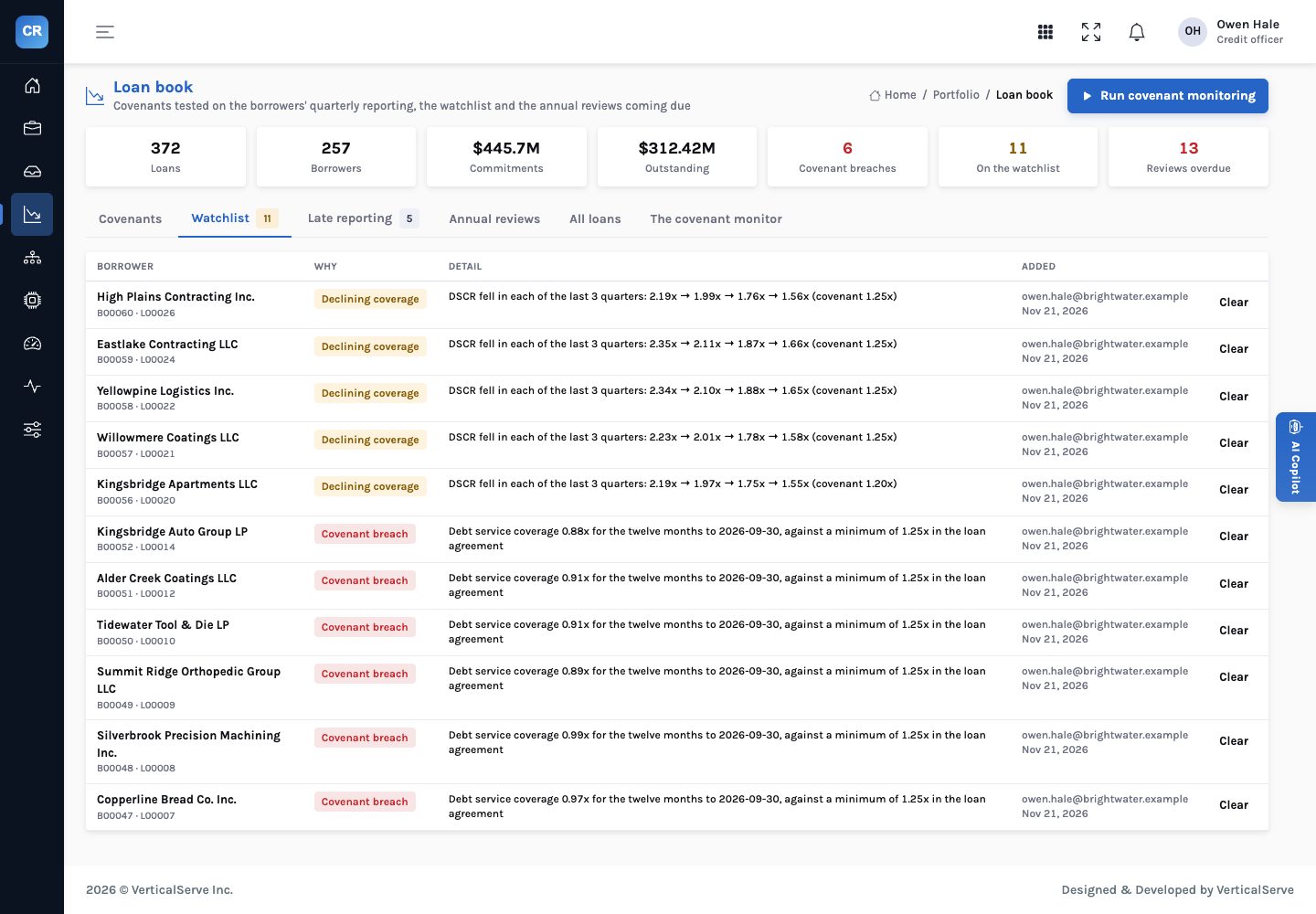
Covenants tested on every quarterly package. Breaches and declining coverage prepared for the watchlist; late packages and annual reviews coming due listed for the people who chase them.
A worked case, from the demo bank
A $175,000 roof loan the coverage couldn’t carry
Tidewater Industrial Properties LLC, a fictional property owner at the fictional Brightwater Commercial Bank, asks for an additional advance to replace a roof and HVAC. The statements say revenue has fallen two years running while interest has risen. InsightCredit spreads it, and the arithmetic does the rest.
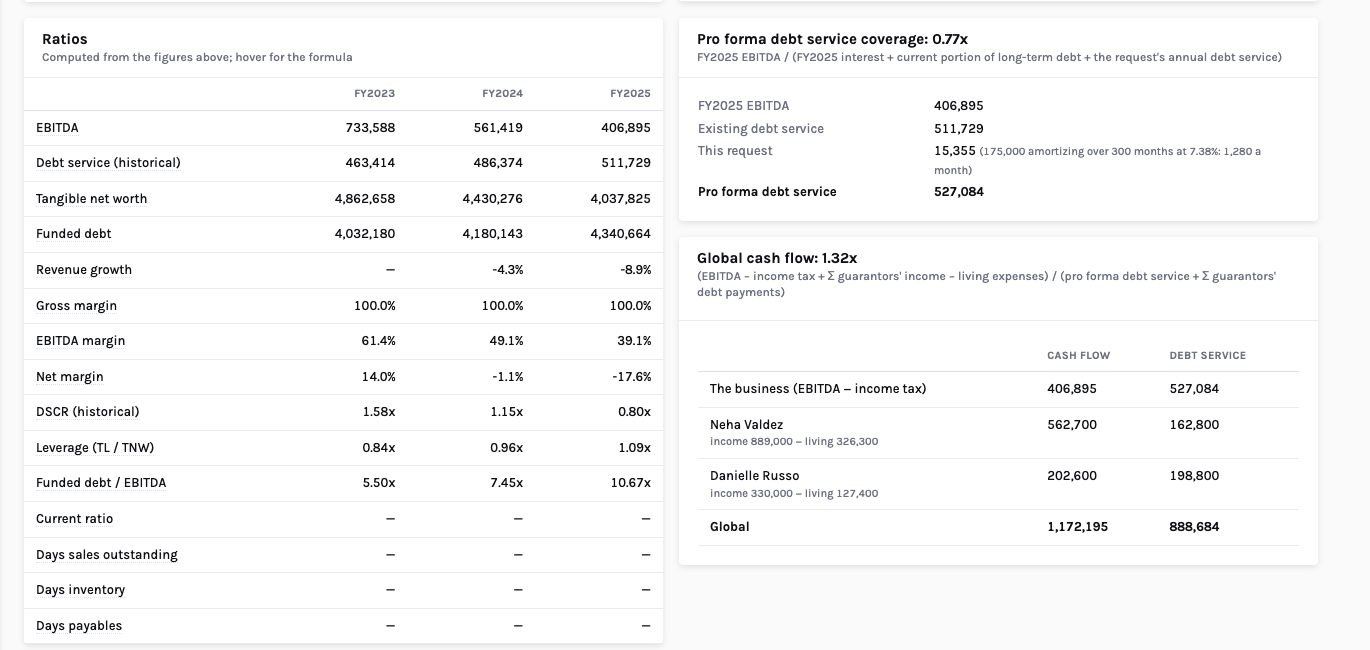
FY2023DSCR 1.58xEBITDA $733,588 over debt service $463,414
FY2024DSCR 1.15xEBITDA $561,419 over $486,374
FY2025DSCR 0.80xEBITDA $406,895 over $511,729
Pro forma0.77x with the request+$15,355 a year: $175,000 over 300 months at 7.38%
The grade
Grade 6, Special mention, at 51 points
An explainable points scorecard: every factor’s points and the figure behind them. Bands and grades are illustrative; a bank sets its own.
- Debt service coverage (pro forma)0.77x, below the 1.00x band+30
- Revenue trend−6.6% a year over the spread+8
- Collateral coverage1.00x of lendable value+4
- Guarantor supportglobal DSCR 1.32x+3
- Industry, statement qualitymedium-risk industry; compiled statements+6
- Grade → 6 Special mention51
The policy
One control blocks; two refer
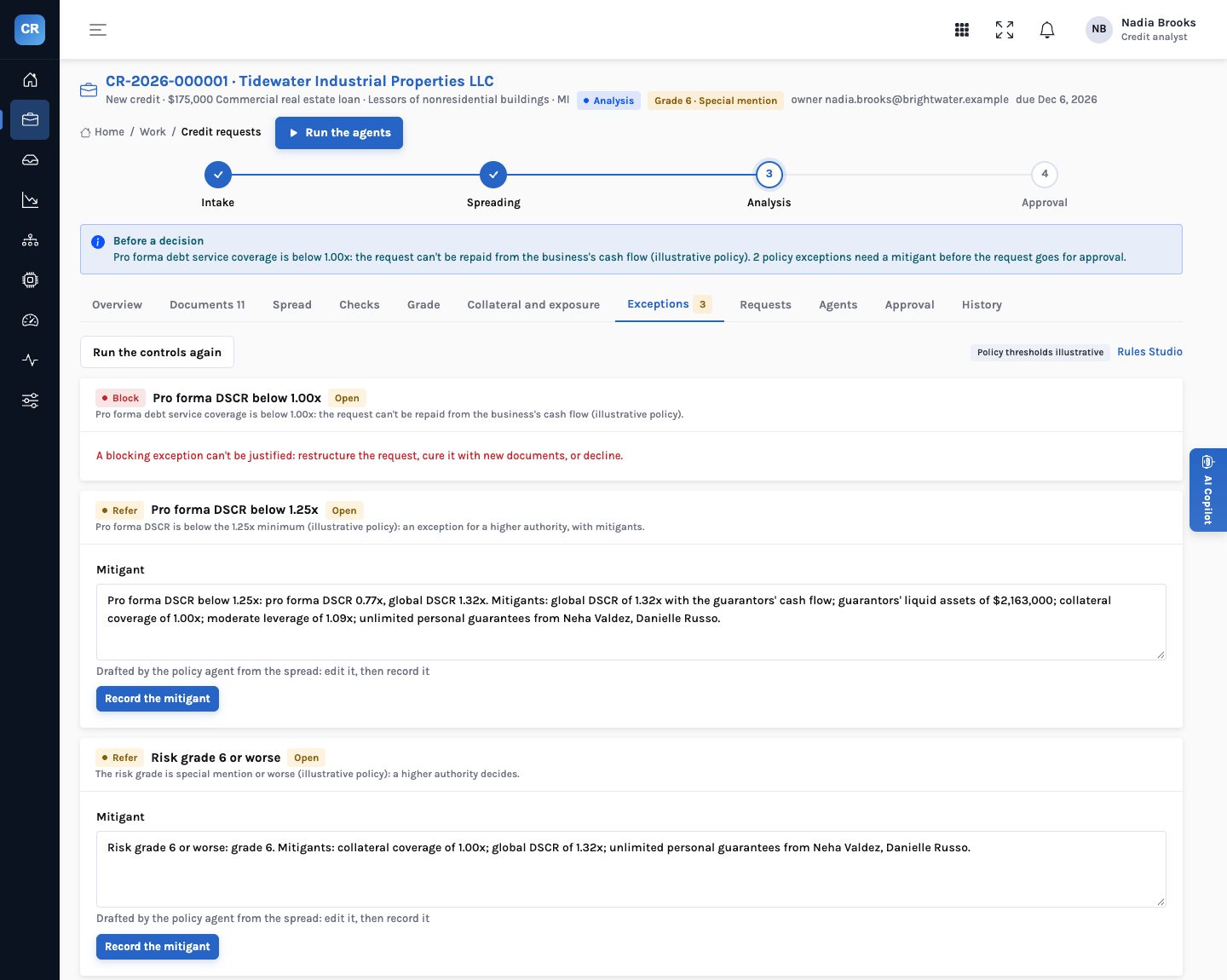
Rules Studio controls run on the case’s own figures (thresholds illustrative). A referred exception can carry a mitigant; a block can’t be justified away.
- Pro forma DSCR below 1.00xcan’t be repaid from the business’s cash flowblock
- Pro forma DSCR below 1.25xmitigant drafted: global DSCR 1.32x, guarantors’ liquid assets $2,163,000refer
- Risk grade 6 or worsea higher authority decidesrefer
- Authority neededa referred exception: at least a senior credit officertier 2
The guarantors’ cash flow lifts global coverage to 1.32x. Whether that is enough is a credit officer’s call, and the block means the request must be restructured or declined.
Spread and reconcile
The spread is only the start. The documents have to agree.
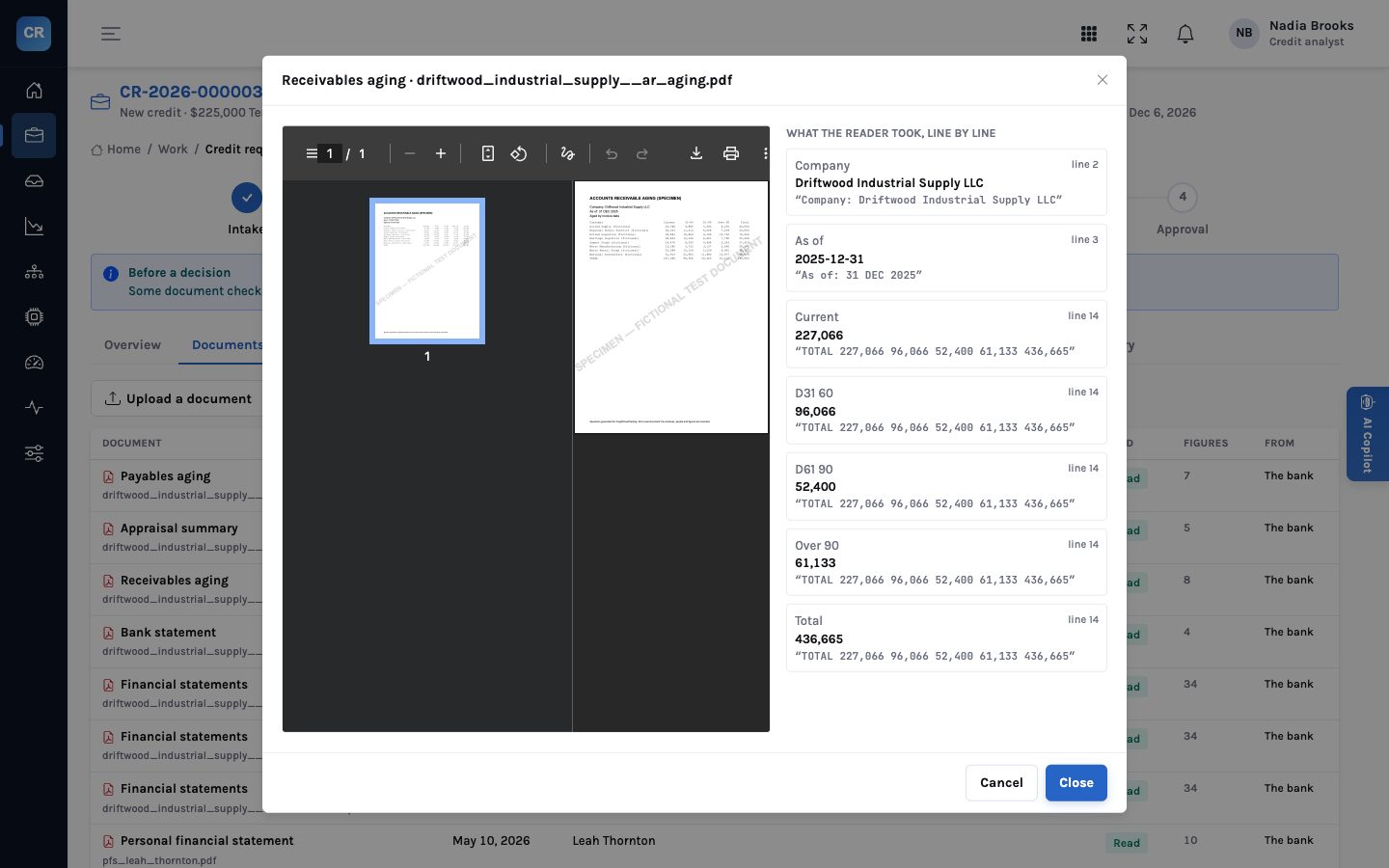
Every cell in the spread links to the line it was read from. Then the checks compare the statements with the business’s other documents and quote both sides. From the demo bank:
Receivables
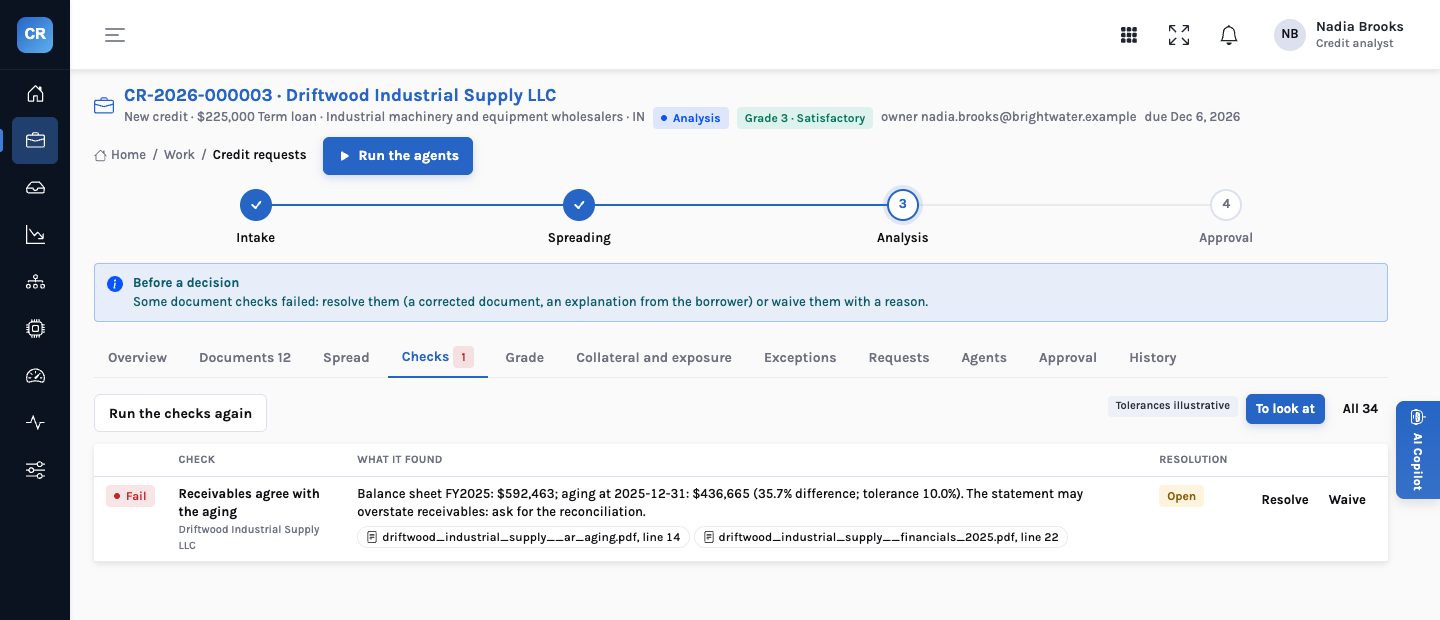
$592,463 against $436,665
Driftwood Industrial Supply’s FY2025 balance sheet carries 35.7% more receivables than its own aging (tolerance 10%, illustrative). The check fails, and the spreading agent drafts a request for the reconciliation.
Tax return
$14.5M of revenue, $11.6M on the 1120
Hawthorne Bakeries’ 2025 statements report $14,517,350; the corporate return shows gross receipts of $11,560,905, a 20.4% difference. Both lines are quoted on the check.
Guarantor
Net worth of −$1,061,000
One of Oakridge Grill House’s three guarantors reports liabilities of $4,963,000 against assets of $3,902,000. The check fails, the grade adds points, and global DSCR falls to 1.24x.
What it does
From application to decision, and every quarter after
Every figure, check and grade comes from deterministic engines. The agents run them, explain them and prepare the next step. People decide.
Document reader
Statements, returns, bank statements, agings, rent rolls, personal financial statements and appraisal summaries read into fields.
- Each figure with its line and the text
- Missing figures noted, not guessed
- Borrower uploads read on arrival
Three-year spread
Income statement and balance sheet side by side, every cell traceable to its document line.
- EBITDA, DSCR, TL / TNW, debt / EBITDA
- Margins, current ratio, DSO, DIO, DPO
- Pro forma and global cash flow
Reconciliations
Statements against the business’s other documents, each difference a check with both lines quoted.
- Returns, agings, deposits, rent roll
- Statement ties and document age
- Tolerances you set
Explainable grade
A points scorecard over coverage, leverage, liquidity, profitability, trend, collateral, guarantors, history, industry and statement quality.
- Every factor’s points and why
- Override with a reason
- Model version kept with the grade
Collateral and exposure
Lendable value from the appraisals and the aging at your advance rates; LTV and coverage.
- Relationship exposure
- Related-party groups against a house limit
- Stale appraisals flagged for new money
Policy exceptions
Twelve credit policy controls in Rules Studio that block or refer, on the case’s own figures.
- A mitigant drafted from the spread
- Recorded by a person
- Blocks cured or declined, never waved through
Credit memo
Drafted from the engines: the request, the spread, coverage, collateral, guarantors, grade and exceptions.
- Every number from the spread
- Ungrounded sentences thrown away
- Accepted and edited by the analyst
Approval
Four eyes on every approval, and delegated authority set by relationship exposure, exceptions and group limits.
- The submitter never approves
- Credit committee decisions recorded
- A decision record frozen at the time
Portfolio monitoring
Covenants tested on every quarterly package across the loan book.
- Minimum DSCR, maximum leverage, current ratio
- Declining coverage before it breaches
- Late packages and annual reviews due
AI agents
Eight agents prepare. None of them can say yes.
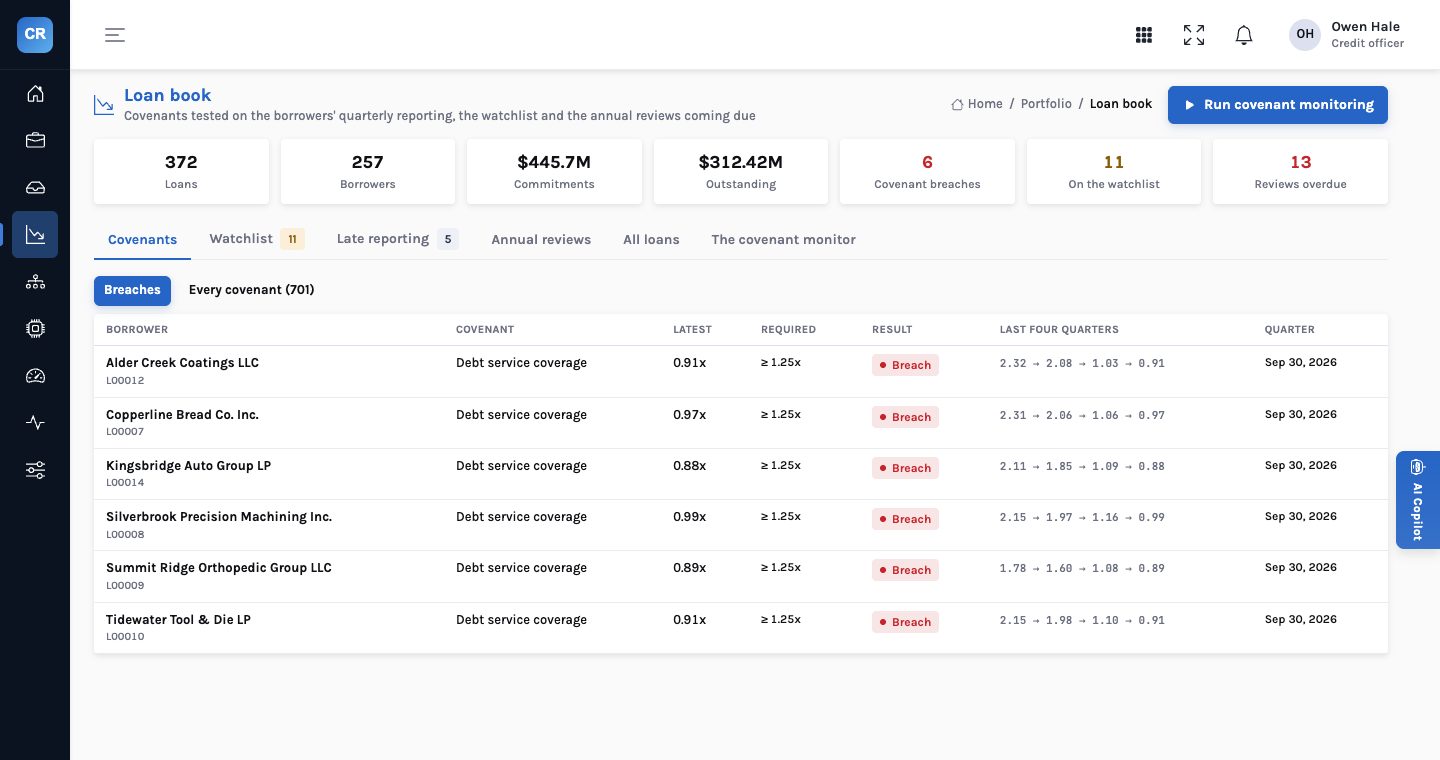
Each agent does one stage of the request and stops at a prepared decision: a request to send, a mitigant to record, a memo to accept, a submission to make. You accept, reject or ask a question, and every answer goes on the record. Every action is capped at L2: the agent prepares the decision and asks a person first.
- Intake, spreading, collateral, credit analyst — read, spread, reconcile, value and grade, each figure from a document
- Policy, memo writer, supervisor — draft the mitigants and the memo, and say what still blocks a decision and whose authority it needs
- Covenant monitor — tests the loan book every quarter and prepares the watchlist and overdue reviews
- Never on their own — deciding a request, recording a mitigant, clearing a check, ordering an appraisal or writing to a borrower
- Model optional — with the language model off, every agent runs on its rules and says so
Asking the borrower
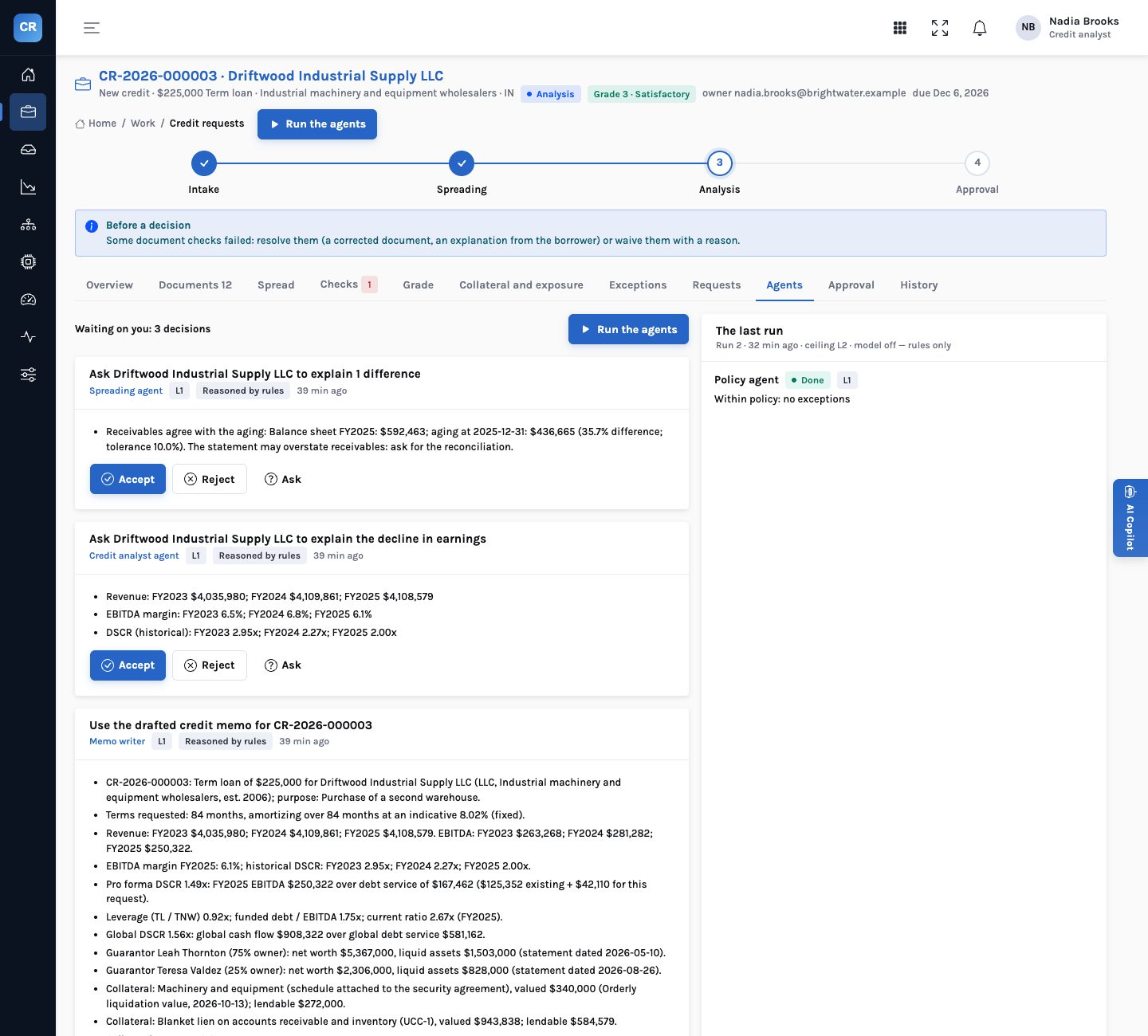
The request is drafted for you. Nothing leaves until you send it.
When a document is missing or two documents disagree, the agent that noticed drafts the request. It is held on the case for an analyst to edit and send. The borrower answers through their own link, with no account to create, and what they upload is read at once: the spread and the checks run again.
- Held for review — every request waits for a person; the agents never send
- One link per request — shown once; InsightCredit keeps only a fingerprint of it
- Questions and files — a text box for each question, an upload for each document
- Read on arrival — uploads become case documents, and the spread and checks rerun
After the decision
Credit doesn’t end at the closing
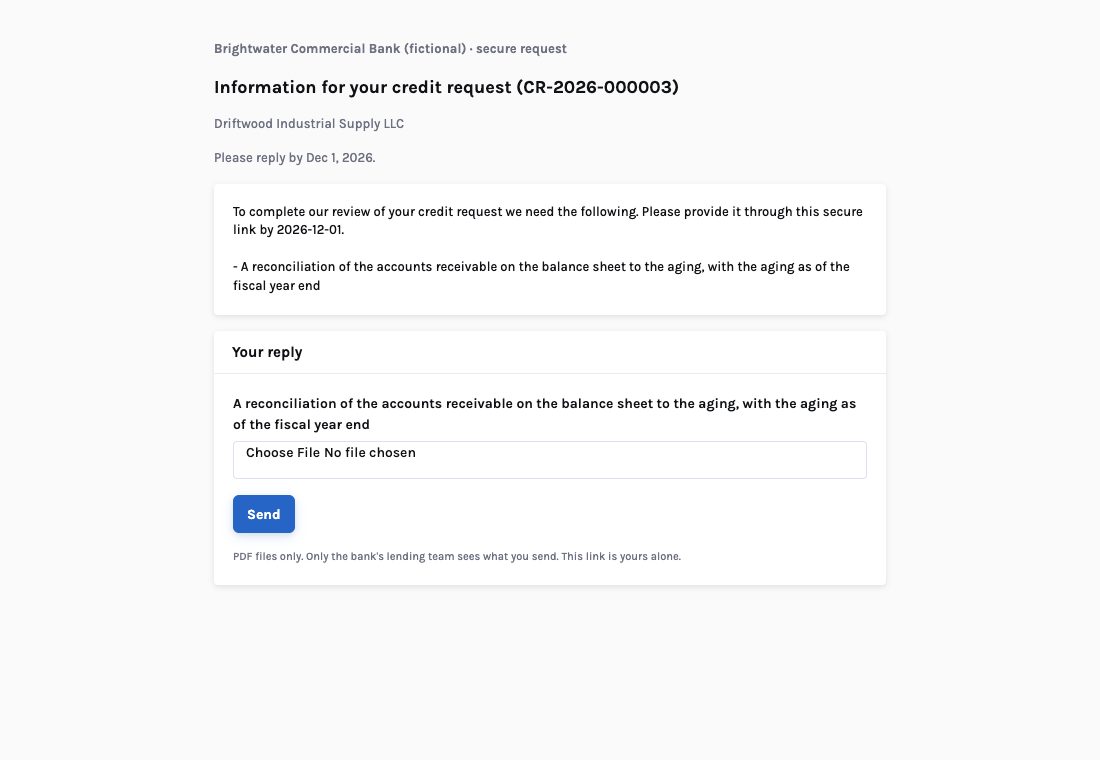
On the demo bank’s book of 372 loans to 257 borrowers, the covenant monitor ran 701 covenant tests on the latest quarterly reporting: 6 breaches, 5 borrowers whose coverage fell three quarters running, 5 packages late, and 46 annual reviews due within 60 days, 13 of them overdue. A credit officer decided who went on the watchlist.
For credit and risk leaders
Answers for the examiner, the auditor and the board
The questions a chief credit officer is asked are simple. InsightCredit keeps the evidence for each answer on the case, as it stood when the decision was made.
Why did we approve it?
The decision record: the grade, coverage, leverage, the controls that fired, each exception and its mitigant, the authority and the conditions.
Did it have the authority?
Authority by exposure, exceptions and group limits, enforced at the moment of approval. The person who submits never approves.
How many exceptions?
Every block and refer kept as a policy exception on the case, with the figure that triggered it and the mitigant someone recorded.
What did the AI do?
Every agent step, what it prepared, who answered and how, and the agreement rate for each action. No agent decides.
Design & trust
Built to be examined
A Python API, a React app and PostgreSQL, designed to run in your own cloud account against your own systems. Nothing in a credit file is a value a model made up.
Grounded
No invented figures
A figure comes from a document line; ratios, reconciliations, grades, LTV and covenant tests are deterministic code. A memo sentence with a number not in the facts is thrown away.
Read-only sources
Your systems stay yours
InsightCredit reads applications, borrowers, documents, loans, covenants and reporting from your systems and keeps its own work in its own schema.
Policy
Your thresholds, not ours
Every threshold in the demo is illustrative. Controls live in Rules Studio; authorities, tolerances and the house limit are settings you own.
Roles
Analysts, officers, auditors
Analysts prepare and submit. Credit officers approve within their authority and override grades with a reason. Viewers and auditors read everything and change nothing.