- contact@insightcreditai.com
Use cases
Real credit situations, worked end to end
Each one on the demo bank’s data, a fictional bank with invented borrowers, showing what the agents prepare and what the credit team decides.
Worked end to end
Eight situations every credit team meets
Each is a real request on the demo bank’s data, with the screens and a step-by-step account of who does what.
Commercial real estate · new money
Coverage that fell below one
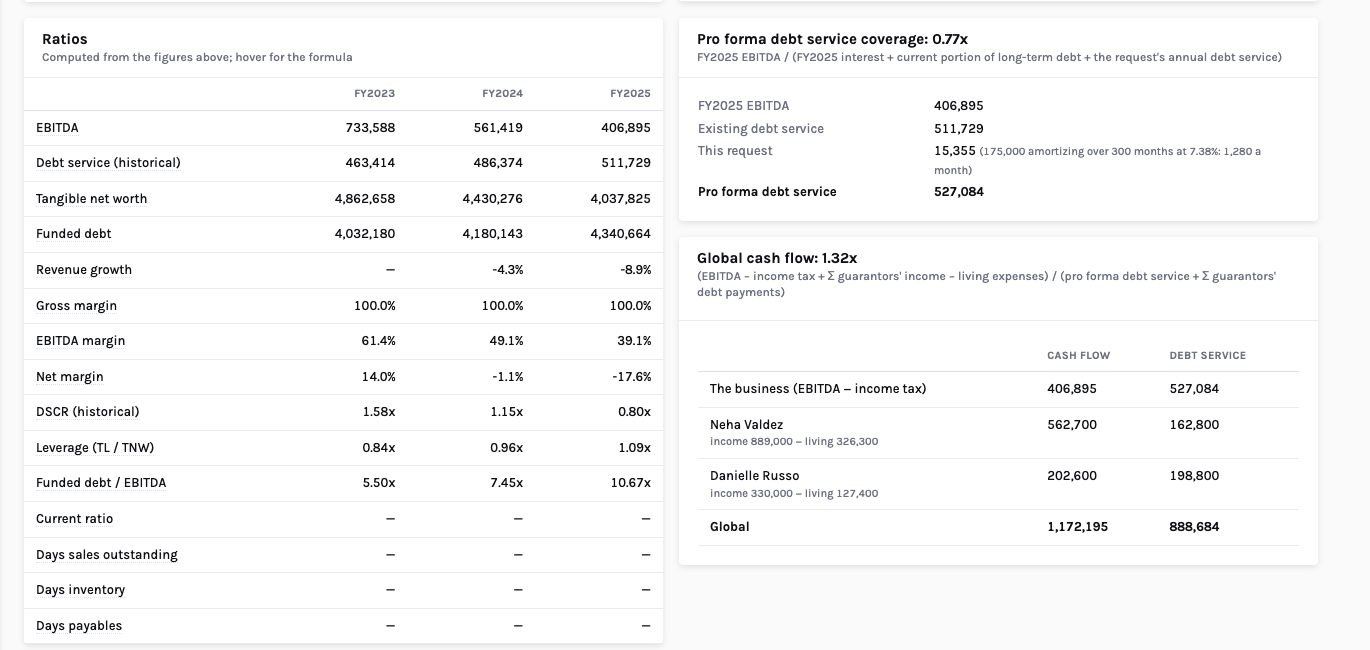
A property owner asks for $175,000 for a roof and HVAC. DSCR went 1.58x, 1.15x, 0.80x; with the request it is 0.77x. The guarantors lift global coverage to 1.32x.
- Pro forma DSCR from the request’s own terms
- Grade 6 at 51 points, every factor shown
- A block that no mitigant can clear
Spreading · reconciliation
Receivables the aging didn’t support
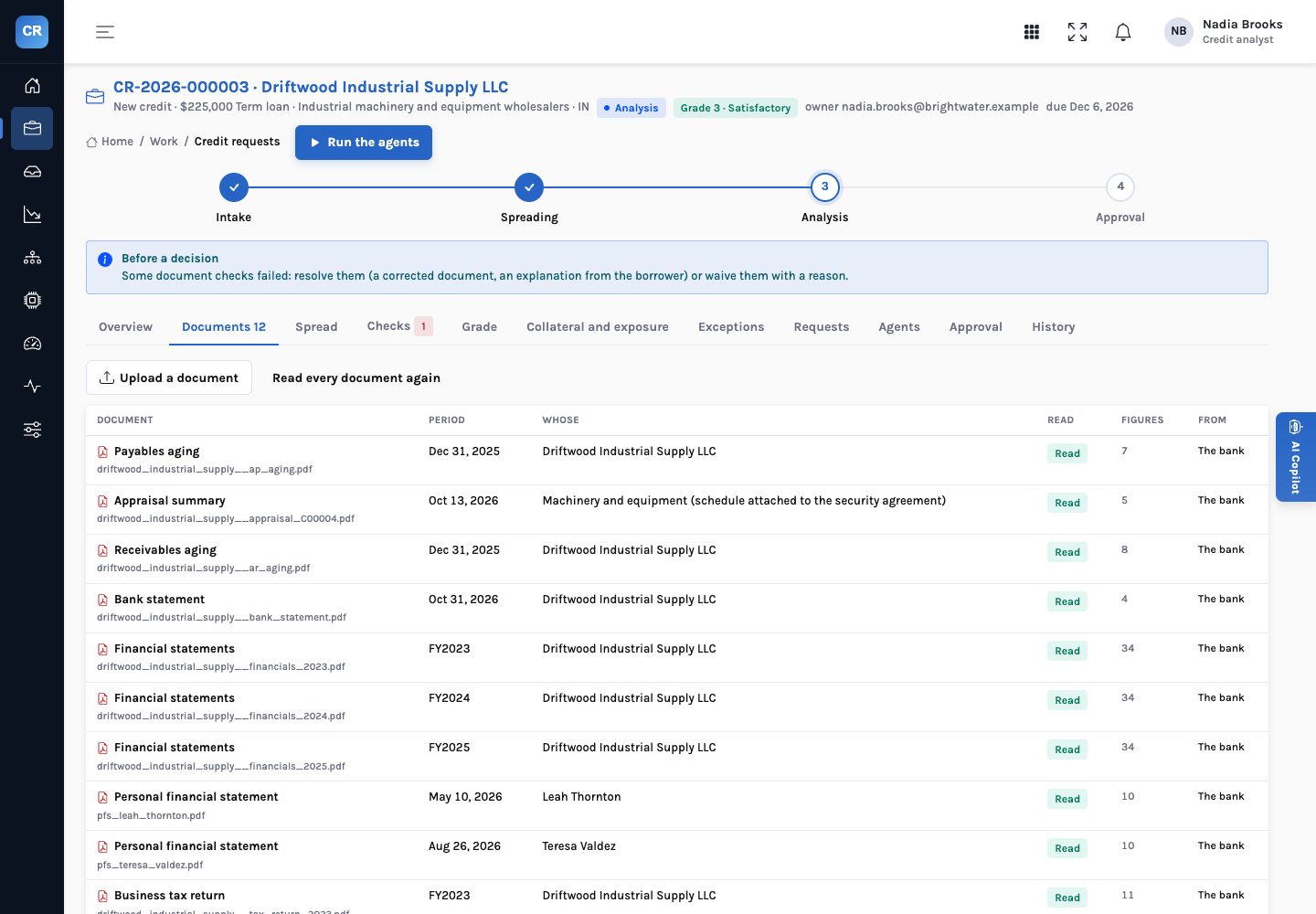
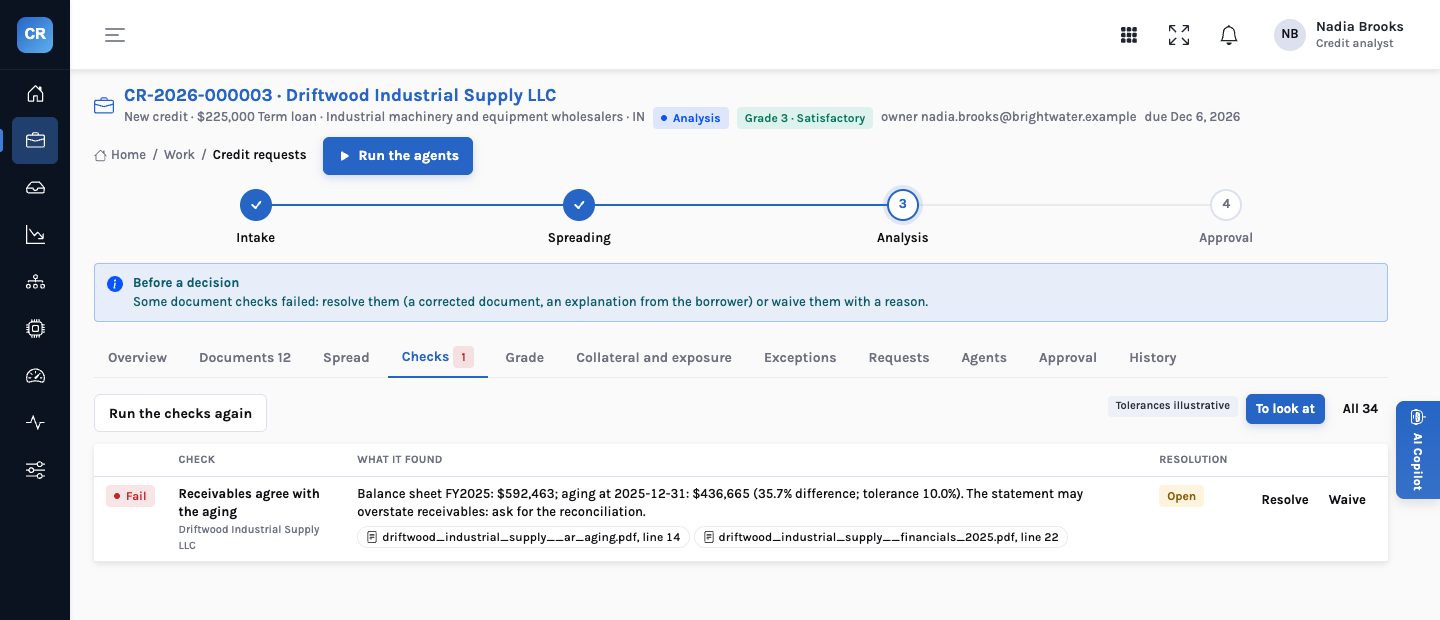
A wholesaler’s balance sheet carries $592,463 of receivables; its own aging totals $436,665, a 35.7% difference.
- Both lines quoted on the check
- The borrowing base uses the aging
- A request for the reconciliation, held for review
Spreading · reconciliation
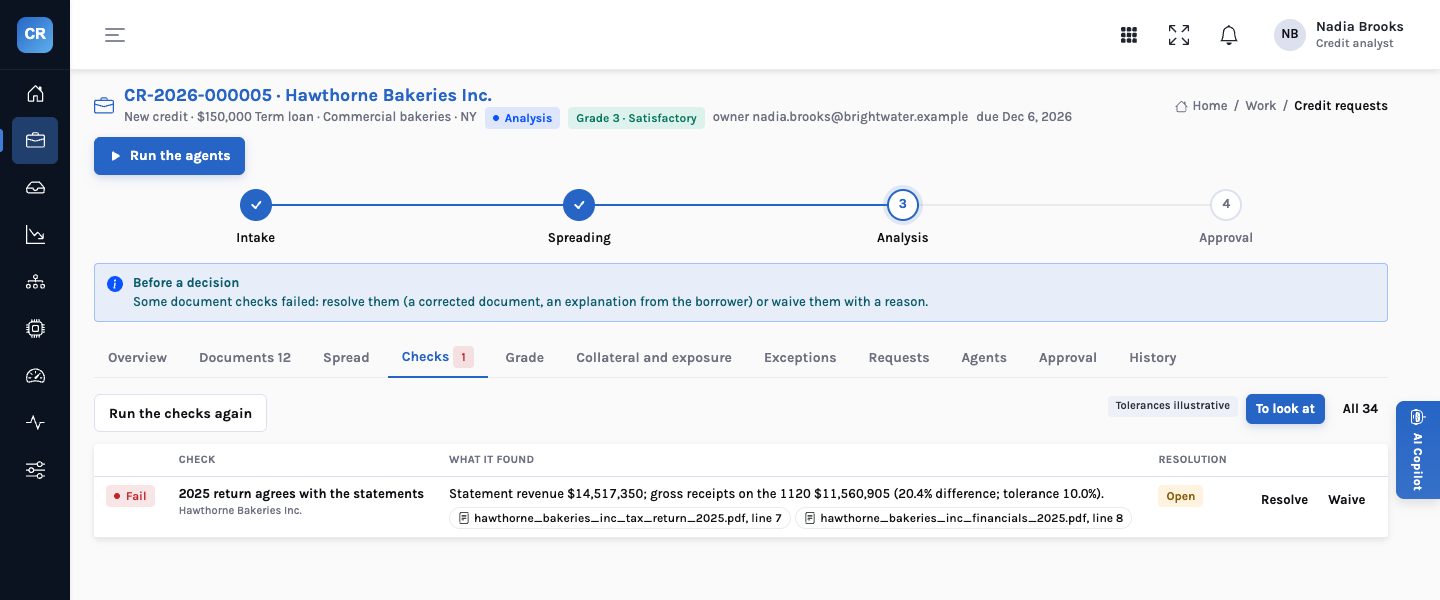
The tax return that didn’t match
A bakery’s 2025 statements show $14,517,350 of revenue; its Form 1120 shows $11,560,905 of gross receipts.
- Each return against its year
- Tolerance you set
- Failed checks block approval until resolved
Collateral · appraisal
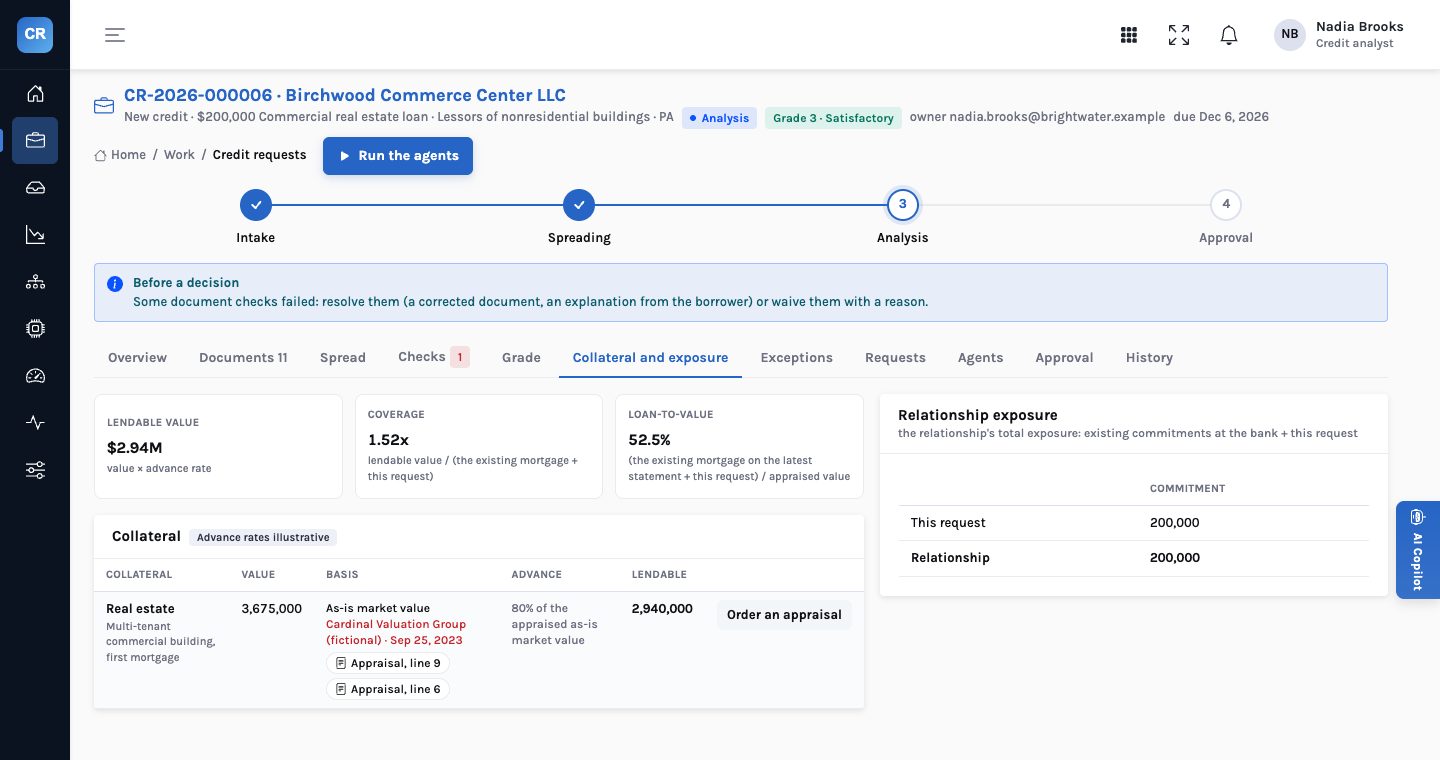
An appraisal three years old
An additional advance against a building last valued in September 2023, 1,153 days before the case.
- Stale is a fail when there is new money
- The collateral agent prepares the order
- A person places it
Guarantors · global cash flow
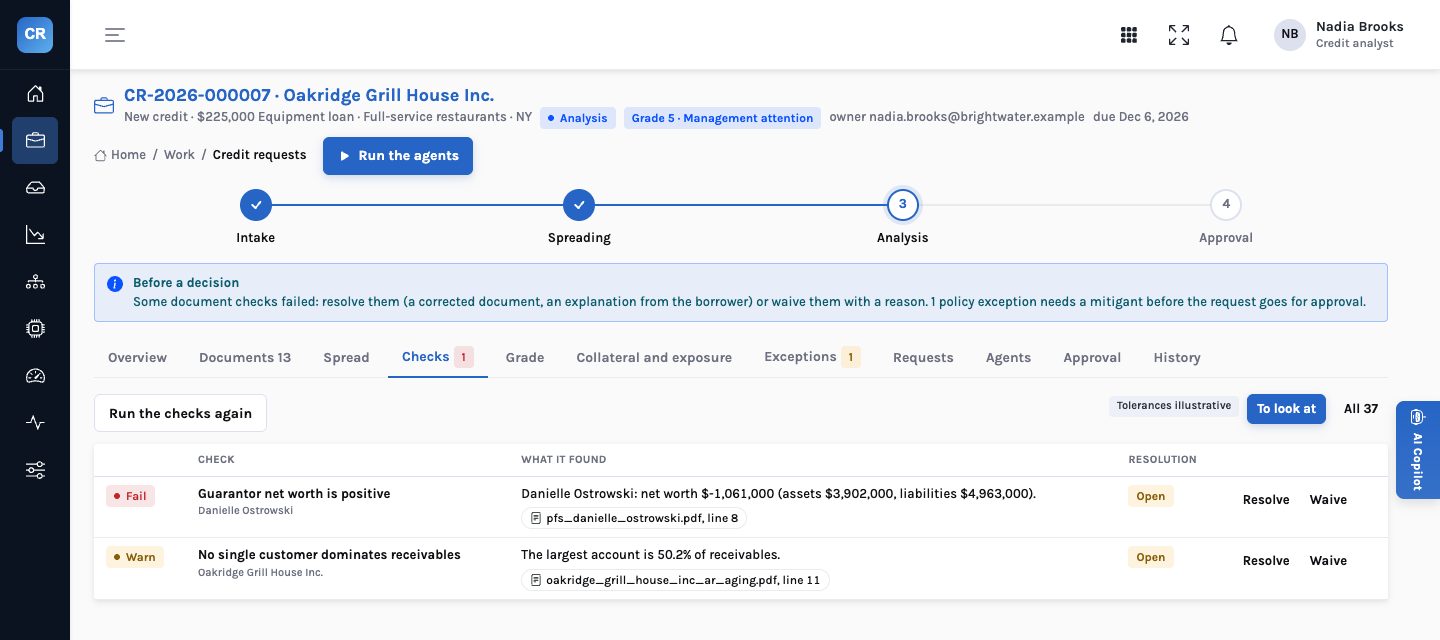
A guarantor with negative net worth
One of three guarantors owes $4,963,000 against assets of $3,902,000. Global DSCR is 1.24x, just under the 1.25x line.
- A failed check with the statement’s line
- +5 points on guarantor support
- A referred exception with a mitigant
Exposure · related parties
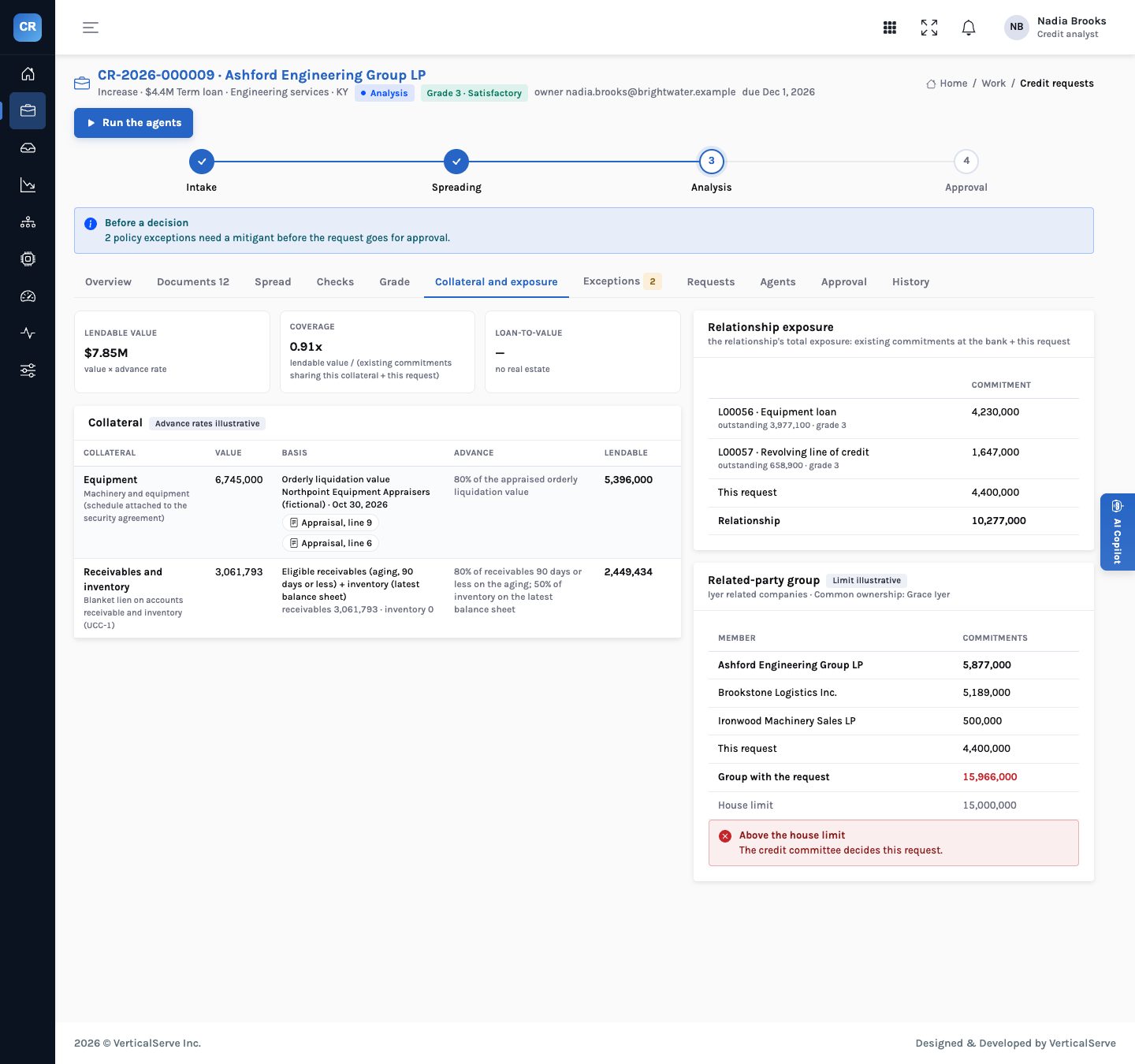
A related group over the house limit
A $4.4 million acquisition loan takes a three-company group to $15,966,000 against a $15,000,000 house limit.
- Group exposure aggregated
- Credit committee authority
- The committee’s decision recorded by a senior officer
Portfolio · monitoring
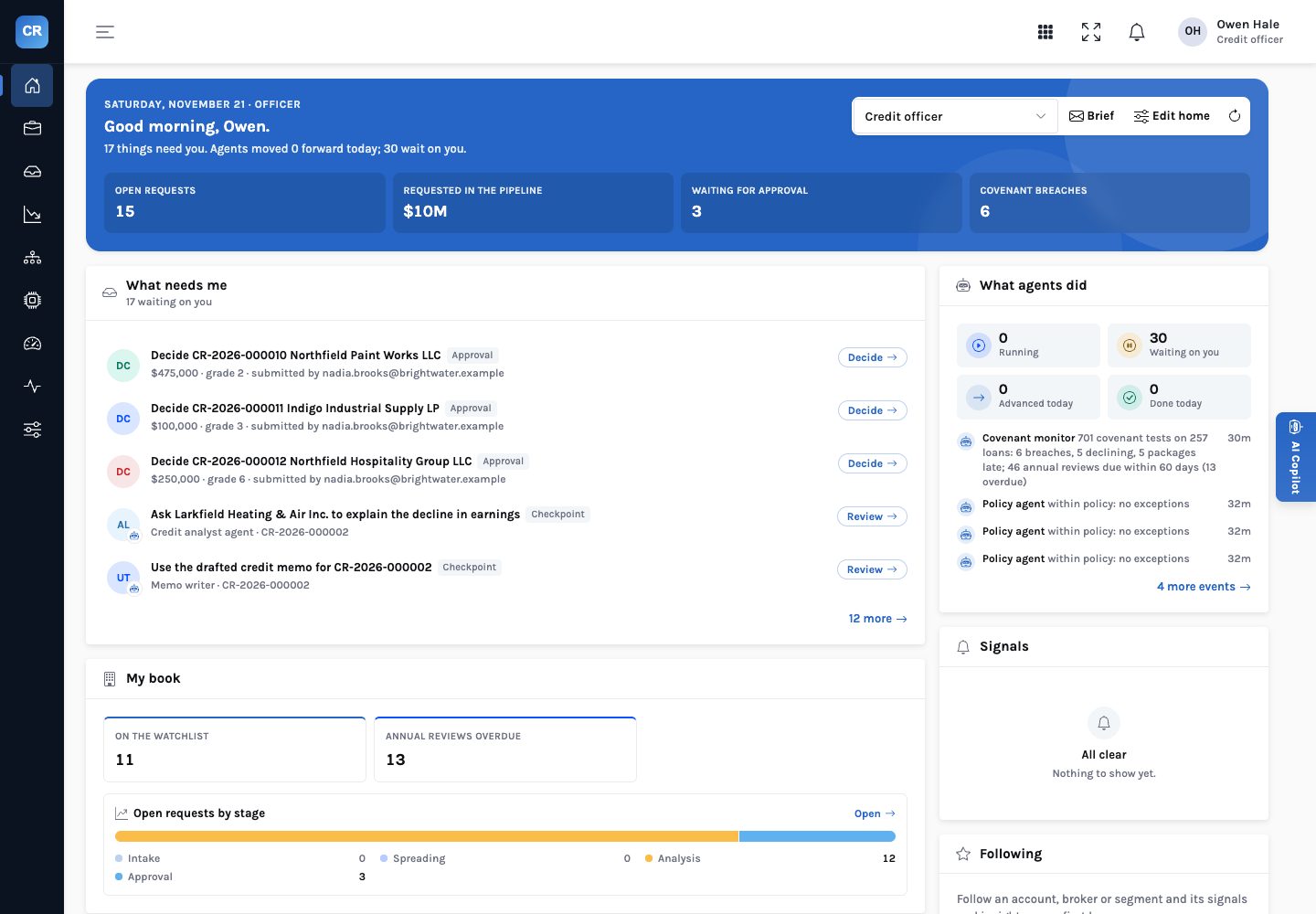
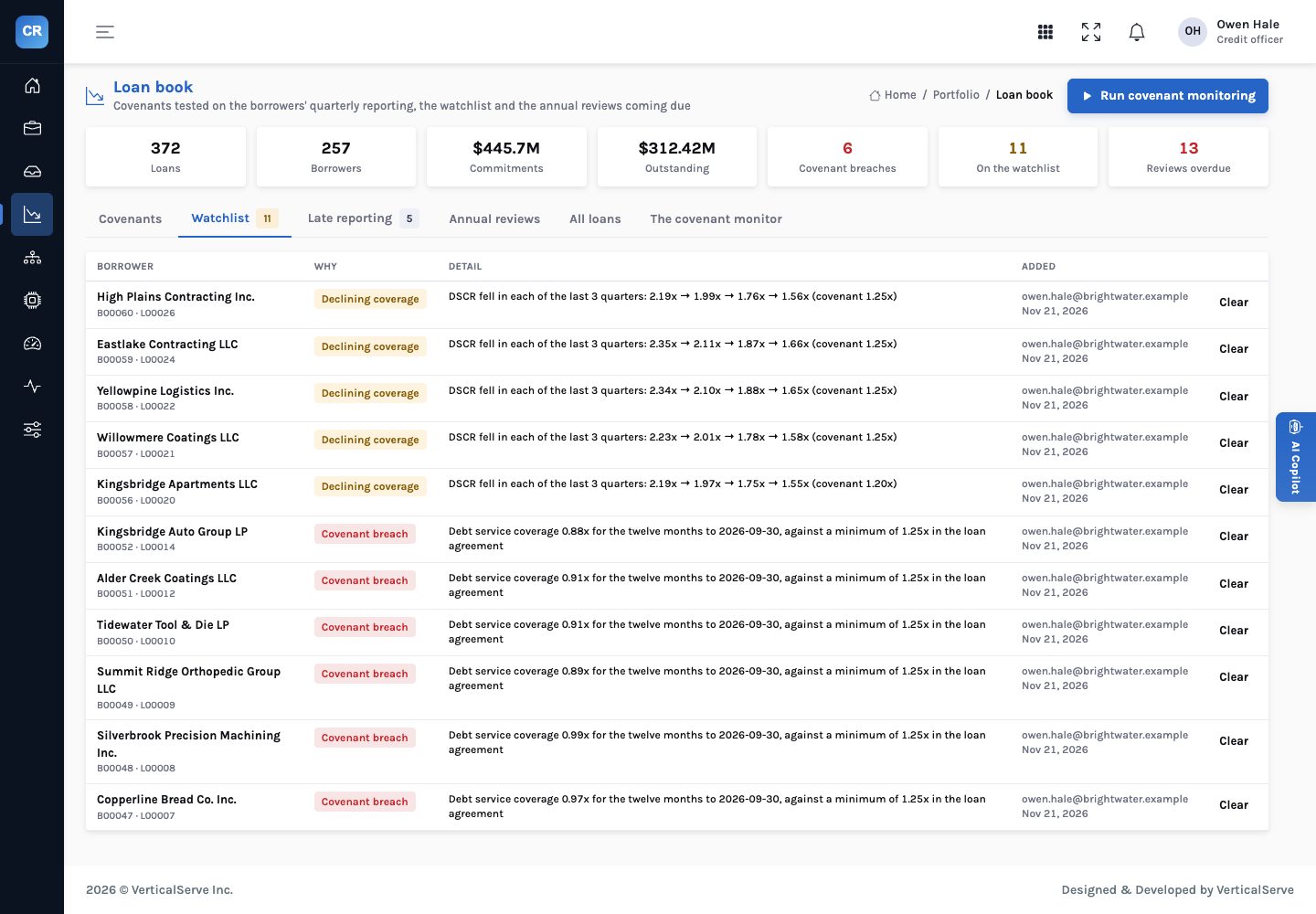
From a covenant breach to the watchlist
701 covenant tests across the book: 6 breaches, 5 borrowers with coverage falling three quarters running, 5 late packages.
- Breaches shown with their quarters
- Declining coverage caught before it breaches
- A credit officer decides the watchlist
Requests · borrower
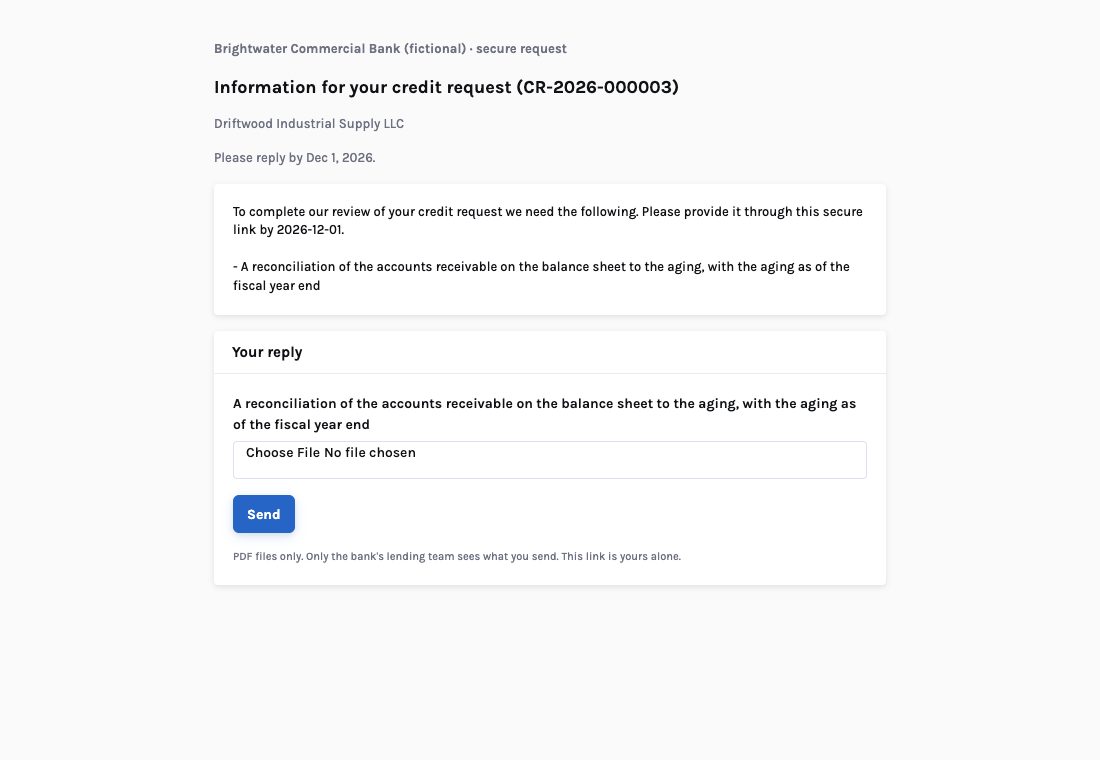
Asking the borrower, and getting an answer
An agent drafts the request, an analyst sends it, the borrower answers through a link, and the spread and checks rerun.
- Held until a person sends it
- A no-login link, shown once
- Uploads read on arrival
Three ways work starts
Requests, annual reviews and the quarterly book
The same engines and the same controls, whatever opened the work.
| Trigger | Case type | What the agents prepare | What a person decides |
|---|---|---|---|
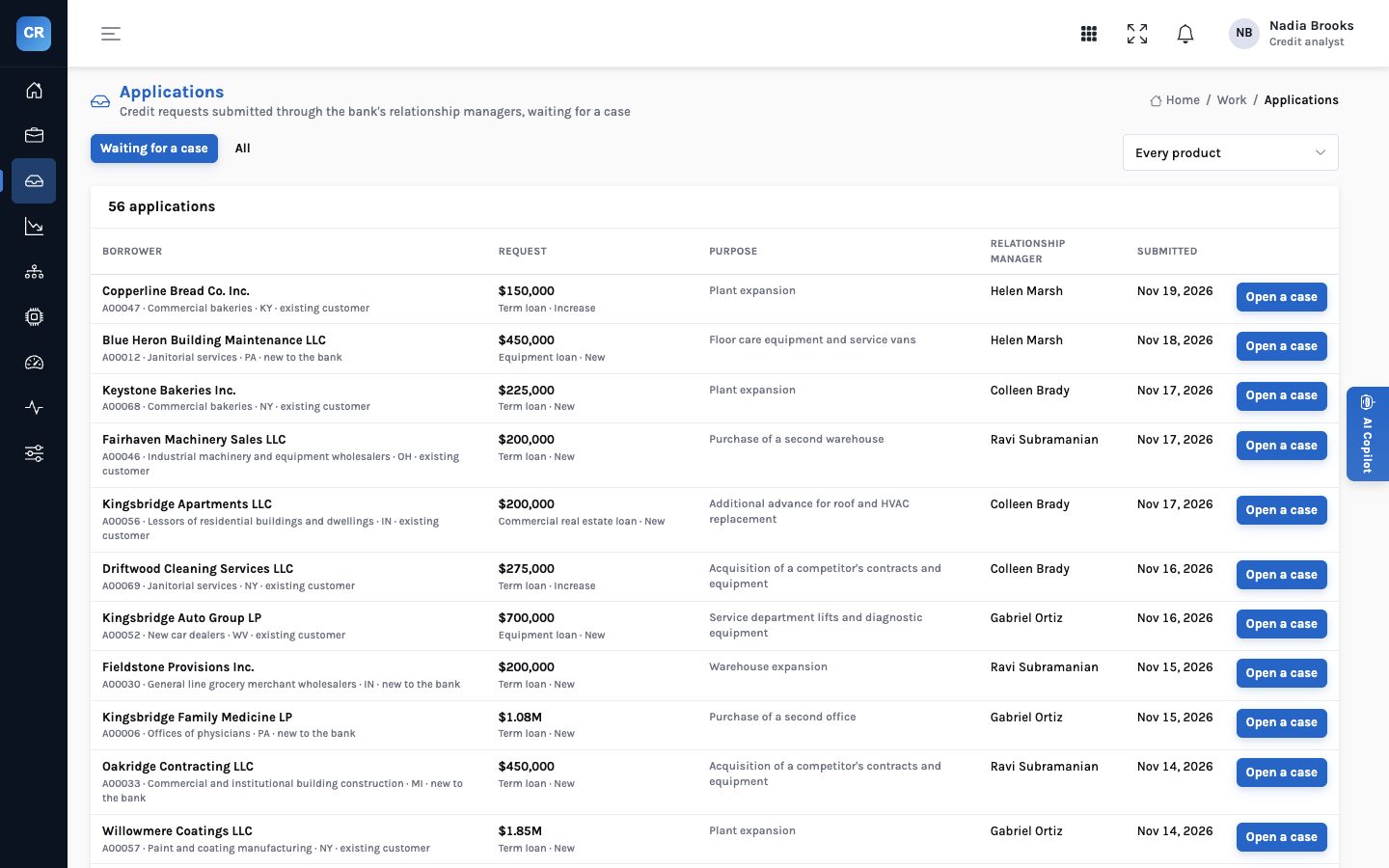
| An application from the relationship manager | New credit, increase or renewal | Documents read, spread, checks, collateral, grade, exceptions and mitigants, memo, submission | Resolutions, mitigants, what to send, submit; approve or decline within authority |
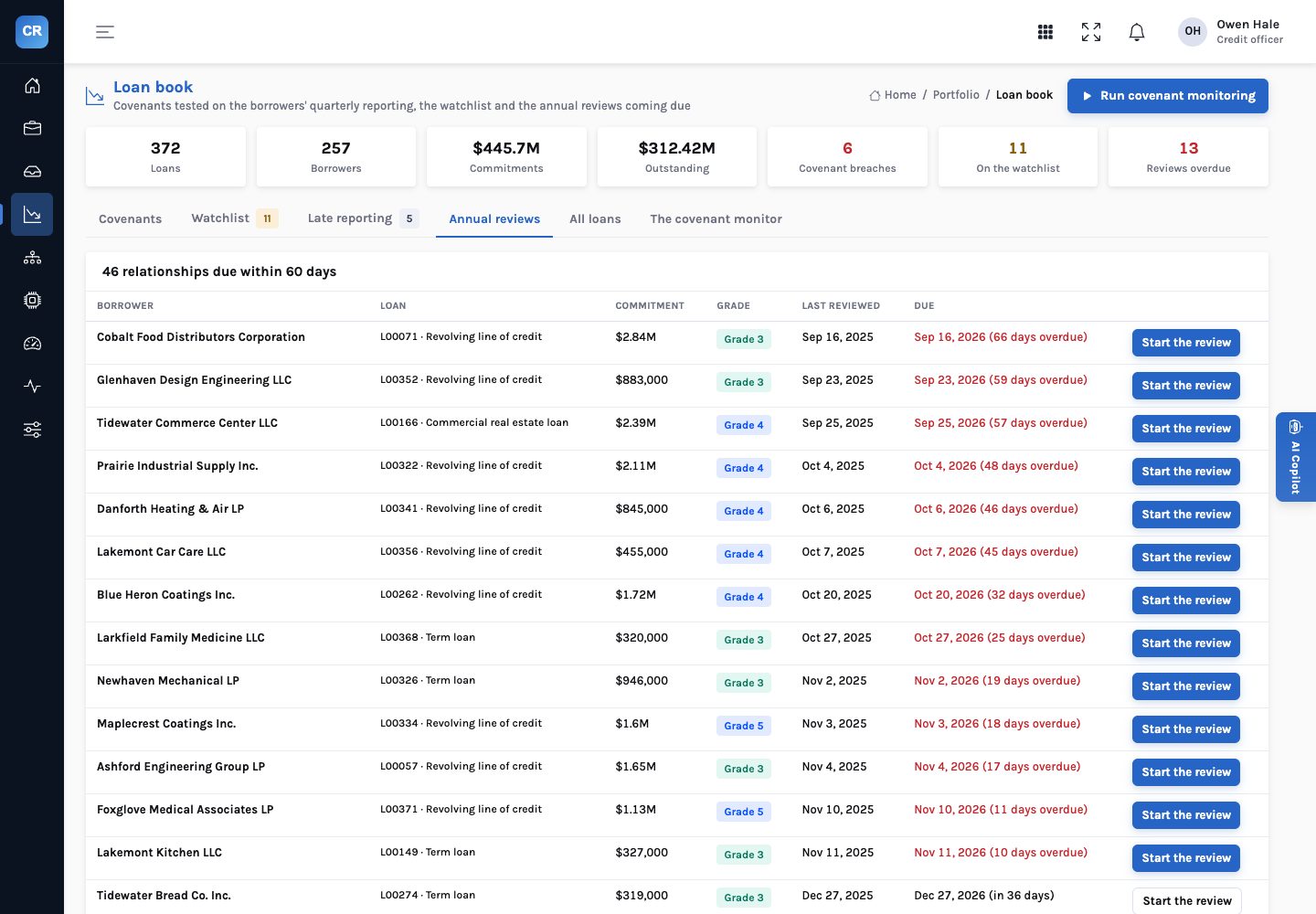
| An annual review falls due | Annual review | The same, on the latest statements, with no new money | Whether the relationship continues, its grade and the next review |
| Quarterly reporting arrives | Portfolio monitoring | Covenant tests, declining coverage, late packages, overdue reviews | Who goes on the watchlist and comes off it, and which reviews to open |
Who does what
Agents prepare. These people decide.
Roles come from the identity service: analysts, credit officers, senior credit officers and administrators, and read-only viewers.
Credit analyst
Prepares and submits
Works the queue, reviews what the agents prepared, resolves checks with reasons, sends requests to borrowers, records mitigants, accepts the memo and submits.
Credit officer
Approves within authority
Approves what someone else submitted, up to their delegated authority; overrides a grade with a reason; changes the credit policy controls.
Senior credit officer
Higher authority and committee
Approves referred exceptions and larger exposures, records the credit committee’s decisions, and sets how much the agents may do.
Auditor or viewer
Reads everything
Sees every case, spread, check, exception and decision record, and changes nothing.