A personal guarantee is the lender’s second way out. When the business can’t pay, the owners who signed can. That only holds if the owners have something to pay with. Three signatures on a guarantee look like three layers of support; read the personal financial statements and one of them may be a liability in its own right. This post follows one such request through InsightCredit, from the line on the statement to the decision a person has to make about it.
In short
- The reader takes the figure; the check says what it means. Danielle Ostrowski’s personal financial statement reports net worth of $(1,061,000) on line 8. A check fails: “Guarantor net worth is positive”, with assets of $3,902,000 and liabilities of $4,963,000 quoted beside it.
- Global cash flow counts every guarantor, both sides. Her income less living expenses adds $356,100 to the numerator; her own debt payments add $373,500 to the denominator. With three guarantors the global DSCR is 1.24x, just under the illustrative 1.25x policy line.
- The grade and the policy both notice. The scorecard adds 5 risk points for a guarantor with negative net worth; the global DSCR control refers the request, so it needs a mitigant and at least a senior credit officer.
- An agent drafts the mitigant; a person decides whether it holds. The draft lists all three unlimited guarantees as support. An analyst should ask how much one of them is worth.
The situation
The case uses InsightCredit’s demo data for Brightwater Commercial Bank. The bank, the borrower, the guarantors, the appraiser and every figure are fictional. The documents are specimen PDFs generated for the demo; the figures below are what the document reader took from them and what the engines computed, unrounded unless the screen rounds them.
CR-2026-000007, Oakridge Grill House Inc. is an S-Corp running full-service restaurants in Rochester, New York, in business since 1996. It asks for a $225,000 equipment loan over 60 months, fully amortizing, at an indicative 7.27% fixed, to buy kitchen equipment for a second location. The relationship manager is Colleen Brady; the case is owned by Nadia Brooks, credit analyst. It is a new credit, so the demo’s illustrative service level gives it 15 days: due 6 December 2026.
| Fiscal year | Revenue | EBITDA | Historical DSCR |
|---|---|---|---|
| FY2023 | $6,747,911 | $495,253 | 1.83x |
| FY2024 | $7,306,368 | $502,761 | 1.44x |
| FY2025 | $7,478,286 | $549,541 | 1.58x |
The business itself is unremarkable in the good sense. Revenue has grown 5.3% a year over the spread. Every statement adds up, all three tax returns agree with the statements within a fraction of a percent, and three months of bank deposits annualize to 104.2% of FY2025 revenue. FY2025 EBITDA margin is 7.3%, thin but normal for a restaurant; leverage (total liabilities over tangible net worth) is 2.01x; the current ratio is 1.18x. Of 37 checks on the case, 35 pass.
Three owners guarantee the loan, each without limit. Their personal financial statements are on file, all dated within the last year:
| Guarantor | Owns | Net worth | Liquid assets | Income less living | Own debt payments | Statement dated |
|---|---|---|---|---|---|---|
| Danielle Ostrowski, president | 50% | $(1,061,000) | $275,000 | $356,100 | $373,500 | 2026-08-26 |
| Rebecca Thornton | 30% | $2,373,000 | $588,000 | $333,800 | $75,000 | 2026-05-07 |
| Laura Kowalski | 20% | $3,279,000 | $1,133,000 | $163,900 | $285,600 | 2026-09-25 |
The president and majority owner, the guarantor the bank would look to first, owes more than she owns.
Why guarantors get misread
Guarantor analysis is where commercial credit work most often turns into a formality. The reasons are familiar to anyone who has spread a file:
- The guarantee is counted, not weighed. “Unlimited personal guarantees from all principals” reads as strength in a memo regardless of what stands behind each one.
- The statement is a form, typed into a spreadsheet. Net worth is a single line at the bottom, and a figure in parentheses is easy to key as a positive number.
- Global cash flow is built by hand. Each guarantor’s income, living expenses and debt payments are added in a separate tab, and a guarantor whose own debts eat their income can quietly add more to the denominator than to the numerator.
- Nobody connects it to policy. A weak guarantor should move the grade and may trip a coverage threshold. In a spreadsheet those are three different places, and nothing links them.
The memo lists three unlimited guarantees. The PFS figures are keyed by hand into a global cash flow tab, the grade is set separately, and a negative net worth is noticed if someone reads to the bottom of the form.
The reader takes each PFS line with its quote. A check fails on negative net worth, global cash flow counts each guarantor’s income and debts, the grade adds risk points, and the policy control refers the request.
How InsightCredit handles it
One line on one form reaches the checks, the global cash flow, the grade and the policy controls, each with its own effect.
The statement, read line by line
The document reader is deterministic: it matches patterns in the PDF’s text layer, not a model’s guess. For a personal financial statement it takes total assets, liquid assets, total liabilities, net worth, annual income, annual debt payments, living expenses and contingent liabilities, and keeps the line number and the exact text for each. From Danielle Ostrowski’s statement:
| Field | Line | What the document says |
|---|---|---|
| Total assets | 5 | Total assets … 3,902,000 |
| Liquid assets | 6 | Liquid assets … 275,000 |
| Total liabilities | 7 | Total liabilities … 4,963,000 |
| Net worth | 8 | Net worth … (1,061,000) |
| Annual income | 9 | Annual income … 544,000 |
| Annual debt payments | 10 | Annual debt payments … 373,500 |
| Annual living expenses | 11 | Annual living expenses … 187,900 |
The parentheses are read as a negative number, and the statement is internally consistent: $3,902,000 less $4,963,000 is $(1,061,000). Had a line been missing, the reader would have marked the document partial rather than guess.
The check
Every guarantor gets three checks: a personal financial statement on file, net worth positive, and the statement dated within 365 days (illustrative). Rebecca Thornton and Laura Kowalski pass all three. Danielle Ostrowski’s statement is 87 days old, so it is current; her net worth check fails. The check is one row with its evidence, and only a person can resolve it, with a corrected document or an explanation, or waive it with a reason. An agent cannot clear a check.
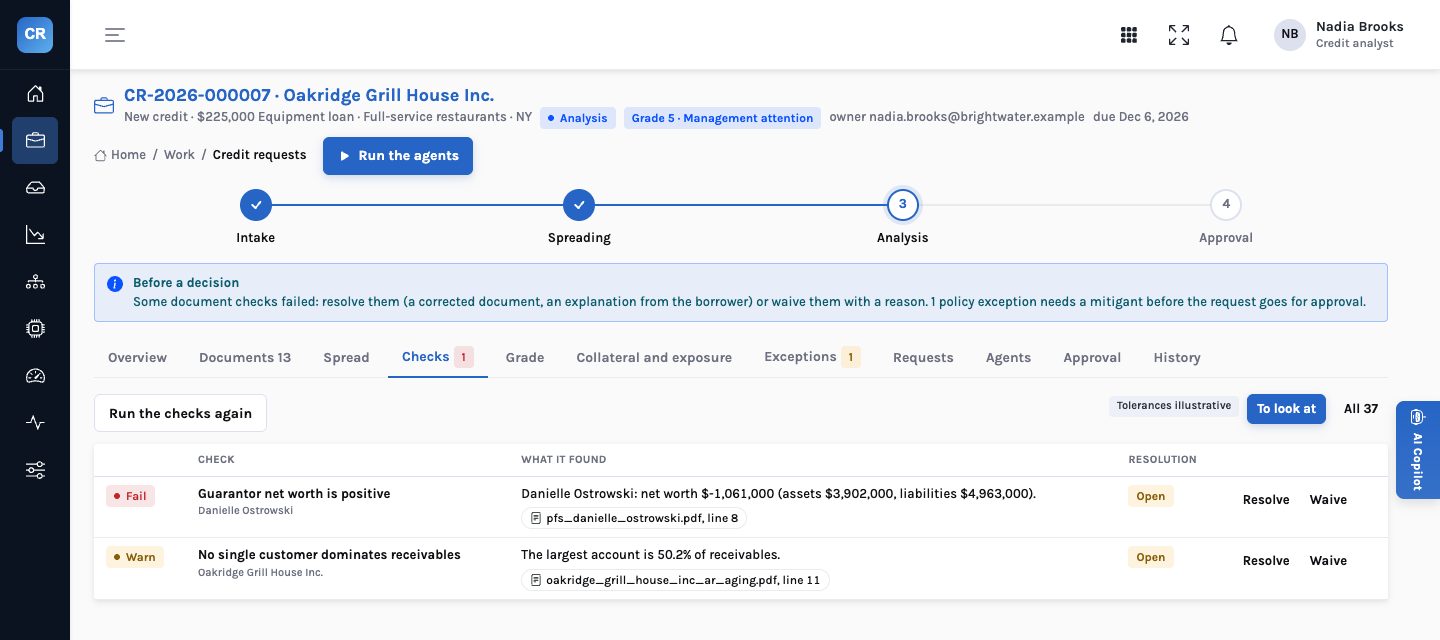
The case also carries a warning: the largest customer account is 50.2% of receivables. On a restaurant with $59,017 of receivables against $7.5 million of revenue it matters little, and the analyst can say so in one line. It is a reminder that the checks report, and people weigh.
Global cash flow, guarantor by guarantor
Pro forma debt service coverage is the business on its own: FY2025 EBITDA of $549,541 over $400,976 of debt service, which is $347,168 of existing interest and current maturities plus $53,808 a year for this loan ($4,484 a month). That gives 1.37x.
Global cash flow adds the guarantors. For each one, annual income less living expenses goes into the cash flow and their own annual debt payments go into the debt service, all from the statements the reader took:
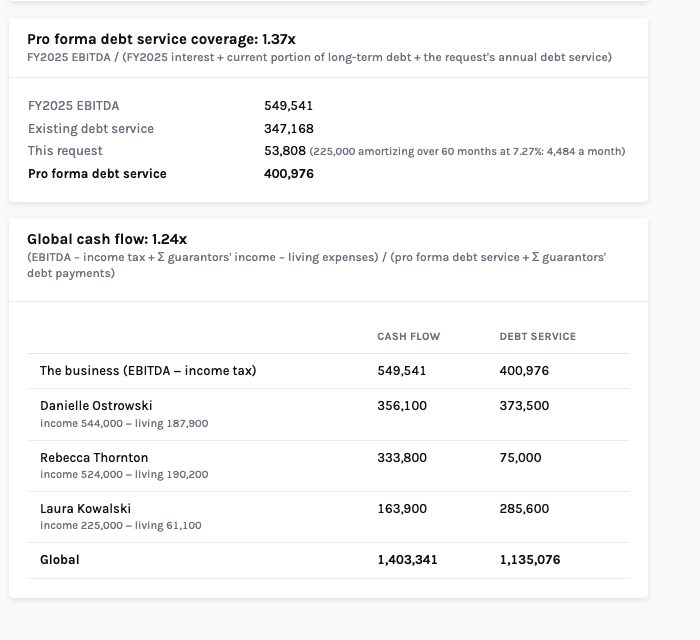
The global figure is $1,403,341 over $1,135,076: 1.24x. Look at Danielle Ostrowski’s row. Her $356,100 of income after living expenses doesn’t quite cover her own $373,500 of debt payments. As a matter of simple arithmetic, which the analyst can do from the screen, leaving her out entirely would give $1,047,241 over $761,576, about 1.38x. Her guarantee doesn’t add cash flow support; it subtracts a little.
Why the formula is built this way
A guarantor’s personal debts are claims on the same income that would service the guarantee. Counting their income without their debts overstates support; leaving out a weak guarantor flatters the ratio in the other direction only if the bank is prepared not to rely on that guarantee at all. The formula is shown with every result so the analyst can see which effect is at work.
The grade
The scorecard (model “1.0-illustrative”, with bands and boundaries set for the demo) gives risk points per factor and says why. Oakridge totals 45 points: grade 5, Management attention.
| Factor | Value | Points |
|---|---|---|
| Guarantor support (global cash flow) | 1.24x, and a guarantor’s net worth is negative (+5) | 11 |
| Debt service coverage (pro forma) | 1.37x | 10 |
| Liquidity (current ratio) | 1.18x | 6 |
| Profitability (EBITDA margin) | 7.3% | 6 |
| Leverage (TL / TNW) | 2.01x | 4 |
| Collateral coverage | 1.21x | 4 |
| Industry | Full-service restaurants: medium (illustrative list) | 3 |
| Quality of the statements | Reviewed | 1 |
| Revenue trend | 5.3% a year | 0 |
| Time in business | 30 years | 0 |
Two things are worth noticing. The negative guarantor costs 5 points on its own, and the guarantor factor is the largest single driver. And 45 is exactly the upper boundary of grade 5 in the demo’s scale: one more point would make it grade 6, Special mention, which the illustrative GRADE_WATCH control would refer as well. A credit officer can override the grade with a reason; the model version is stored with it either way.
The controls and the exception
Rules Studio evaluates the twelve credit policy controls (all illustrative, editable by a credit officer) on the request’s figures. Two fire:
| Control | Outcome | Why |
|---|---|---|
| FAILED_CHECKS | Block | A document check failed and is unresolved: the guarantor net worth check |
| GLOBAL_DSCR_MIN | Refer | Global debt service coverage 1.24x is below 1.25x (illustrative policy) |
A block can’t be justified; it is cured. Here the cure is a person resolving or waiving the failed check with a reason. A refer becomes a policy exception on the case, and it needs a recorded mitigant before the request can go for approval. Because a referred exception is open, the required authority rises: at $225,000 the exposure alone sits with a credit officer, but the exception lifts it to at least a senior credit officer (both illustrative tiers).
The policy agent drafts the mitigant from the engines’ figures. Its draft, word for word:
The policy agent’s draft (held for a person)
Global DSCR below 1.25x: pro forma DSCR 1.37x, global DSCR 1.24x. Mitigants: guarantors’ liquid assets of $1,996,000; collateral coverage of 1.21x; moderate leverage of 2.01x; unlimited personal guarantees from Danielle Ostrowski, Rebecca Thornton, Laura Kowalski.
Every figure in it is right, and that is the point of the draft: the analyst doesn’t retype numbers. But a draft is not a judgement. Two of its claims deserve a harder look before anyone records it:
- The $1,996,000 of liquid assets includes Danielle Ostrowski’s $275,000, which her own creditors have a claim on.
- Listing her unlimited guarantee as a mitigant for weak guarantor support is close to circular. The honest mitigant may be the other two guarantors, the business’s own 1.37x and the collateral.
The analyst edits the draft and records it with “Record the mitigant”. The agent’s wording, the person’s edits and who recorded it are all kept.
Collateral, for completeness
The equipment being bought has an orderly liquidation value of $255,000 (Keel & Morrow Asset Valuation (fictional), 7 October 2026); at the illustrative 80% advance rate that lends $204,000. The blanket lien on receivables and inventory adds $68,373.30 of lendable value (80% of $57,251 of receivables 90 days or less, 50% of $45,145 of inventory). Lendable value of $272,373.30 against $225,000 gives coverage of 1.21x. The collateral is real support, but thin: it is mostly the equipment the loan buys.
Who does what
The engines compute and the agent drafts. The analyst resolves the check and records the mitigant; a different person decides.
Open the PFS from the check. Which liabilities drive the deficit: a mortgage on an asset also listed, personal debt, or business debt she already guarantees?
A request for her schedule of liabilities or an updated statement goes through the same held-for-review request flow as any other request to the borrower.
With a reason that names the fact. Waiving says the bank knows and proceeds; it doesn’t make the number positive.
Rely on it, restructure it (for example the other guarantors increase their support), or treat it as having little value and say so in the memo.
Start from the policy agent’s draft; remove what doesn’t hold.
Four eyes: the analyst who submitted cannot approve. The decision record keeps the exception, the mitigant, the grade and the global DSCR.
The analyst’s choices
| What the facts show | Reasonable response | What goes on the record |
|---|---|---|
| The deficit is a timing item, for example a property loan against an asset carried at cost | Ask for a supporting schedule or an updated statement; resolve the check with it | The new document, read and quoted; the check resolved with the reason |
| The deficit is real and persistent | Waive the check with a reason and give the guarantee little or no weight in the analysis | The waiver reason; a mitigant that rests on the other guarantors and the business |
| The other guarantors can carry it | Consider whether their support should be restructured; note Laura Kowalski’s $1,005,000 of contingent liabilities before leaning on her | The structure proposed and why |
| Coverage without her support is too thin | Restructure the request (amount, amortization, collateral) or decline | The decline reason, or the revised request and its new figures |
A note on regulation
data
Supervisory guidance treats a guarantee as support whose value depends on the guarantor’s financial capacity and willingness to pay, which the lender is expected to evaluate rather than assume. Separately, Regulation B (ECOA) applies to business credit and limits when a creditor may require the signature of an applicant’s spouse or another person; asking a guarantor’s spouse to join the guarantee because the guarantor is weak is the kind of step to check with compliance first.
Sources: OCC Comptroller’s Handbook, “Rating Credit Risk” and “Commercial Loans” booklets; Regulation B, 12 CFR 1002.7(d). This is a summary, not legal advice; a bank’s own policy and counsel decide how it applies.
InsightCredit does not make a bank compliant with any of this. What it does is put the guarantor’s figures, the check, the global cash flow and the exception in one place, quoted to their source, so the evaluation is visible and the decision record shows it was made.
What it means for each audience
For the chief credit officer
Guarantor support is evaluated, not counted. A negative net worth fails a check, moves the grade and can refer the request, and each effect is traceable to a line on the statement.
The mitigant a person records, and the authority that approved it, are on the decision record.
For the credit team lead
The analyst doesn’t key PFS figures or build global cash flow by hand. The time goes into the question that matters: what is this guarantee worth?
The agent’s mitigant draft is a starting point with every number right; the judgement is the analyst’s.
For the board
Small business lending leans on owners’ guarantees. Knowing which ones are real support is part of knowing what the bank owns.
The same discipline applies on renewal: the guarantor’s statement is read again, not carried forward.
Metrics to track
What to be careful about
- A PFS is self-reported. The reader takes what the statement says. Verifying it (credit reports, tax returns, statements of the assets) is the analyst’s work and the bank’s policy.
- Contingent liabilities are read but not tested. The reader takes them; no check fires on them. Laura Kowalski reports $1,005,000 against $3,279,000 of net worth; look before you rely on her.
- Thresholds are illustrative. The 1.25x global DSCR line, the +5 points, the grade boundaries and the authority tiers were set for the demo. A bank sets its own in Rules Studio and the credit settings.
- Don’t record the draft unread. An agent’s mitigant that lists the weak guarantee as a strength is accurate arithmetic and weak reasoning.
A guarantee is worth what stands behind it.
Read every guarantor’s statement to the last line, count their debts as well as their income, and let the person who decides see exactly which support is real.