Business cases for credit automation tend to die in the same meeting. The slide says spreading gets faster and analysts handle more deals, the CFO asks where the numbers came from, and the answer is another bank, another loan mix, another year. This post contains no numbers about what InsightCredit will do for you. It gives you a model with named inputs, the measurements that fill it, a worked example with inputs we made up so you can see the arithmetic, and the questions a finance team will ask. The case you take forward should be built from your own credit operation.
In short
- Measure before you model. A two-week sample of where analyst and officer time goes, by request type, is worth more than any benchmark, including ours.
- Value comes from four places. Analyst hours on preparation, time from complete package to decision, the annual review and covenant backlog, and the cost of a missed signal in the book.
- Cost is more than the licence. Integration, policy translation, validation, parallel running and change management belong in the case from the first draft.
- One variable decides most cases. How long an analyst needs to review a prepared spread, check list and memo, rather than build them. Run the model at a pessimistic value before anyone signs.
Start with a time sample
Before any model, find out where the time goes today. Pick a representative fortnight and, for a sample of requests of each type (new credit, increase or renewal, annual review), ask analysts and credit officers to log minutes against a short list of activities. Keep the categories coarse. Precision matters less than honesty, and the minutes nobody likes to admit to (re-keying a spread because the template changed, chasing the same tax return three times) are the ones the case needs.
| Activity | Preparation or decision? | Measure |
|---|---|---|
| Gathering: statements, tax returns, agings, rent rolls, PFSs, appraisals, prior files | Preparation | Minutes per request; documents missing at intake |
| Spreading: keying three years of statements into the template, tying them out | Preparation | Minutes per request |
| Reconciling: returns to statements, receivables to the aging, rent roll to rental revenue | Preparation | Minutes per request; how often a difference is found |
| Cash flow: pro forma debt service, global cash flow from each guarantor’s PFS | Preparation | Minutes per request |
| Collateral: lendable values, coverage, LTV, appraisal age | Preparation | Minutes per secured request |
| Chasing the borrower and the relationship manager | Preparation | Minutes per request, and days waiting |
| Grading and writing the credit memo, including exceptions and mitigants | Preparation | Minutes per request |
| Reviewing, deciding, committee preparation | Decision | Minutes per request, by approval authority |
| Rework after credit review or a returned memo | Both | Share of requests returned; minutes to fix |
Alongside the time sample, pull a handful of numbers from your systems: requests per year by type, median days from a complete package to a decision, the number of annual reviews overdue today, covenant tests that were late or never performed last year, and the share of memos returned by credit review or approvers. These are the baseline you will be measured against later, so record them before anything changes.
Agents can take on preparation. They do not take on decisions, so decision minutes stay in the model unchanged.
The model
Write the case as formulas with named inputs, so finance can change any one of them and see the
effect. For each request type t:
# inputs you measure
N_t        requests per year of type t
P_t        preparation minutes per request today
D_t        decision minutes per request today          # analyst, officer and committee time
R_t        minutes to review a prepared request         # estimate, then measure in a pilot
C          fully loaded cost per analyst minute

# 1. analyst capacity released
minutes_today    = Σ_t N_t × (P_t + D_t)
minutes_after    = Σ_t N_t × (R_t + D_t)
capacity_value   = (minutes_today − minutes_after) × C × share_redeployed

# 2. time to decision (only where you can show deals lost to speed)
L          approved deals per year lost to a faster lender
f          share of L you would win with a faster decision   # your estimate, defended
M          annual margin per relationship, after cost of funds and expected loss
speed_value      = L × f × M

# 3. the backlog (only if a cost is actually planned)
backlog_value    = contractor or remediation spend avoided

# 4. the missed signal: usually described, not counted
signal_value     = 0   # unless credit risk supplies a defensible figure

# the case
annual_value     = capacity_value + speed_value + backlog_value + signal_value
annual_cost      = licence + run_cost + support + share_of(integration + validation + change)
A model, not a forecast: every input is yours. Leave any line at zero if you cannot measure it.
Where the value comes from
1. Analyst capacity
The largest line in most cases. Preparation minutes (P_t) are replaced by review minutes
(R_t); decision minutes (D_t) stay exactly as they are, because a person
still decides every request and a second person approves it. Be explicit about what the released
capacity is for: absorbing growth in the pipeline without hiring, bringing annual reviews back on
schedule, or more time on the hard credits. A CFO will discount “productivity” that does
not change a budget line, which is what share_redeployed is there to make honest.
2. Time to decision
Faster decisions are worth money only where speed is why you lose deals. Many commercial borrowers stay with the bank that knows them, and much of the elapsed time is spent waiting on the borrower, not on the bank. So count this line only if relationship managers can name approved or nearly approved deals that went to a faster lender, and apply a fraction for the ones you would have lost anyway. Funding a loan a week earlier mostly moves interest income in time; it is rarely new revenue, and a careful finance team will say so.
3. The review and monitoring backlog
Overdue annual reviews and covenant tests that slipped are an exposure examiners and credit review notice. The value of clearing them is usually avoided cost: the contractors or the remediation programme the bank would otherwise fund. Put that cost in if one is actually planned; otherwise leave this line at zero and describe the backlog as a control gap instead.
4. The cost of a missed signal
This is the line everybody wants to count and almost nobody can. A covenant breach caught a quarter late, a debt service coverage ratio drifting down for three quarters while still passing, a guarantor whose net worth turned negative between reviews: earlier sight of these gives the bank more options, and a risk rating that moves sooner feeds the allowance and the watchlist sooner. But turning that into a dollar figure needs loss data and a counterfactual that most banks do not have. Most finance teams prefer it described as a risk reduction, with examples from the bank’s own history, rather than counted. We agree with them.
A worked example, with made-up inputs
These are hypothetical inputs, not results
Every number in this section was invented to show the arithmetic. None of them comes from a customer, a pilot or our demo bank, and none is a claim about what InsightCredit will do. Replace every one with your own measurement.
Take a hypothetical commercial lending team that handles three request types and costs
C = $1.25 a minute fully loaded ($75 an hour). Suppose its time sample and an estimate
of review effort look like this:
| Request type (hypothetical) | N_t | P_t (min) | D_t (min) | R_t estimate (min) | Minutes today | Minutes after |
|---|---|---|---|---|---|---|
| New credit | 400 | 600 | 60 | 240 | 264,000 | 120,000 |
| Increase or renewal | 500 | 360 | 45 | 150 | 202,500 | 97,500 |
| Annual review | 900 | 240 | 30 | 90 | 243,000 | 108,000 |
| Total | 709,500 | 325,500 |
The difference is 384,000 minutes, or 6,400 hours a year. At $1.25 a minute that is $480,000 of
analyst time, before share_redeployed. If the team can only show that half of
it changes a budget line (two fewer hires next year, say), the capacity line is $240,000. The other
three lines stay at zero until someone can defend them.
Now double every review estimate (480, 300 and 180 minutes). Minutes after become 577,500, the difference falls to 132,000 minutes (2,200 hours), and the undiscounted capacity value to $165,000. Same team, same software, a third of the value. That is the whole argument for the next section.
The variable that decides it
Almost every credit automation case is most sensitive to one input: R_t, the minutes an
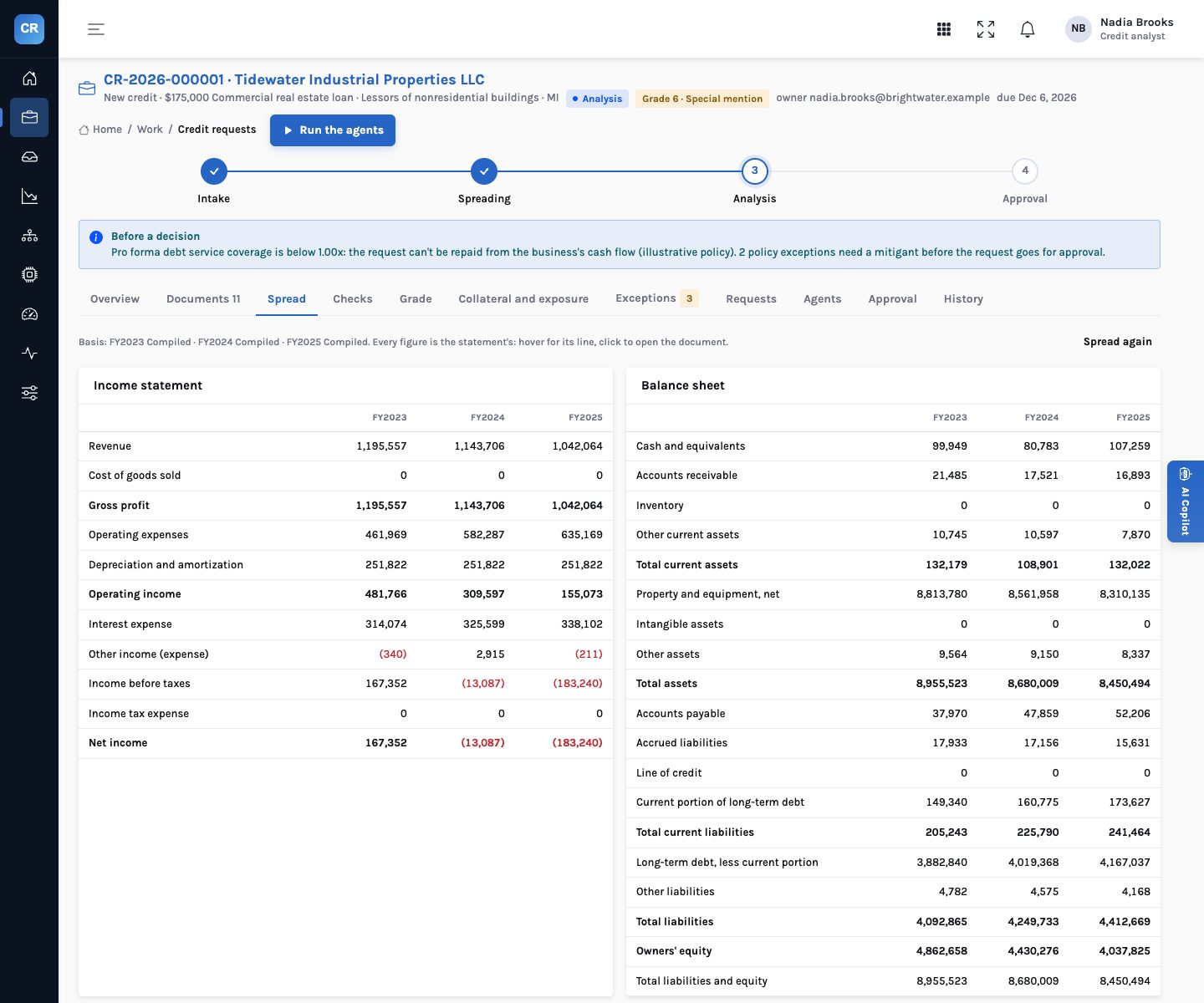
analyst spends checking a prepared request. If the spread shows where every figure came from, the
reconciliations show what they compared, and the memo carries no number the engines did not
produce, review is quick. If analysts have to re-key the statements to trust the spread,
R_t approaches P_t and the case disappears.
A spread with no sources, a ratio with no formula, a risk rating and a memo paragraph that reads well. The analyst re-opens every PDF and re-ties every statement to be safe. Review takes nearly as long as building did.
Every cell linked to its document and line, every ratio with its formula, every check quoting both figures it compared, every memo figure taken from the engines. The analyst reads, challenges what looks wrong and moves on.
Run the model at three values of R_t: your estimate, double it, and the value at which
the case breaks even, which you can solve for directly once the cost line is known:
R_breakeven = (Σ_t N_t × P_t − annual_cost / (C × share_redeployed)) / Σ_t N_t
# one blended value across types; solve per type if the mix matters
If the case only works at the optimistic value, say so in the paper. The pilot then becomes the decision point, not the business case.
Estimate review effort, then replace the estimate with a measurement from a pilot before asking for the full budget.
Costs to include
| Cost | What it covers | Often forgotten? |
|---|---|---|
| Licence or subscription | The platform itself | No |
| Run cost | Hosting, in your cloud or the vendor’s; model inference if a language model is switched on | Inference, often |
| Integration | The loan origination or application system, the document store, core banking for existing exposure and the loan book, borrower reporting | The number of systems, often |
| Policy translation | Turning the credit policy into controls and settings: DSCR and leverage limits, LTV, advance rates, tolerances, approval authorities, house limits; and signing each off | Yes |
| Validation | Model risk review of the risk rating scorecard and any model components; testing against known scenarios | Yes |
| Change management | Teaching analysts to review a prepared request rather than build one; credit review sampling during the transition | Yes |
| Parallel running | Spreading a sample of requests both ways during the pilot | Yes |
Validation deserves its own line because it is where credit differs from many other automation projects. A risk rating scorecard is a model in the sense of SR 11-7 / OCC Bulletin 2011-12 at most banks that follow that guidance, and it will be reviewed as one. InsightCredit stores the model version with every grade, and every factor shows its points and why, which makes that review easier; it does not make it unnecessary, and the work belongs in the cost.
Measure the pilot so it can fill the model
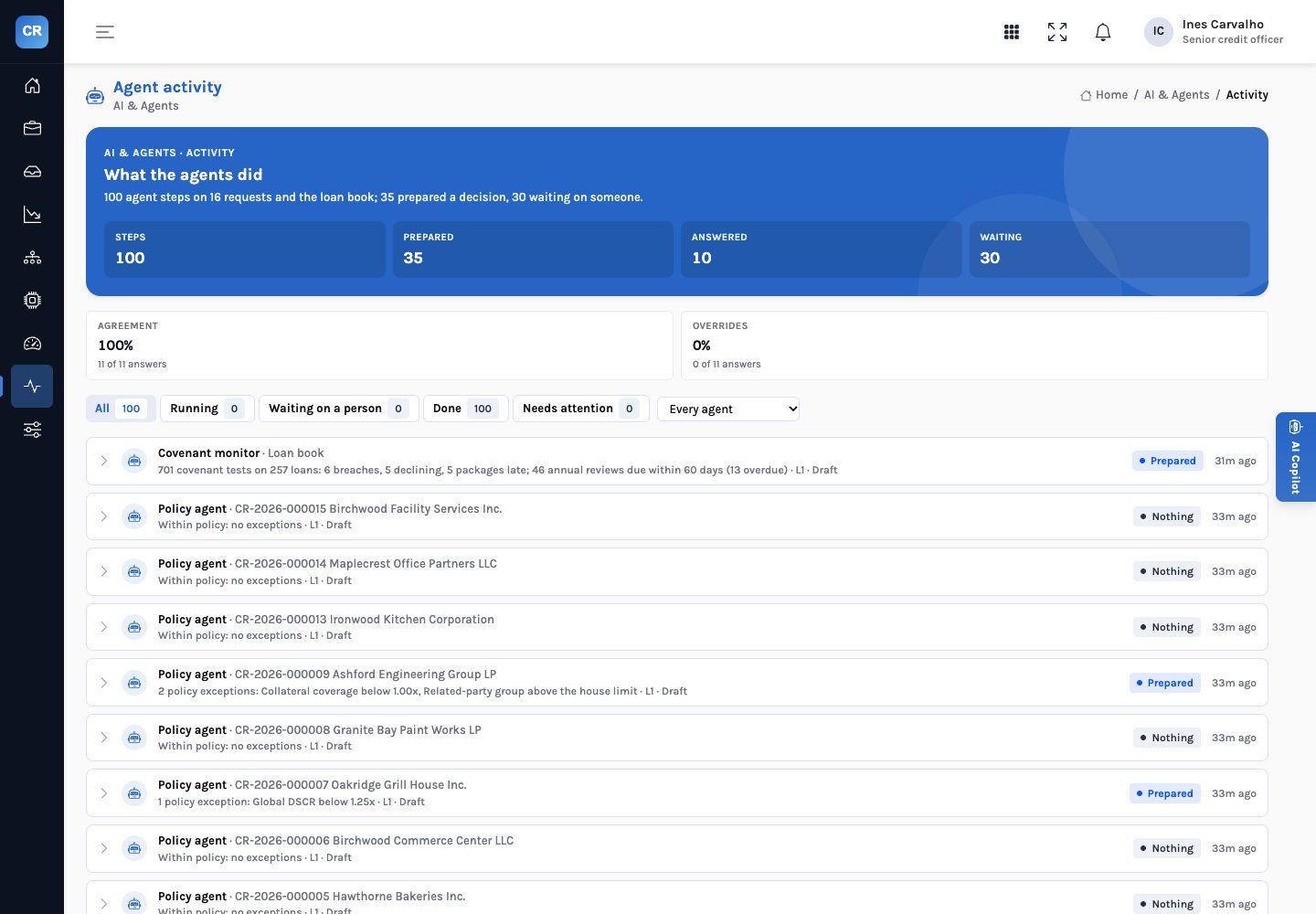
A pilot that only produces opinions cannot replace an estimate. Decide before it starts which
inputs it will measure: R_t per request type, days from complete package to decision,
and how often people accept, reject or question what the agents prepared. InsightCredit records
every prepared decision and every answer, with who and when, and tracks agreement and override
rates per action, so the pilot produces those numbers as a side effect of the work rather than as
a separate survey.
Questions finance will ask
- Which budget line changes, and when? Hires avoided, contractors released, a review remediation programme not funded. Name the line and the year.
- What happens if volume falls? In a slow year, a fixed cost looks different from a per-request one. Model a year at 70% of today’s pipeline as well as a good year.
- What did the pilot actually measure? Your
R_t, your days, your agreement rates, not a vendor’s reference customer. - What does leaving cost? Where the spreads and decision records live, in what form, and whether they stay readable if the platform is replaced.
- What does it not change? The approval authorities, four eyes, the credit committee. If someone hears “automation” as “fewer approvers”, correct it early; agents in InsightCredit never decide a request.
How we would run the pilot
One product line, one or two request types, a few weeks, with a sample spread both ways. Agents start at L1, so they prepare and people do every piece of work themselves; the platform records how long each step took and how often each prepared decision was accepted, rejected or questioned. The demo bank in our screenshots is fictional. Your pilot’s numbers will be your own, and they are the only ones that should go in the paper.
What it means for each audience
For the chief credit officer
Put control in the case as well as cost: spreads that tie to their sources, reviews done on time and covenant tests that are never skipped are worth stating even where they are not counted as money.
Insist that the pilot measures agreement and credit review findings, not just speed.
For the credit team lead
Your time sample is the foundation. Make it honest, including the hours spent re-keying, chasing borrowers and fixing returned memos.
Be clear in advance about what released capacity will be used for, and who decides.
For the board
Ask for the model, not the answer: named inputs you can challenge, a pessimistic case, a break-even review effort, and a pilot that replaces estimates with measurements before the full spend.
A case that only works with a vendor’s benchmark is not a case.
The best business case for credit automation contains no number you did not measure yourself.
Sample the work, model it with your own inputs, keep the missed-signal line honest, and let a pilot settle the one variable that matters: how long a person needs to review a prepared request.