Driftwood Industrial Supply LLC, an industrial machinery wholesaler, asks for a $225,000 term loan to buy a second warehouse. The ratios are comfortable, the grade is 3, Satisfactory, and no policy control fires. One check fails. The 2025 balance sheet carries $592,463 of accounts receivable; the company’s own receivables aging at the same date adds up to $436,665. That is $155,798 of receivables that the detailed ledger doesn’t show.
In short
- Two documents from the same borrower disagree by 35.7%. The reconciliation compares the balance sheet with the aging at the same date and quotes both lines.
- The collateral is already safe from it. The borrowing base is built from the aging, not the balance sheet, so the overstated figure never becomes lendable value.
- The ratios are not. The current ratio and days sales outstanding use the balance sheet. If the aging is right, the current ratio flatters the borrower and DSO is distorted.
- The fix is a question, not a verdict. The spreading agent drafts the request for a reconciliation; an analyst sends it, and a person resolves or waives the check with a reason.
The situation
This case runs on InsightCredit’s demo data: a fictional bank, Brightwater Commercial Bank, with
fictional borrowers, customers, guarantors and figures. The case is CR-2026-000003, a new
credit for Driftwood Industrial Supply LLC, an industrial machinery and equipment wholesaler (NAICS
423830) in Indiana, established in 2006. Colleen Brady is the relationship manager; Nadia Brooks owns
the case.
| Term | Requested |
|---|---|
| Product | Term loan, $225,000 |
| Purpose | Purchase of a second warehouse |
| Term and amortization | 84 months, fully amortizing, at an indicative 8.02% fixed ($3,509 a month) |
| Guarantors | Leah Thornton (75%) and Teresa Valdez (25%), unlimited personal guarantees |
| Collateral | Machinery and equipment; a blanket lien on receivables and inventory (UCC-1) |
Twelve documents are on file: three years of compiled statements, three business tax returns, a bank statement, the receivables and payables agings at 31 December 2025, an equipment appraisal and both guarantors’ personal financial statements. The reader took every one in full. Thirty-four checks ran. Thirty-three pass, among them the ones that usually catch a bad statement:
| Check | What it found | Result |
|---|---|---|
| 2025 return agrees with the statements | Revenue $4,108,579; gross receipts on the 1065 $4,121,619 (−0.3%) | Pass |
| Deposits support the revenue | $1,046,973 over three months, $4,187,892 a year: 101.9% of revenue | Pass |
| Payables agree with the aging | Balance sheet $351,828; aging $353,734 (−0.5%) | Pass |
| FY2025 statements add up | Assets = liabilities + equity; the subtotals tie | Pass |
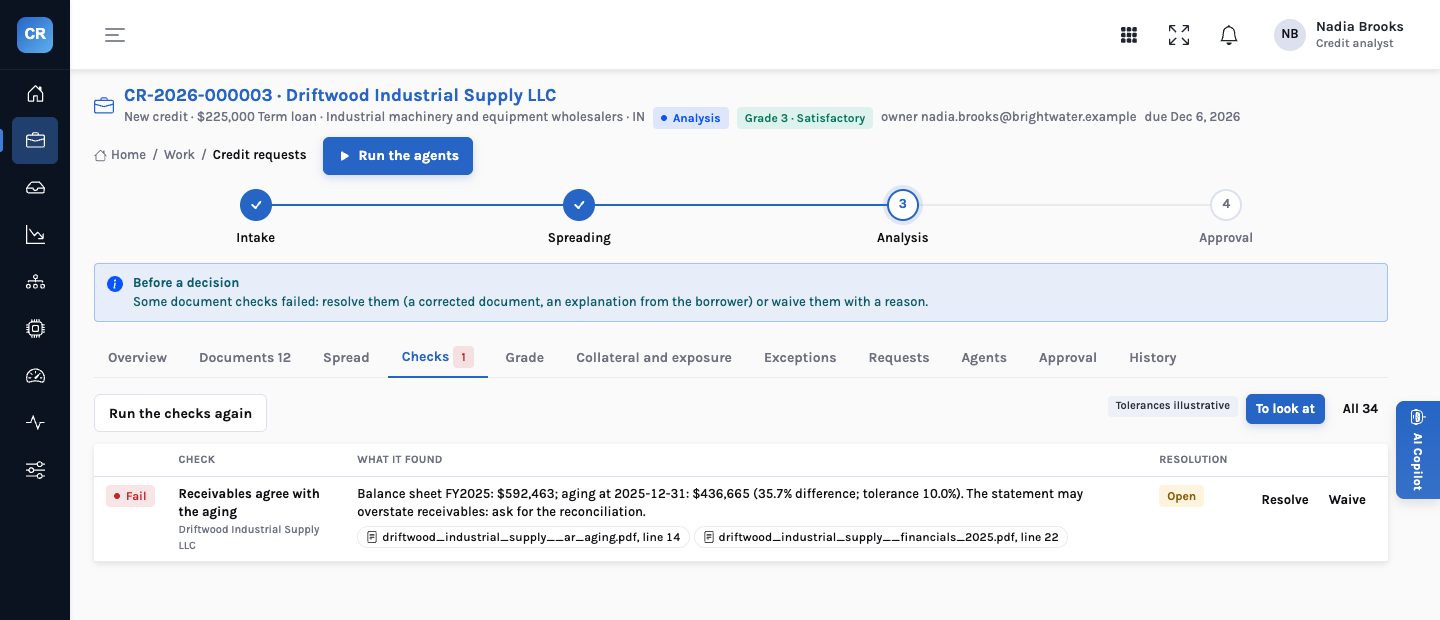
| Receivables agree with the aging | Balance sheet $592,463; aging $436,665 (35.7%) | Fail |
Revenue agrees with the tax return and with the bank deposits. Payables agree with their aging. Only the receivables line doesn’t agree with the document that is supposed to support it.
Why this gets missed
A receivables aging is usually collected for one reason: to build a borrowing base. Someone opens it, takes the total and the over-90 bucket, and applies an advance rate. Comparing it to the balance sheet is a separate step, and in a manual spread it is the step that gets skipped:
- The two documents are read by different people, or at different times. The statements go into the spread; the aging goes into the collateral worksheet. Nobody holds both totals at once.
- The difference hides in a healthy picture. A current ratio of 2.67x and a grade of 3 don’t invite a second look. Days sales outstanding of 52.6 days is unremarkable for a wholesaler.
- The dates don’t always match. An aging run in February against a December balance sheet differs for good reasons, and that teaches analysts to shrug at differences. Here both are at 31 December 2025, so the usual excuse doesn’t apply.
Compiled means no one checked
Driftwood’s statements are compiled. Under the AICPA’s standards for compilation engagements (SSARS), the accountant presents management’s figures without obtaining or providing any assurance on them; a review gives limited assurance and an audit reasonable assurance. A compiled balance sheet’s receivables are whatever the borrower’s books said. The scorecard reflects this (compiled statements add 3 risk points), but a reconciliation to the borrower’s own detail is the check that actually tests the figure.
How InsightCredit finds it
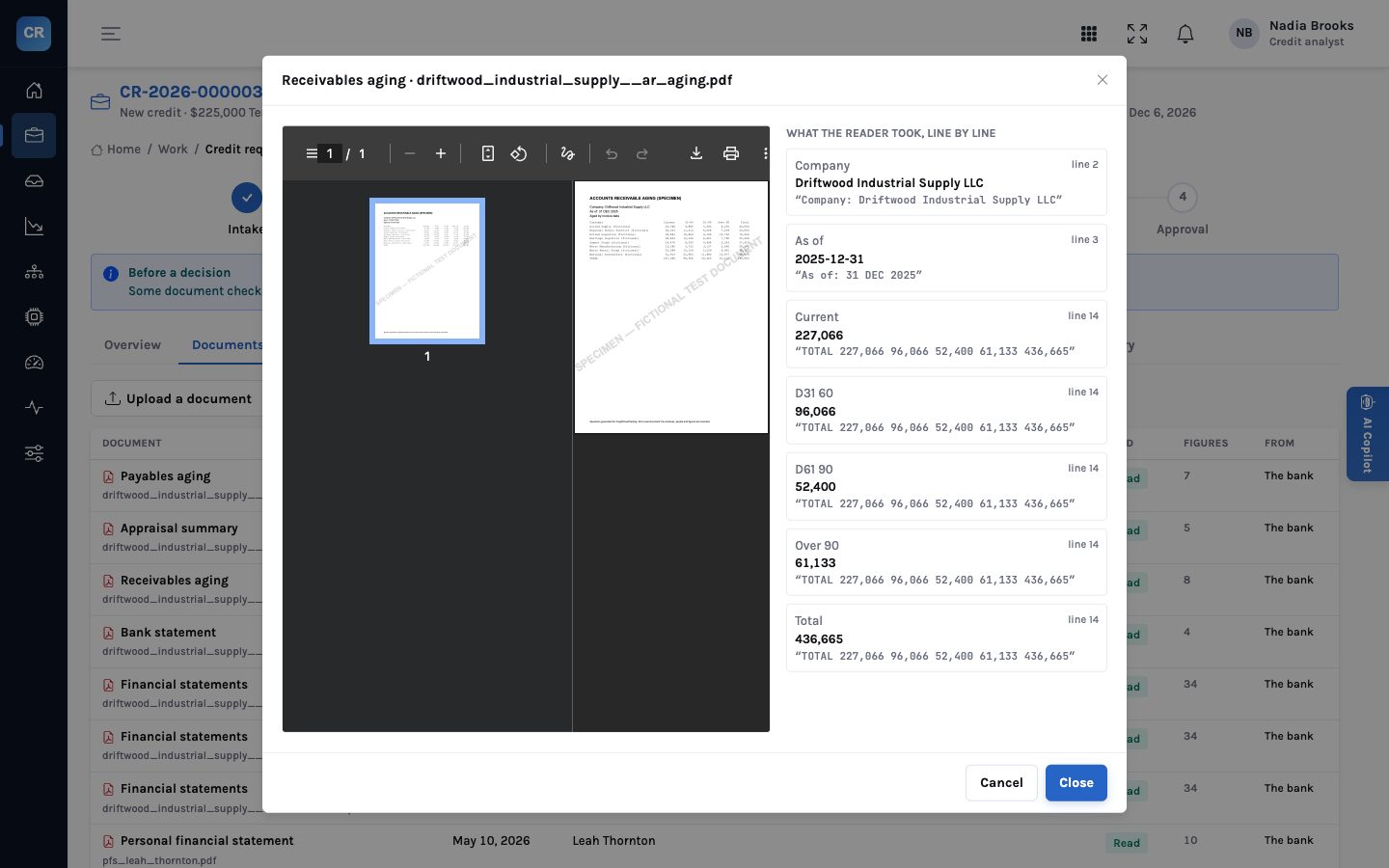
The document reader works on the PDF’s text layer with deterministic patterns, not a model. From the receivables aging it takes the company, the as-of date, each customer row and the totals line, each with its line number and the exact text. From the FY2025 statement it takes the accounts receivable line. The spreading agent’s reconciliation then compares the two at the same date.
The difference is measured against the aging, the borrower’s detailed record. Both inputs are quoted lines.
The check row on the case says exactly what it found and where: “Balance sheet FY2025: $592,463;
aging at 2025-12-31: $436,665 (35.7% difference; tolerance 10.0%). The statement may overstate
receivables: ask for the reconciliation.” Beneath it are two links,
driftwood_industrial_supply__ar_aging.pdf, line 14, and
driftwood_industrial_supply__financials_2025.pdf, line 22. A reviewer can check the
finding in two clicks without trusting the software.
What the difference touches, and what it doesn’t
The most useful thing about this case is that the two receivables figures feed different parts of the analysis. Knowing which is which tells the analyst how much the difference matters before the borrower answers.
The borrowing base comes from the aging. The liquidity ratios come from the balance sheet.
| Analysis | Built from | Effect of the difference |
|---|---|---|
| Collateral: receivables and inventory | The aging: receivables 90 days or less, $375,532, at an illustrative 80%; inventory $568,306 at 50%. Lendable $584,579 | None. The overstated figure never enters the borrowing base. |
| Collateral coverage | Lendable value $856,579 (with the equipment’s $272,000) over the $225,000 request: 3.81x | None |
| Current ratio | Balance sheet: 2.67x | Flattered, if the aging is right |
| Days sales outstanding | Balance sheet: 52.6 days | Distorted: on the aging figure, collections would look faster |
| Pro forma and global DSCR | Income statement and guarantors’ statements: 1.49x and 1.56x | None directly, unless revenue is overstated too |
| Grade | Scorecard: 19 points, grade 3 | Liquidity scores 0 points at 2.67x; the difference would have to be large to move it |
So the credit case doesn’t collapse. What the difference does is raise a question about the statements themselves, and that is a bigger question than the receivables line. An overstated receivable is often the other half of overstated revenue. Here, revenue agrees with the tax return within 0.3% and with three months of deposits (101.9%), which makes the innocent explanations more likely. But “more likely” isn’t a reconciliation.
What the rest of the aging says
Because the reader took each customer row, the spreading agent runs the aging’s other checks at the same time. Both pass on this case:
- Receivables over 90 days: $61,133 of $436,665, 14.0%, under the illustrative 15% warning level. Those receivables are excluded from the borrowing base either way.
- Concentration: the largest of eight customers, National Contractors (fictional), owes $99,833, 22.9% of the aging, under the illustrative 35% warning level.
Asking the borrower
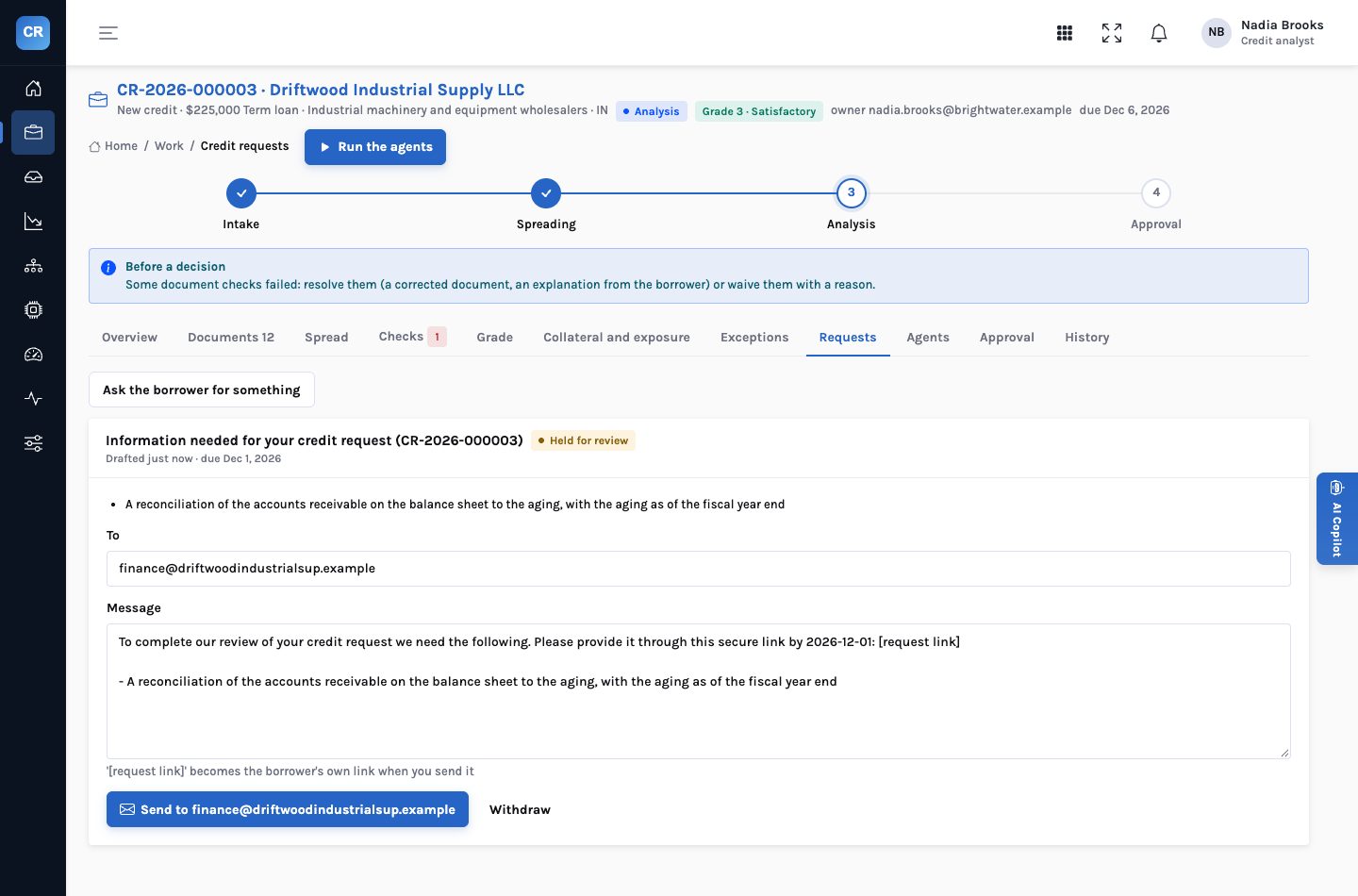
The spreading agent prepares one decision on the Agents tab: “Ask Driftwood Industrial Supply LLC to explain 1 difference.” The item it drafts is specific: “A reconciliation of the accounts receivable on the balance sheet to the aging, with the aging as of the fiscal year end.” In the demo every agent action starts at L1, Draft: it prepares, a person does the work.
Nadia accepted it. The request then sat on the Requests tab, held for review, with a message she could
edit. The message has to keep the [request link] placeholder, which becomes the
borrower’s own link when she sends it.
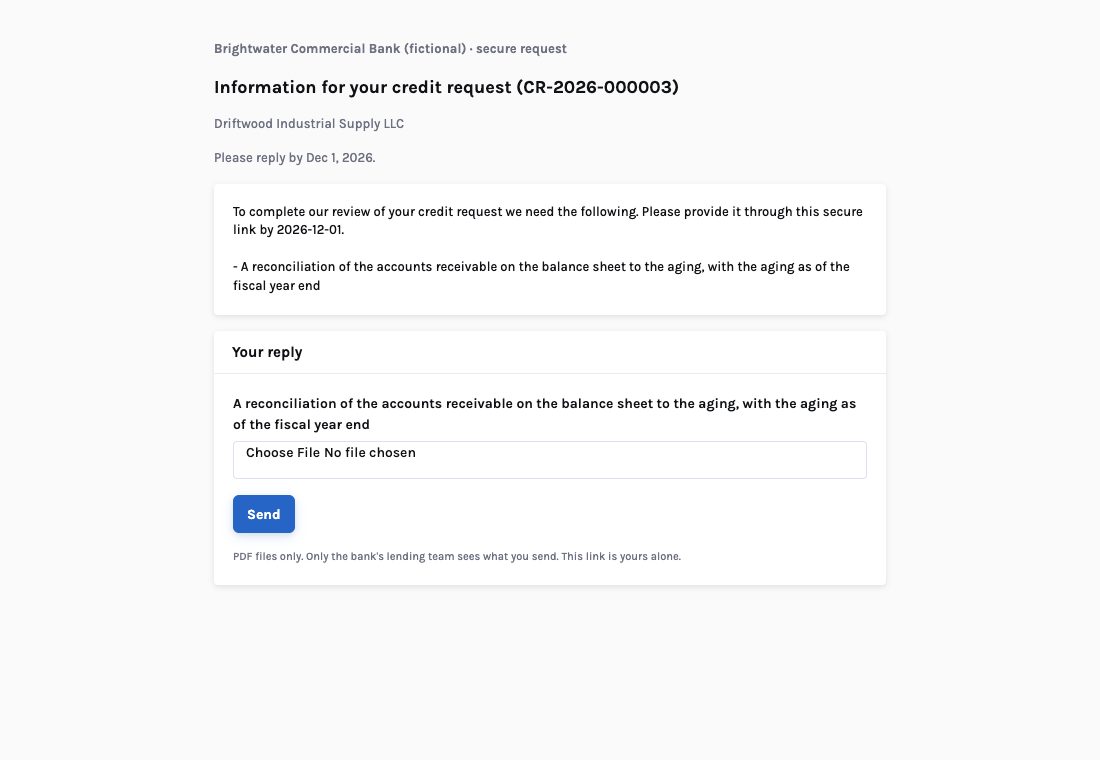
In the demo environment nothing is delivered: the “Send it yourself” dialog shows the borrower link once, and the analyst copies the message into her own email. InsightCredit keeps only a fingerprint of the link’s token, not the link. Live delivery is a setting the bank turns on.
Outcomes, and what each means
| What the borrower sends | What happens | Likely outcome |
|---|---|---|
| A reconciliation showing the $155,798 is other receivables (an employee or related-party loan, a note, a tax refund) booked in the receivables line | The analyst resolves the check with the explanation; related-party amounts become a question of their own | Proceed; perhaps reclassify in the analysis and exclude related-party receivables from any borrowing base |
| A corrected aging that agrees with the balance sheet | The reader takes the new aging at once; the reconciliation and the borrowing base rerun on it | The check passes on new evidence |
| A corrected balance sheet with lower receivables | The spread rebuilds; current ratio and DSO change | Proceed on the corrected figures, with a note on statement quality |
| No reconciliation, or one that doesn’t reconcile | The check stays open and the case can’t go for approval | Waive with a written reason, or decline |
The same pattern, a second time
The demo has a second instance, which is the point of running the check on every case rather than when
someone is suspicious. CR-2026-000004, Ridgeway Coatings LP, a paint and coating
manufacturer in Michigan, asks for a $200,000 equipment loan for production line automation. Its FY2025
balance sheet shows receivables of $752,437 (ridgeway_coatings_lp_financials_2025.pdf, line
22); its aging at the same date totals $546,883 (ridgeway_coatings_lp_ar_aging.pdf, line 13).
The difference is 37.6%, the check fails, and the spreading agent prepares the same request.
| Driftwood (CR-2026-000003) | Ridgeway (CR-2026-000004) | |
|---|---|---|
| Balance sheet receivables | $592,463 | $752,437 |
| Aging total, 31 Dec 2025 | $436,665 | $546,883 |
| Difference vs the aging | 35.7% | 37.6% |
| Over 90 days on the aging | $61,133 (14.0%) | $76,564 (14.0%) |
| Largest customer | 22.9% | 30.1% |
| Other open checks | None | Warn: 1 NSF item on the bank statement |
| Pro forma DSCR / grade | 1.49x / grade 3, 19 points | 1.63x / grade 3, 13 points |
| Authority | Credit officer | Credit officer |
Two cases, two healthy-looking borrowers, two balance sheets carrying more than a third more receivables than their own agings. Neither would have been stopped by a ratio.
Who does what
A failed check leaves the case only by new evidence, a person’s resolution, or a person’s waiver with a reason.
Takes the balance sheet line and the aging’s totals and customer rows, each with its line and text.
Compares the two at the same date, measures the difference against the aging, and fails the check above the tolerance.
Prepares a request for the reconciliation. The analyst accepts it on the Agents tab.
Edits the message, keeps the [request link], and sends it. The borrower gets a link without a login.
Reads the upload at once and reruns the spread and the checks.
Resolves the check with the explanation, or waives it with a written reason. Either way the reason stays on the case.
Within credit officer authority for this exposure. The submitter can never approve.
What the decision record keeps
The check’s resolution, its note and who gave it stay on the case with the borrower’s upload. The memo writer’s draft lists the open failed check by name until it is resolved: on Driftwood the draft ends “Open: Receivables agree with the aging” with the figures. When the credit officer decides, the decision record keeps the verdict, the grade, the coverage ratios, the authority and why, who submitted and who approved, and any conditions, such as a borrowing base certificate with each quarterly package.
What it means for each audience
For the chief credit officer
Statement-to-detail reconciliations are a basic test of whether the financial statements can be relied on. Running them on every case, with the tolerance written down, turns an analyst’s habit into a control.
The tolerance is a setting the bank owns. Tighten it for compiled and company-prepared statements if policy calls for it.
For the credit team lead
The analyst gets the finding, both quoted lines and a drafted request at once, instead of finding the difference at the end, if at all.
Because the borrowing base comes from the aging, the team knows straight away that the collateral figure is not inflated.
For the board
Lending decisions rest on figures the bank has tested against the borrower’s own records, not only on the summary the borrower prepared.
That is cheap insurance against the rare case where the difference isn’t innocent.
What to be careful about
- The tolerances are illustrative. 10% for receivables, 15% for over-90 and 35% for concentration were set for the demo (CREDIT_TOL_RECEIVABLES and its siblings). Set them to your policy.
- The check compares totals, not ledgers. It can’t tell a related-party receivable from a trade receivable, or a real customer from an invented one. That is what the borrower’s reconciliation, and the analyst’s reading of it, are for.
- A matching aging isn’t proof. An aging is also the borrower’s document. For a large receivables-based facility, field exams and verification of receivables are still the bank’s own work.
- The reader needs a text layer. A scanned aging with no text is refused in plain words, and the check waits for a readable copy.
The balance sheet is the borrower’s summary. The aging is the borrower’s detail.
When the two disagree, quote both lines, ask for the reconciliation, and let a person decide what the answer means.