Tidewater Industrial Properties LLC owns a multi-tenant commercial building in Grand Rapids and asks for $175,000 to replace the roof and the HVAC. The building was appraised three months ago at $5,645,000, two guarantors with net worth of $5,628,000 and $3,268,000 stand behind it, and every one of the case’s 30 document checks passes. The trouble is in the income statement: debt service coverage has gone 1.58x, 1.15x, 0.80x in three years. The business already can’t cover the debt it has, and the request can’t pass.
In short
- The request isn’t the problem; the trend is. The new loan adds $15,355 a year of debt service. Without it, coverage is already 0.80x.
- Every figure is traceable. EBITDA, debt service and both coverage ratios are built from lines read out of the borrower’s own statements, each one a click from its source.
- Some controls can be argued, one can’t. Coverage below 1.25x and grade 6 are referred, with mitigants the policy agent drafts. Coverage below 1.00x is a block: restructure, cure or decline.
- Strong guarantors are a mitigant, not a repayment source. Global cash flow is 1.32x, and the case shows exactly how much of it comes from two people’s personal income.
The situation
This case runs on InsightCredit’s demo data: a fictional bank, Brightwater Commercial Bank, with
fictional borrowers, guarantors, appraisers and figures. The case is CR-2026-000001, a new
credit for Tidewater Industrial Properties LLC, a lessor of nonresidential buildings (NAICS 531120) in
Michigan, established in 2007. Dana Whitfield is the relationship manager; Nadia Brooks, a credit
analyst, owns the case. The application asks for:
| Term | Requested |
|---|---|
| Product | Commercial real estate loan, additional advance |
| Amount | $175,000 |
| Purpose | Roof and HVAC replacement |
| Term and amortization | 120 months, amortizing over 300 months |
| Indicative rate | 7.38%, fixed |
| Guarantors | Neha Valdez (50%) and Danielle Russo (50%), both unlimited personal guarantees |
On paper it is the sort of request credit teams approve every week. A small advance against a large, recently appraised building, to protect that same building. The statements are compiled by an accountant, the returns agree with them within a fraction of a percent, the rent roll and the bank statement support the revenue, and both personal financial statements are recent. Nothing in the document checks is wrong. What is wrong is the direction of three years of numbers.
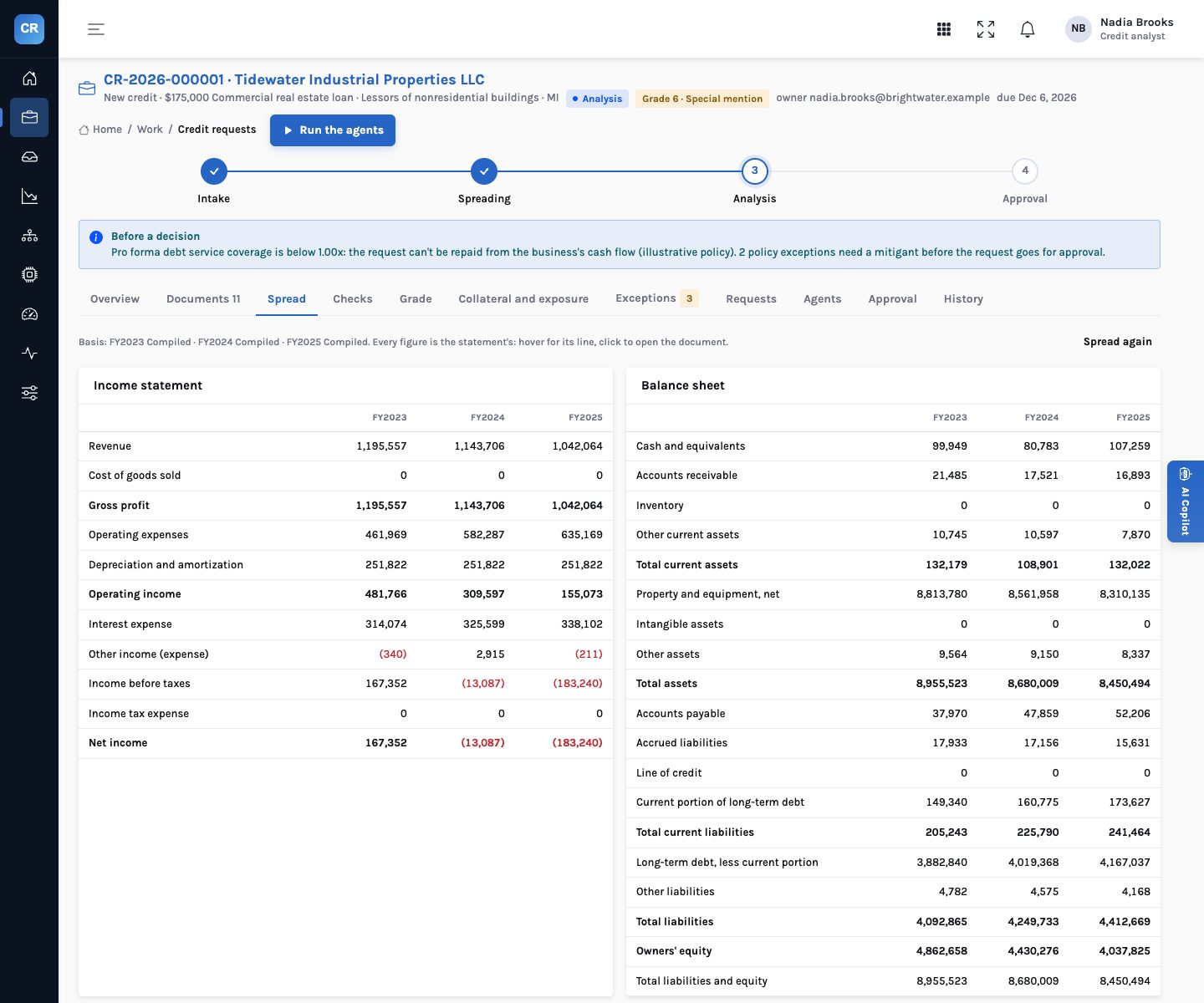
| From the statements | FY2023 | FY2024 | FY2025 |
|---|---|---|---|
| Revenue | $1,195,557 | $1,143,706 | $1,042,064 |
| Operating expenses | $461,969 | $582,287 | $635,169 |
| Depreciation and amortization | $251,822 | $251,822 | $251,822 |
| Operating income | $481,766 | $309,597 | $155,073 |
| Interest expense | $314,074 | $325,599 | $338,102 |
| Current portion of long-term debt | $149,340 | $160,775 | $173,627 |
| Net income | $167,352 | $(13,087) | $(183,240) |
Revenue fell 8.9% in 2025, operating expenses rose for the second year running, and interest went up
with the debt. In the FY2025 statement, tidewater_industrial_propert_financials_2025.pdf,
revenue is on line 8, operating expenses on line 11, operating income on line 13 and interest expense on
line 14. Those are the lines the coverage ratios below are built from.
Why this gets missed
Declining coverage is not hidden. It is in the statements the borrower sent. It gets missed because of how a small request against a big asset is read:
- The collateral looks like the answer. A building appraised at $5,645,000 against a $175,000 request feels safe. But the existing debt is already about $4.3 million, so the bank is lending at the edge of its own loan-to-value limit, not far inside it.
- The request is judged on its own payment. $1,280 a month looks trivial next to a million dollars of rent. The question is not whether the business can pay $1,280 more; it is whether it can pay what it already owes.
- The guarantors look strong. Two principals with $2,163,000 of liquid assets between them make it easy to approve on character and wealth, and to write the cash flow analysis afterwards.
- The spread is one year deep. A spreadsheet updated for the latest year shows 0.80x as a number. Three years side by side show it as a path.
What “special mention” means
The federal banking agencies define a special mention asset as one with potential weaknesses that deserve management’s close attention; if uncorrected, those weaknesses may weaken the repayment prospects or the bank’s credit position at some future date. The OCC’s Comptroller’s Handbook booklet Rating Credit Risk sets out the definitions. InsightCredit’s demo scale uses the same label for grade 6, but the scale, its point bands and its boundaries are illustrative; a bank maps them to its own rating system.
How InsightCredit builds the numbers
The document reader takes each statement line from the PDF’s text layer with its line number and the exact text, then the spread places the three fiscal years side by side. Nothing is typed in. Each derived figure carries its formula, and each input links back to its document and line.
Every box above the ratios is a quoted line from the borrower’s FY2025 statement. The request’s debt service is a level payment at the indicative rate.
The arithmetic, with the case’s own figures:
| Figure | Formula | FY2025 |
|---|---|---|
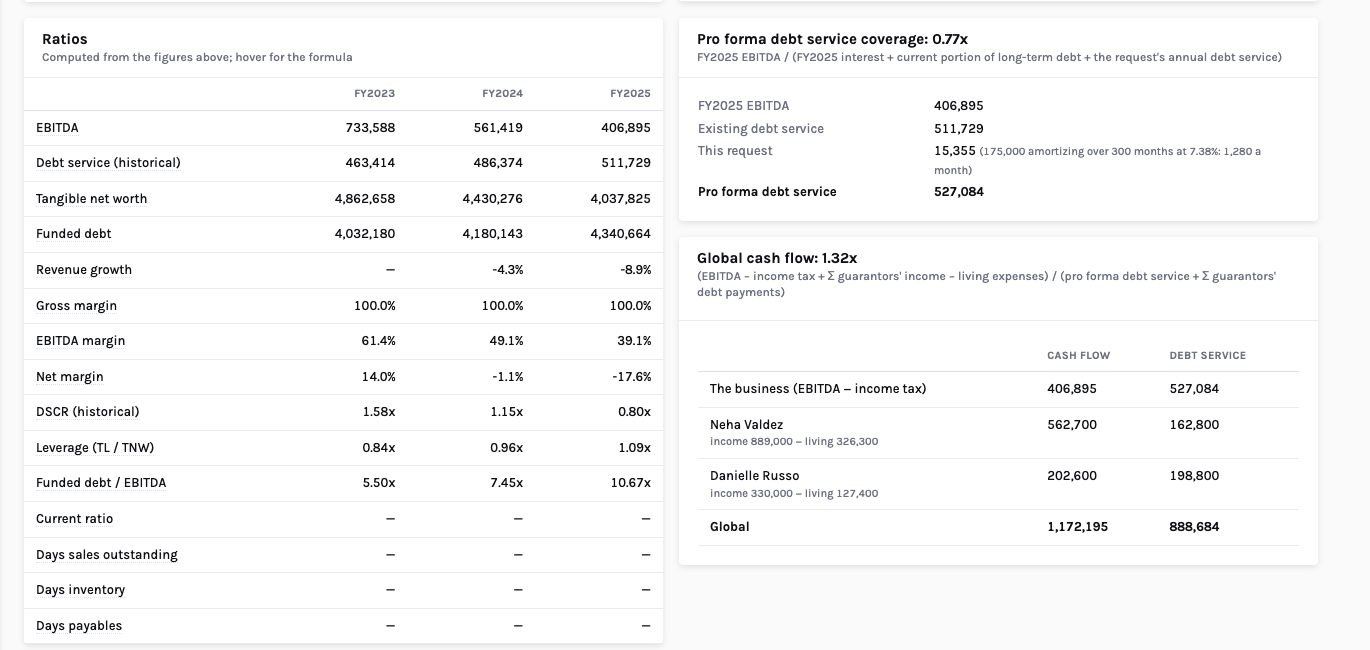
| EBITDA | Operating income + depreciation and amortization = 155,073 + 251,822 | $406,895 |
| Historical debt service | Interest + current portion of long-term debt = 338,102 + 173,627 | $511,729 |
| Historical DSCR | 406,895 / 511,729 | 0.80x |
| Request’s annual debt service | $175,000 amortizing over 300 months at 7.38%: $1,280 a month | $15,355 |
| Pro forma debt service | 511,729 + 15,355 | $527,084 |
| Pro forma DSCR | 406,895 / 527,084 | 0.77x |
The trend is the part a single-year spread loses. Over the three years the engine reports a revenue compound annual growth rate of −6.6%, an EBITDA margin that fell from 61.4% to 39.1% (a change of 22.3 points), and the DSCR path 1.58x, 1.15x, 0.80x. Funded debt to EBITDA went from 5.50x to 10.67x. Leverage, total liabilities over tangible net worth, is only 1.09x: the building carries plenty of equity on the balance sheet. That is why leverage alone would never have raised the question.
What the guarantors add, exactly
Global cash flow asks whether the business and its guarantors together can carry the business’s debt and their own. The engine takes each guarantor’s annual income, living expenses and annual debt payments from their personal financial statement, the lines quoted like any other figure:
| Cash flow | Debt service | |
|---|---|---|
| The business (EBITDA − income tax of $0) | $406,895 | $527,084 |
| Neha Valdez: income $889,000 − living expenses $326,300 | $562,700 | $162,800 |
| Danielle Russo: income $330,000 − living expenses $127,400 | $202,600 | $198,800 |
| Global | $1,172,195 | $888,684 |
$1,172,195 over $888,684 is 1.32x. That clears the illustrative 1.25x minimum for global coverage, but look at where it comes from: $765,300 of the $1,172,195 is the two guarantors’ personal cash flow. The building produces about a third. If the bank approves, it is lending to a property that doesn’t pay its own way, on the strength of two people’s incomes. That can be a reasonable decision. It should be a visible one.
The grade
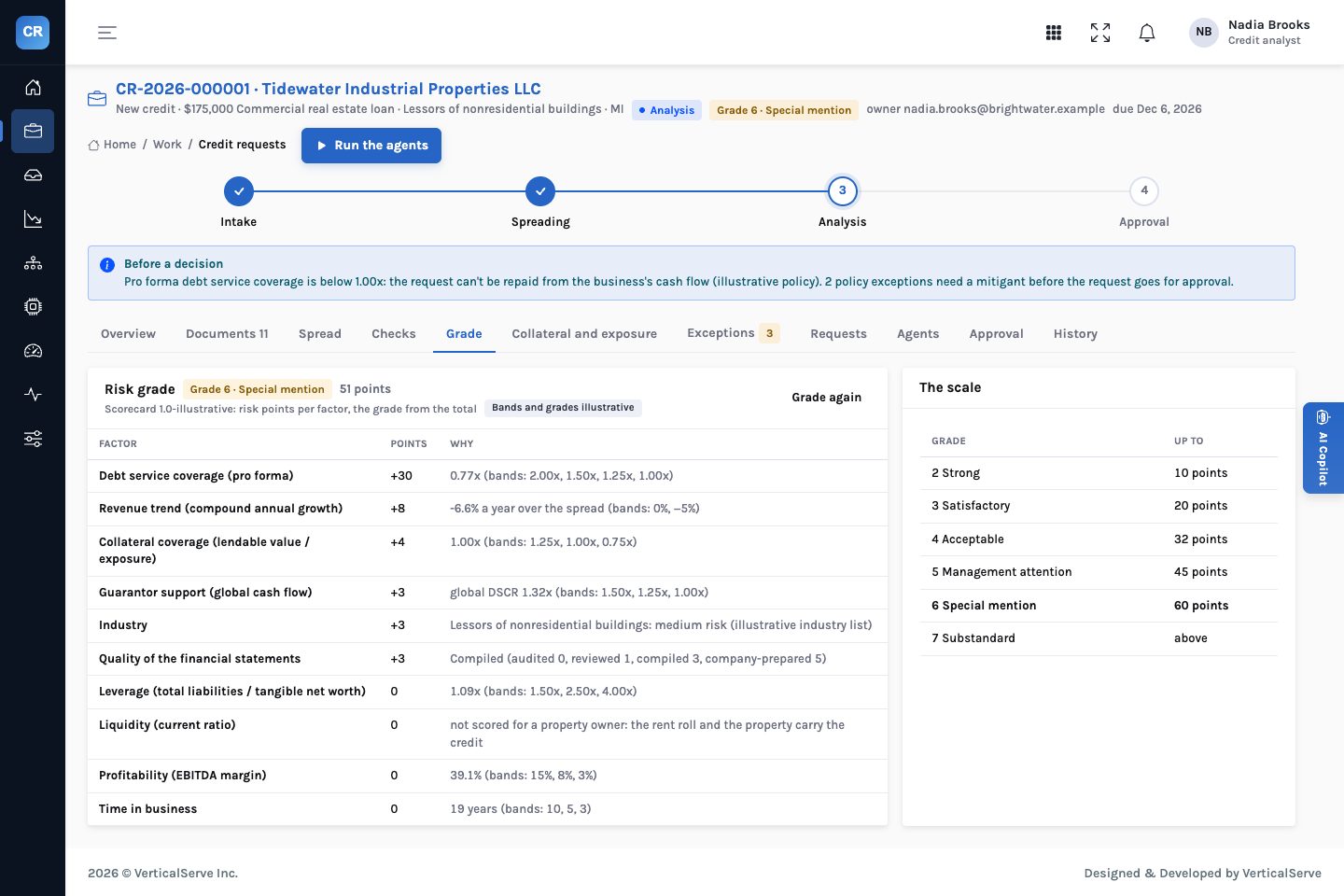
The credit analyst agent scores the case on the illustrative scorecard (model version “1.0-illustrative”). Every factor shows its points and why:
| Factor | Value | Risk points |
|---|---|---|
| Debt service coverage (pro forma) | 0.77x, below the lowest band of 1.00x | 30 |
| Revenue trend (compound annual growth) | −6.6% a year, below −5% | 8 |
| Collateral coverage | 1.00x | 4 |
| Guarantor support (global cash flow) | 1.32x | 3 |
| Industry | Lessors of nonresidential buildings: medium (illustrative list) | 3 |
| Quality of the financial statements | Compiled | 3 |
| Leverage, profitability, time in business | 1.09x; 39.1% EBITDA margin; 19 years | 0 |
| Liquidity | Not scored for a property owner: the rent roll and the property carry the credit | — |
| Total | 51: grade 6, Special mention |
The controls: two refers and a block
The policy agent runs the bank’s credit policy controls from Rules Studio. Three fire on this case. Each becomes a policy exception, and the difference between a refer and a block is the heart of this case.
| Control (illustrative) | Outcome | What has to happen |
|---|---|---|
| Pro forma DSCR below 1.00x | Block | Can’t be justified. Restructure the request, cure it with new figures, or decline. |
| Pro forma DSCR below 1.25x | Refer | A person records a mitigant; a higher authority decides. |
| Risk grade 6 or worse | Refer | A person records a mitigant; a higher authority decides. |
Two controls sit right at their lines and don’t fire. Loan-to-value is (the existing debt on the latest balance sheet, $4,340,664, plus the request) over the appraised value: $4,515,664 / $5,645,000, which the engine reports as 79.99% and the screen shows as 80.0%, against an illustrative maximum of 80%. Collateral coverage is the lendable value, 80% of $5,645,000 = $4,516,000, over the same $4,515,664: 1.00x. A reviewer should read both as “at the limit”, not “comfortably inside it”.
For the two refers, the policy agent drafts a mitigant from the engines’ figures. The draft for the DSCR exception reads:
The policy agent’s draft, as prepared
“Pro forma DSCR below 1.25x: pro forma DSCR 0.77x, global DSCR 1.32x. Mitigants: global DSCR of 1.32x with the guarantors’ cash flow; guarantors’ liquid assets of $2,163,000; collateral coverage of 1.00x; moderate leverage of 1.09x; unlimited personal guarantees from Neha Valdez, Danielle Russo.” Every number in it comes from the spread, the global cash flow or the collateral engine. It is a draft: a person edits it and records it.
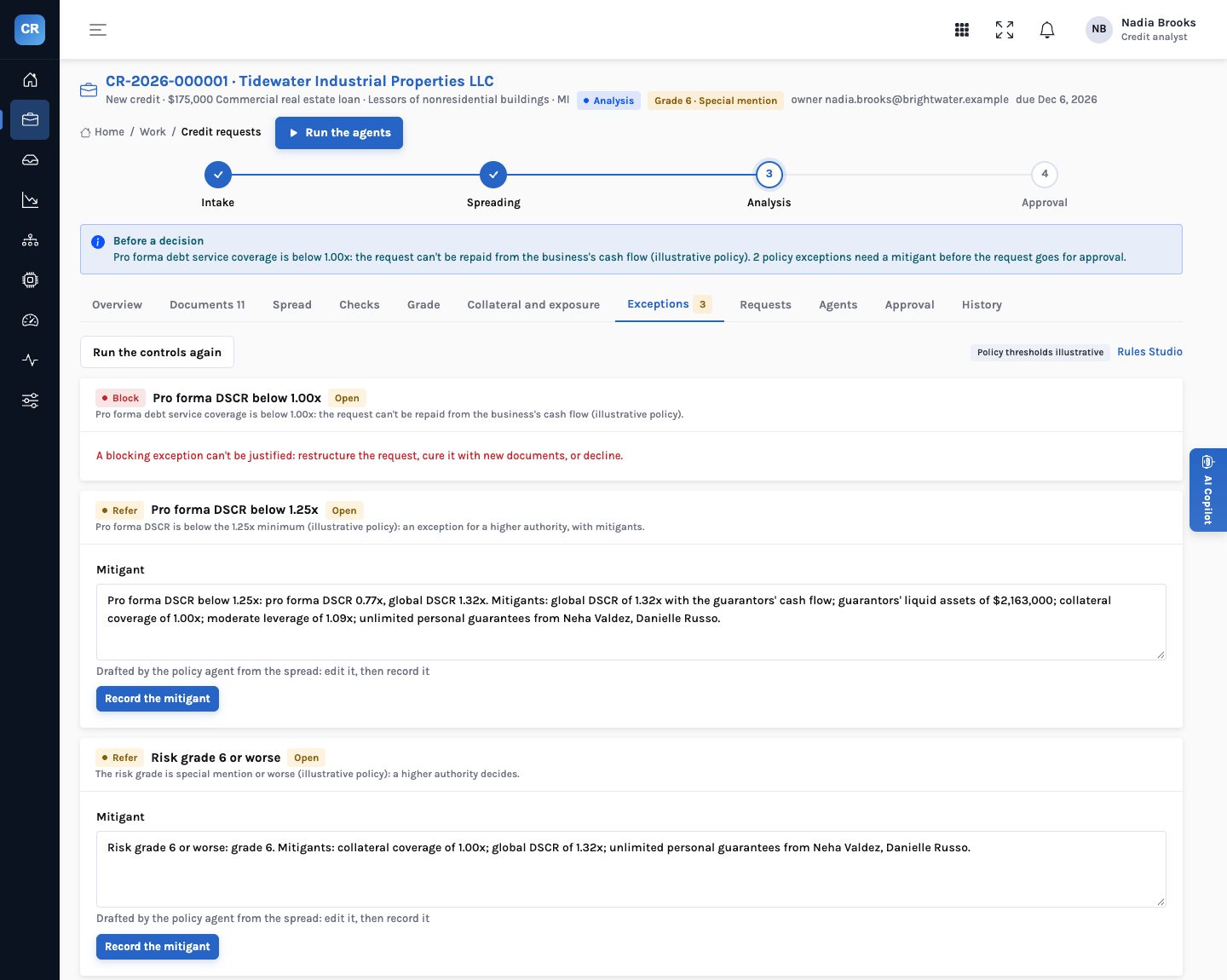
Recording both mitigants would not move this case to approval. The block stays. That is deliberate: an illustrative policy in which no wording, however good, lets a request through when the business’s own cash flow doesn’t cover its debt. A bank that wants guarantor-supported lending below 1.00x can change the control to a refer in Rules Studio. Then it is a policy decision, made once, by the people who own the policy, not a judgement made case by case under deadline.
Refers need a recorded mitigant and a higher authority. A block has no mitigant field at all.
Who would decide
Approval authority follows relationship exposure: existing commitments at the bank plus this request. In the demo data Brightwater carries no existing commitments for Tidewater, so exposure is the $175,000 request, inside a credit officer’s illustrative $2.5 million authority. But an open referred exception raises the requirement to at least a senior credit officer. The case says so in plain words: “Relationship exposure $175,000: Credit officer authority” and “a referred policy exception: at least a senior credit officer”. In the demo that is Ines Carvalho, and the analyst who submits can never be the one who approves.
Who does what
The agents compute and draft. People ask the borrower, change the request, and decide.
Reads the statements line by line, builds the spread, EBITDA, debt service, the pro forma and global coverage, and the trend.
Scores the case on the scorecard with the reason for each factor, and prepares a request asking the borrower to explain the decline, with year-to-date 2026 statements.
Raises one block and two refers, and drafts a mitigant for each refer from the engines’ figures.
Accepts the prepared request on the Agents tab, edits the wording, and sends it. Nothing reaches the borrower until a person sends it.
With the borrower’s answer, the team decides whether the request can be reshaped so it passes, or recommends a decline with a reason.
If the block is cured, edits and records each refer’s mitigant. The supervisor agent then shows what still blocks and who has authority.
Approves or declines. A decline needs a reason. The submitter can never approve.
Can it be restructured?
Usually the first instinct is to shrink the request. Here that doesn’t help: coverage without any new loan is 406,895 / 511,729 = 0.80x, already under 1.00x. A longer amortization doesn’t help either, because the problem is the existing debt, not the new payment. The options that do change the numbers are the ones a credit team would actually discuss:
- Fund the roof another way. The guarantors’ statements show $2,163,000 of liquid assets. An equity contribution leaves the bank’s exposure where it is.
- Wait for evidence of a recovery. The rent roll at 30 September 2026 shows $92,007 a month, $1,104,084 a year, at 85.4% occupancy, which is above FY2025 revenue. If the leases are real and the expenses have come down, the next set of statements will say so. Until the figures the engines compute from change, the block stays.
- Decline, with the reason on the record, and look again at the next annual review.
Approved on collateral and character. The coverage analysis is written afterwards, if at all, and the file shows a grade but not why.
The case shows the path, the formula, the guarantors’ share of global cash flow and a block that has to be cured. The discussion is about the business, not the request.
What the decision record keeps
Whatever is decided, the decision record keeps the verdict; the controls that fired, including the block and how it was cured; each exception and the mitigant a person recorded; the grade and its model version; pro forma DSCR, global DSCR and leverage; the authority required and why; who submitted and who approved or declined; and any conditions. For an approval, the next review is set a year out. An examiner or a loan review team reading it later sees the 0.77x, the 1.32x, and the reasoning that connected them.
What it means for each audience
For the chief credit officer
Declining coverage is the earliest objective sign of a weakening credit, and it shows up at origination as often as in monitoring. A block below 1.00x makes the policy line explicit instead of leaving it to each officer.
If the bank wants to lend on guarantor strength, that becomes a written policy choice, not a pattern noticed later in loan review.
For the credit team lead
The analyst’s time goes on the borrower’s answer and the restructuring conversation, not on rebuilding three years of statements.
Mitigants start from figures the engines computed, so the officer reviews a draft rather than writing a justification from scratch.
For the board
The bank doesn’t extend new money to a property that doesn’t cover its existing debt without someone with authority saying so, in writing.
That is a governance point as much as a credit one.
What to be careful about
- The thresholds are illustrative. 1.00x, 1.25x, the grade bands, 80% loan-to-value, the 80% advance rate and the authority limits were set for the demo. A bank sets its own in Rules Studio and its settings.
- EBITDA is not net operating income. For a property owner, many banks underwrite to net operating income with a replacement reserve, a vacancy factor and market rents. The spread uses the statements as reported; the analyst should still apply the bank’s own real estate underwriting.
- The latest fiscal year carries the pro forma. Interim figures don’t change the engine’s coverage. If the business has recovered in 2026, that has to come through on statements the reader can take, and a person has to judge them.
- A restructure can become a workout. If the bank ends up modifying the existing mortgage to help the borrower, the agencies’ 2023 Interagency Policy Statement on Prudent Commercial Real Estate Loan Accommodations and Workouts is the reference for how to analyse and document it. The product doesn’t make that judgement.
A strong building and strong guarantors can make a weak business look fine.
Three years side by side, every ratio with its formula, and a block that has to be cured, so nobody approves 0.77x without knowing it.