Every commercial loan policy has thresholds: a minimum debt service coverage, a maximum leverage, a loan-to-value ceiling. Every experienced credit officer has approved loans outside them, for good reasons. The policy is not wrong when that happens, and neither is the officer. What goes wrong is the file: an exception that nobody named, a reason that lives in an email, and a portfolio where nobody can say how many loans were made outside policy, or why.
In short
- An exception is a decision, not a defect. Lending outside a policy threshold can be sound credit. Lending outside it without saying so isn’t.
- Two kinds of control. A refer can be accepted with a mitigant and a higher approver. A block can’t be justified at all: cure it or decline.
- The mitigant is drafted from the figures and recorded by a person. InsightCredit’s policy agent drafts it from the spread, the collateral and the guarantors’ statements; a person edits it and records it. No agent can justify an exception.
- Exceptions travel with the decision. Each one raises the approval authority and is frozen on the decision record with its mitigant and who recorded it.
Exceptions are normal. Undocumented ones are not.
Supervisors don’t expect a bank to have no exceptions. They expect it to know about them. The OCC’s Comptroller’s Handbook booklet Commercial Loans treats the identification, approval and tracking of policy exceptions as part of sound loan administration, and examiners commonly look at the volume and nature of exceptions as a signal of how well underwriting standards are holding. For real estate lending the interagency real estate lending standards go further: loans above the supervisory loan-to-value limits are to be identified in the bank’s records and their aggregate reported to the board.
All of that depends on an exception being a thing the bank can count: named by the policy it breaches, carrying the reason it was accepted, and attached to the decision that accepted it. That is the design here.
A line in the memo. Which policy? Which guarantors, how strong? Who decided this was acceptable, and would anyone find it in a portfolio report?
“Pro forma DSCR 1.12x; global DSCR 1.99x with the guarantors’ cash flow; guarantors’ liquid assets $3,166,000…”, raising the approval to a senior credit officer.
Twelve controls: pass, refer or block
Credit policy in InsightCredit is a set of published rules in Rules Studio, the same rules engine the platform uses elsewhere. The demo ships twelve credit policy controls. Each reads the case’s figures and either passes, refers or blocks. Every threshold below is an illustrative demo setting; a credit officer edits them in Rules Studio, and a change is a new published version.
| Control | Outcome | Fires when (illustrative) |
|---|---|---|
| FAILED_CHECKS | Block | A failed document check is still open |
| DSCR_BELOW_ONE | Block | Pro forma DSCR is below 1.00x |
| GRADE_SUBSTANDARD | Block | The risk grade is 7 or worse at origination |
| DSCR_MIN | Refer | Pro forma DSCR is below 1.25x |
| GLOBAL_DSCR_MIN | Refer | Global DSCR, business and guarantors together, is below 1.25x |
| LEVERAGE_MAX | Refer | Total liabilities / tangible net worth is above 4.0x |
| TNW_NEGATIVE | Refer | Tangible net worth is zero or negative |
| CURRENT_RATIO_MIN | Refer | The current ratio is below 1.00x |
| LTV_MAX | Refer | Loan-to-value is above 80% |
| COLLATERAL_SHORTFALL | Refer | Collateral coverage is below 1.00x |
| GROUP_HOUSE_LIMIT | Refer | A related-party group would exceed the house limit; the credit committee decides |
| GRADE_WATCH | Refer | The risk grade is 6 or worse |
Every block or refer except FAILED_CHECKS becomes a policy exception on the case. Failed checks are handled where they arise, on the checks tab, because the remedy is evidence (a corrected document, an explanation, or a waiver with a reason), not a mitigant. If a control stops firing because the figures changed, its exception is cleared; if it fires again, it reopens.
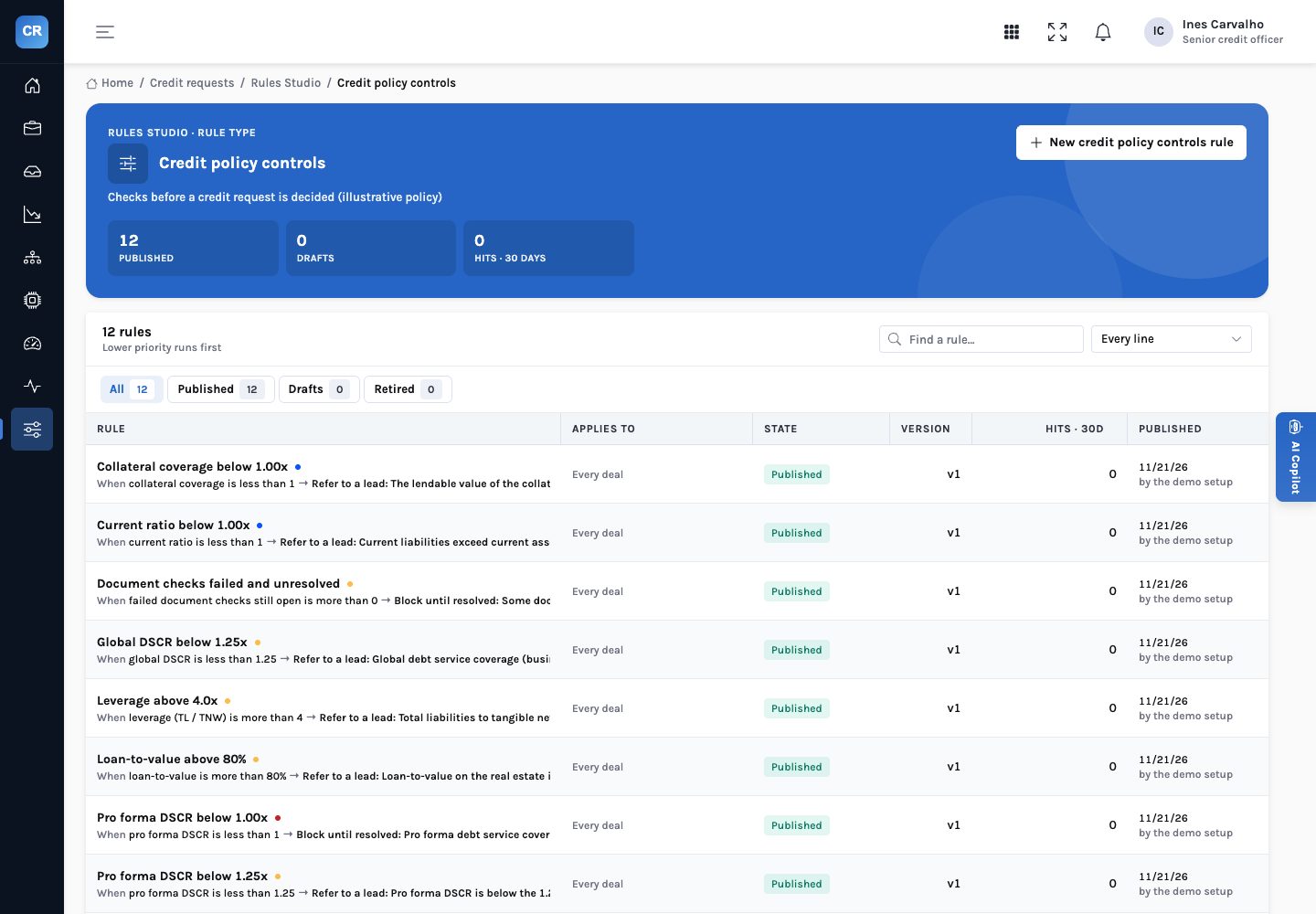
Refer and block are different decisions. A refer asks for a reason and a higher approver; a block asks for a different request.
Refer versus block
The distinction is the heart of the design. A refer says: this is outside policy, but the policy anticipates that it may still be good credit, and wants a reason and a more senior approver. Coverage of 1.12x against a 1.25x minimum, with strong guarantors, is a classic refer. A block says: no reason makes this acceptable as structured. Pro forma coverage below 1.00x means the business’s own cash flow doesn’t cover the debt it would carry, and the demo policy won’t let a mitigant paper over that.
So the product treats them differently. A refer gets a mitigant box and a “Record the mitigant” button. A block gets a sentence: “A blocking exception can’t be justified: restructure the request, cure it with new documents, or decline.” Try to justify one anyway and the system refuses.
What makes a mitigant
A mitigant is the sentence that makes an exception acceptable. A good one is specific, quantified and relevant to the weakness it answers. InsightCredit’s policy agent drafts each one from figures the engines have already computed, choosing among the strengths a credit officer would reach for:
| Strength the draft can cite | Where the figure comes from |
|---|---|
| Global DSCR at or above 1.25x with the guarantors’ cash flow | The global cash flow, from each guarantor’s PFS |
| The guarantors’ liquid assets | The personal financial statements as read |
| Collateral coverage at or above 1.00x | Lendable value from the appraisals and agings, over the secured exposure |
| Moderate leverage, at or below 2.5x | Total liabilities / tangible net worth from the spread |
| Pro forma DSCR, where it is the strength | The spread and the request’s terms |
| Unlimited personal guarantees, by name | The guarantors on the case |
The draft is a starting point. It has two limits worth stating plainly: it only cites figures it can compute, so it can’t know about a signed lease or a pending sale; and it doesn’t judge whether a figure is persuasive. That is the person’s job. The mitigant box is editable, the recorded text is what the person wrote or accepted, and an agent attempting to record it is refused: “Justifying a policy exception is a person’s call; the policy agent only drafts the mitigant.”
Worked case: Tidewater, one block and two refers
Tidewater Industrial Properties (CR-2026-000001; fictional, like all the demo data on
Brightwater Commercial Bank) asks for $175,000 to replace a roof and HVAC on a multi-tenant commercial
building. Its pro forma DSCR is 0.77x and its grade is 6, Special mention, at 51 points. Three
controls fire:
| Control | Outcome | What the case shows |
|---|---|---|
| DSCR_BELOW_ONE | Block | Pro forma debt service coverage is below 1.00x: the request can’t be repaid from the business’s cash flow |
| DSCR_MIN | Refer | Drafted: “Pro forma DSCR 0.77x, global DSCR 1.32x. Mitigants: global DSCR of 1.32x with the guarantors’ cash flow; guarantors’ liquid assets of $2,163,000; collateral coverage of 1.00x; moderate leverage of 1.09x; unlimited personal guarantees from Neha Valdez, Danielle Russo.” |
| GRADE_WATCH | Refer | Drafted: “Grade 6. Mitigants: collateral coverage of 1.00x; global DSCR of 1.32x; unlimited personal guarantees from Neha Valdez, Danielle Russo.” |
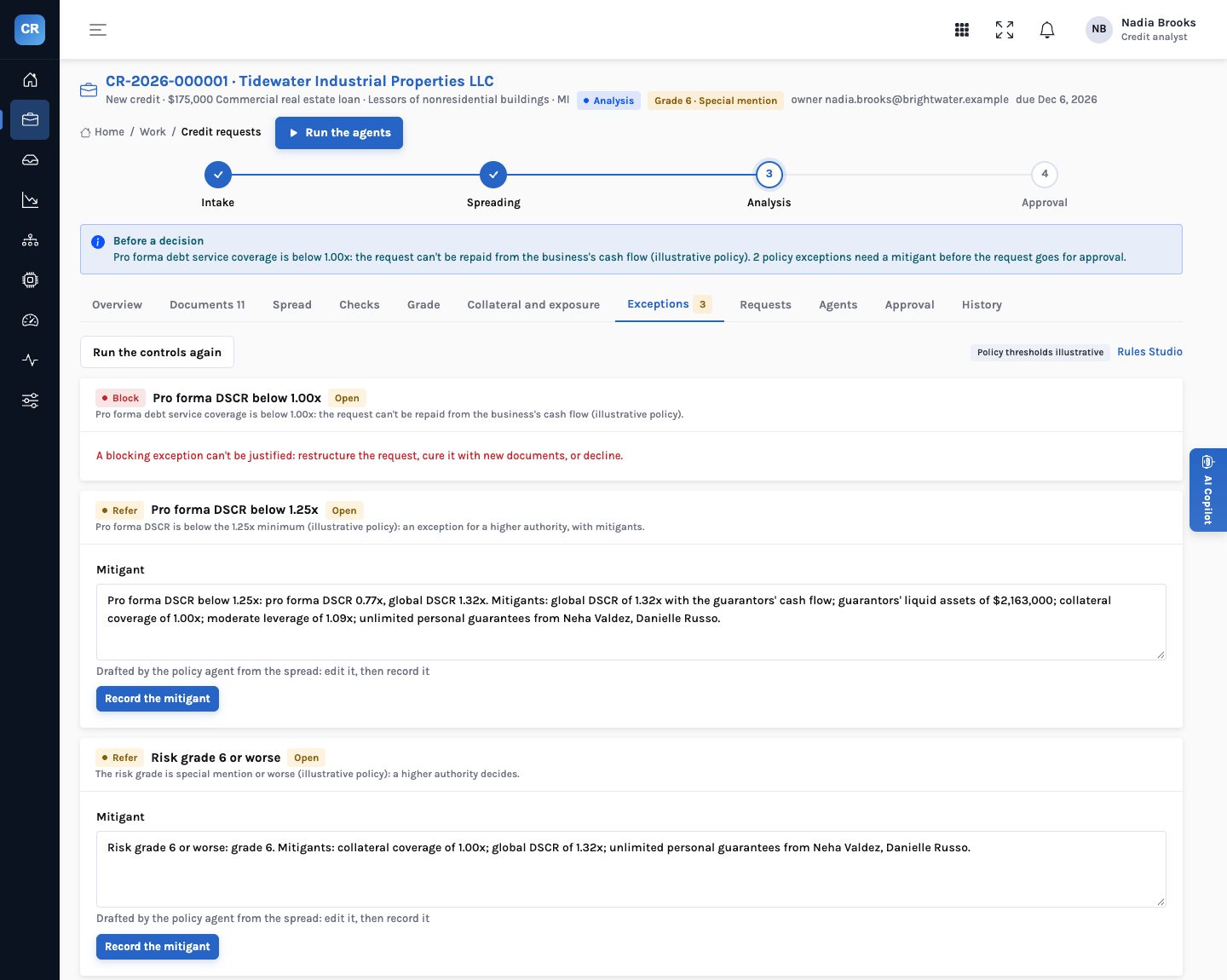
The two refers could be justified today; the drafts are reasonable. The block can’t, and the spread explains why restructuring is hard. Historical DSCR was already 0.80x in FY2025, before the new loan: EBITDA of $406,895 against existing debt service of $511,729. Making the request smaller doesn’t lift coverage above 1.00x, because the existing debt alone isn’t covered. What could cure it is evidence that cash flow has recovered (interim statements, a signed lease), a restructuring of the existing debt, or a decision to decline. Those are credit conversations. The system’s contribution is to make sure they happen before approval, not after.
Worked case: Northfield Hospitality, four justified exceptions
Northfield Hospitality Group (CR-2026-000012), a full-service restaurant group in business
since 1987, asks for a $250,000 increase to buy a second location. It already has an equipment loan
of $333,000 and a $250,000 revolving line. Four refers fired, and all four were justified by Nadia
Brooks, the credit analyst, before she submitted the request:
| Exception | The figure | Mitigant as recorded |
|---|---|---|
| DSCR_MIN | Pro forma DSCR 1.12x | global DSCR 1.99x with the guarantors’ cash flow; guarantors’ liquid assets $3,166,000; collateral coverage 0.48x; unlimited personal guarantees from Maria Castellanos, Jennifer Petrakis, Megan Okafor |
| CURRENT_RATIO_MIN | Current ratio 0.80x | cash $78,122; pro forma DSCR 1.12x; unlimited personal guarantees from the three guarantors |
| COLLATERAL_SHORTFALL | Coverage 0.48x (lendable $277,437 against $583,000) | pro forma DSCR 1.12x; global DSCR 1.99x; unlimited personal guarantees from the three guarantors |
| GRADE_WATCH | Grade 6, 60 points | pro forma DSCR 1.12x; collateral coverage 0.48x; unlimited personal guarantees from the three guarantors |
With every refer justified, nothing blocks the request. But the exceptions haven’t disappeared: they raised the authority it needs. On exposure alone ($833,000 across the relationship) a credit officer could approve it. Because it carries referred exceptions, it needs at least a senior credit officer, and when Owen Hale, a credit officer, opens the approval tab, there is no Approve button for him. The next post in this series follows that decision.
Read the mitigant before you record it
The Northfield mitigants were recorded as drafted, and they show why a person has to read them. “Collateral coverage 0.48x” is listed among the mitigants for the DSCR and grade exceptions, but 0.48x coverage is a weakness, not a strength; the draft states the figure so the reader has it, and a careful analyst would move it out of the mitigant or explain it. Likewise, on Oakridge Grill House (CR-2026-000007) the draft cites an unlimited guarantee from a guarantor whose own statement shows negative net worth of $1,061,000. That failed check stays open on its own, but the sentence should not lean on her guarantee. Drafting from figures saves time; it does not replace judgement.
The agent drafts; a person records; a different, more senior person reads it at the moment of decision.
Exceptions in the decision and in the book
When a request is decided, the decision record keeps every exception that was live at that moment, with its rule, its outcome and its mitigant (or “no mitigant”), alongside the controls that fired and their rule versions. Each exception on the case carries who justified it and when, and the case history records the justification. Because every exception is a row with a rule code rather than a sentence in a memo, the bank has what it needs to count exceptions by rule, by approver or by relationship manager, and to report them.
The twelve controls read the spread, grade, collateral and exposure. Each block or refer becomes an exception on the case.
For each refer, a sentence citing the strengths the figures support. Blocks get no draft: they can’t be justified.
Edit the draft until it is true and relevant, then record it. The exception shows who justified it and when.
Restructure the request, supply new documents, or decline with a reason.
Referred exceptions raise the authority to at least a senior credit officer; the approver reads each mitigant before deciding.
The decision record keeps every live exception with its mitigant, beside the controls and their versions.
What it means for each audience
For the chief credit officer
Every exception to credit policy is named by the rule it breaches, justified in writing by a named person, and approved at a level the policy sets.
Blocks are real: no mitigant, however well written, can approve a request the policy says can’t be justified.
For the credit team lead
Analysts start from a drafted mitigant with the right figures in it, and spend their time on whether it is persuasive.
Approvers see on the approval tab how many exceptions there are and whether any lacks a mitigant, and read each mitigant on the exceptions tab, not buried in a memo.
For the board
The board can be told how much lending happens outside policy, which policies are excepted most, and why.
A rising count of exceptions on one rule is an early signal that either underwriting or the policy needs attention.
What to be careful about
- A drafted mitigant is not a mitigant until someone believes it. Recording a draft unchanged is allowed. Sample recorded mitigants, and look hardest at those identical to the draft.
- Mitigants can go stale. If new figures arrive after an exception was justified and the control still fires, the recorded sentence may now quote old numbers. Reread mitigants after a respread.
- Refer versus block is policy. The demo blocks pro forma DSCR below 1.00x. Some banks would refer it for well-secured real estate with strong guarantors. Decide deliberately and write it into Rules Studio.
- Thresholds are illustrative. The 1.25x, 4.0x, 80% and 1.00x in the demo are not regulatory figures. Set your own, and make sure the LTV control matches your own real estate lending policy and the supervisory limits that apply to you.
An exception without its reason is just a breach of policy that nobody wrote down.
Name it by the rule, draft the reason from the figures, have a person record it, and send it to someone senior enough to accept it.