An approver looks at a spread and stops on one number: FY2025 EBITDA of $406,895. Where did it come from? In most credit files the honest answer is that an analyst typed operating income and depreciation from a PDF into a spreadsheet template, added them, and the template did the rest. The number is probably right. But “probably” is what credit review, the approver and the examiner are all there to test, and a typed spread gives them nothing to test it against except the PDF and an afternoon.
In short
- A spread is a set of claims about documents. Every cell says “the statement shows this”. A spread you can trust lets anyone check that claim in one click: the document, the line and the exact text.
- Read, don’t type. InsightCredit’s document reader takes each figure from the PDF’s text layer with its line number and quote. A figure it can’t find is marked partial, never guessed.
- Every derived number carries its formula. EBITDA, debt service, tangible net worth, the ratios, pro forma DSCR and global cash flow are computed from the spread, and the formula is shown beside the result.
- Reconcile before you rely. The statements are tested against themselves, the tax returns, the agings, the bank deposits and the rent roll. A difference outside tolerance becomes a check a person has to resolve or waive with a reason.
Why traceability is the point
Spreading is the foundation of commercial credit analysis. The approver reads the ratios, the grade reads the ratios, the policy controls read the ratios, and the covenants written into the loan will be tested against the same lines next year. An error in the spread doesn’t stay in the spread. A transposed digit in interest expense moves the debt service coverage, which moves the grade, which can move who is allowed to approve the request.
The usual defence is a second analyst who re-keys or ticks the spread against the statements. That works, slowly, and it leaves no evidence of what was ticked. Credit review, under the Interagency Guidance on Credit Risk Review Systems (2020), is expected to test the accuracy of risk ratings on a sample of loans; examiners look at the analysis that supports repayment capacity. Both start the same way: by asking where the numbers came from.
Numbers in a template. No link to the page they came from, no record of who checked them, and a formula hidden in a cell that someone may have overwritten last year.
Each cell links to its document and line; hover shows the quoted text, a click opens the PDF beside it. Each derived figure names its formula. Nothing in the spread was typed.
Reading, not typing
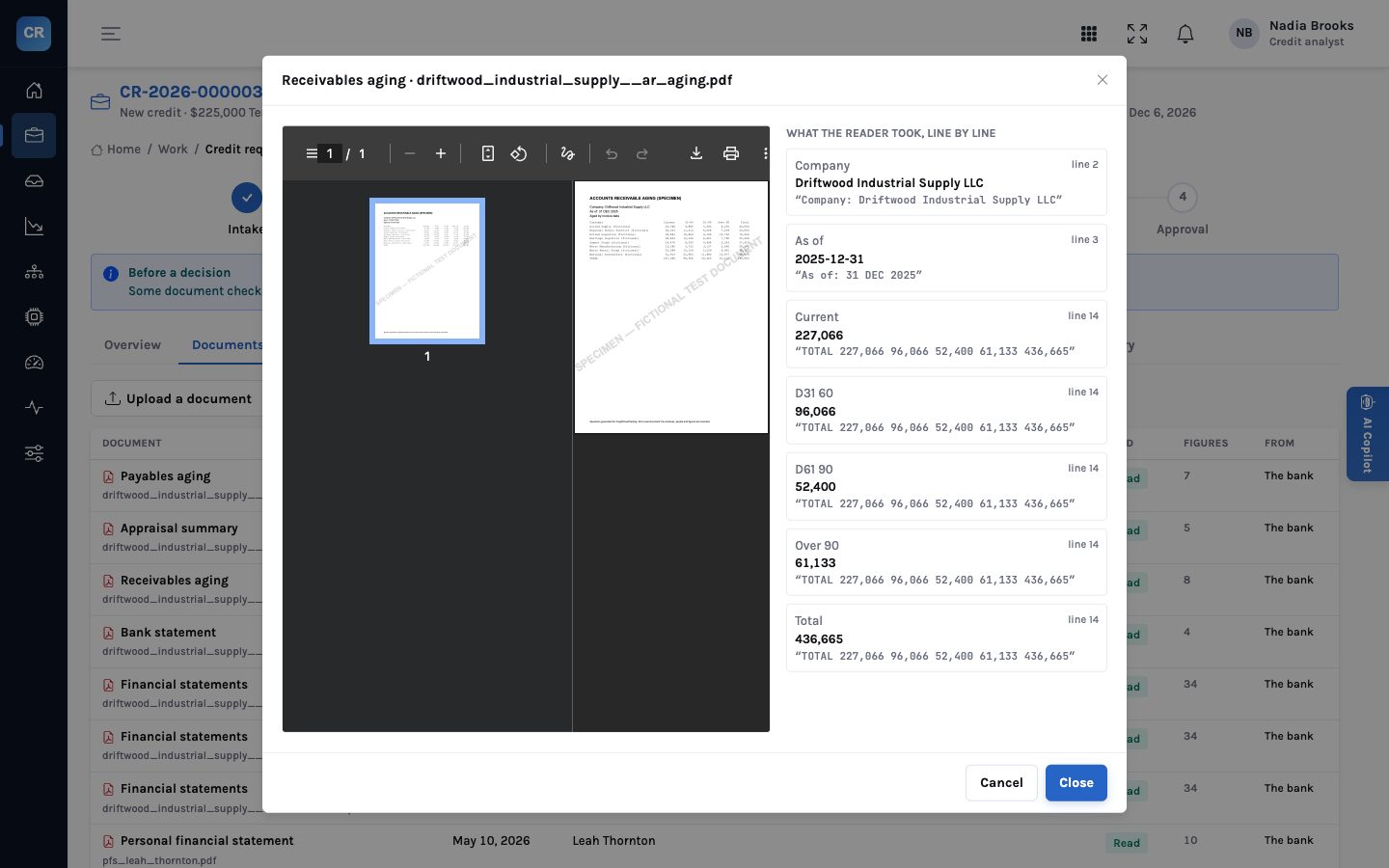
The document reader in InsightCredit is deliberately unglamorous. It is not a language model guessing at a page. It applies deterministic patterns to the text layer of each PDF, document type by document type, and for every field it takes it keeps three things: the value, the line number and the exact text of that line. If the pattern doesn’t find a field, the document is marked partial and the field is left empty. A scanned PDF with no text layer is refused in plain words, so nobody mistakes an image for a document that was read.
| Document | What the reader takes |
|---|---|
| Financial statements | Income statement and balance sheet: 30 lines, from revenue to total liabilities and equity |
| Business tax returns (1120, 1120-S, 1065) | Gross receipts, cost of goods sold, total income, officer compensation, interest, depreciation, deductions, ordinary income, taxable income |
| Bank statements | Total deposits, the months covered, returned (NSF) items |
| Receivables and payables agings | Each bucket, the total, the amount over 90 days, the customers |
| Rent rolls | Monthly rent and occupancy |
| Personal financial statements | Total and liquid assets, liabilities, net worth, annual income, annual debt payments, living expenses, contingent liabilities |
| Appraisal summaries | Appraised value, effective date, appraiser, value type |
Documents come from the bank’s systems when the case is opened, or from the borrower through a secure request; a borrower’s upload is read the moment it arrives, and the spread and checks run again. The analyst’s job shifts from transcription to inspection: open the document, look at what the reader took, decide whether it is the right line.
Three years, side by side
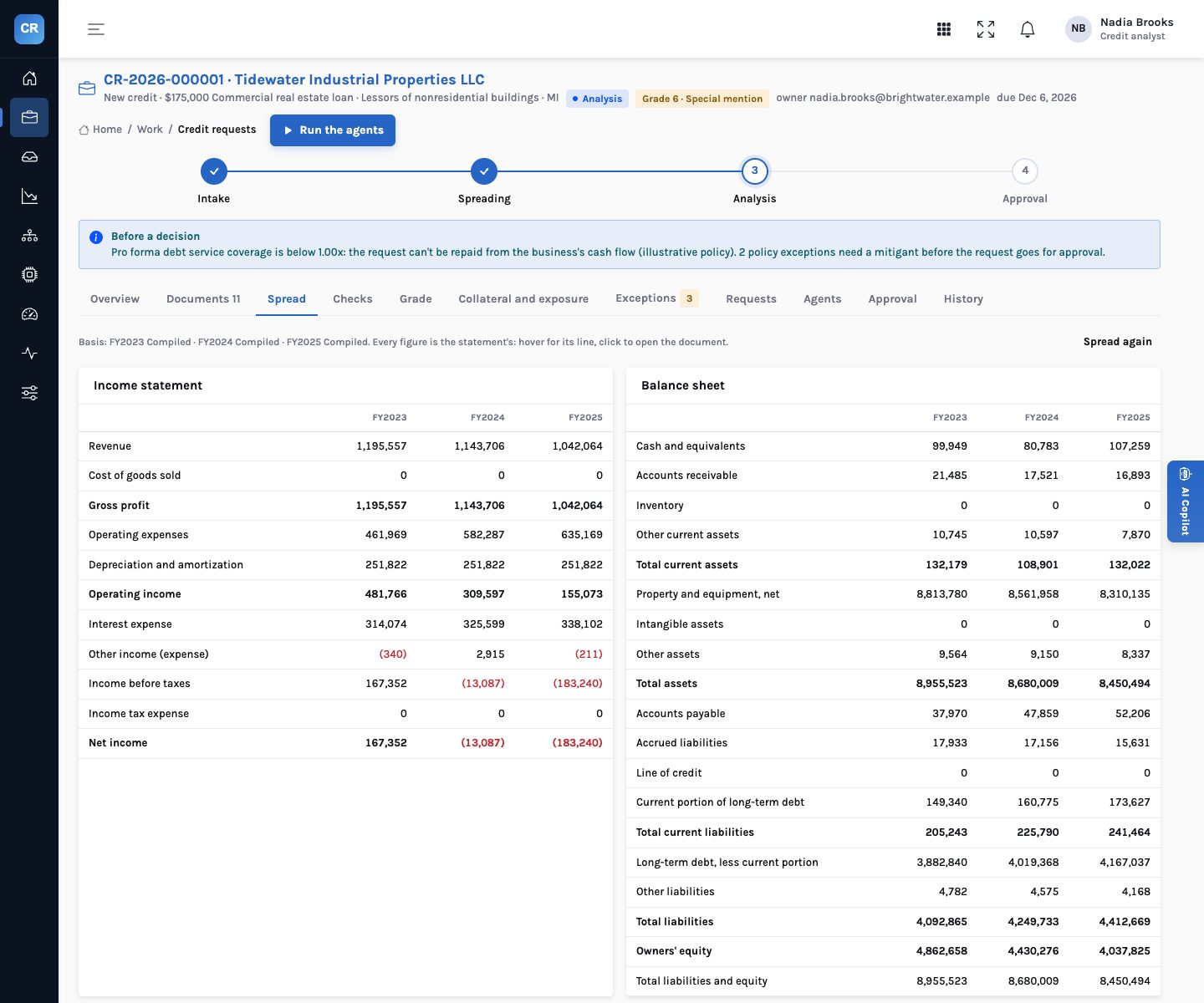
The spread lays out the latest three fiscal years of income statement and balance sheet, built only
from what the reader took. Take the first request in the demo, CR-2026-000001: Tidewater
Industrial Properties LLC (fictional, like every borrower, person and figure on Brightwater Commercial
Bank’s demo data), a Michigan lessor of nonresidential buildings asking for a $175,000 commercial
real estate loan to replace a roof and HVAC. Its statements are compiled, all three years.
| Line | FY2023 | FY2024 | FY2025 | FY2025 source |
|---|---|---|---|---|
| Revenue | 1,195,557 | 1,143,706 | 1,042,064 | financials_2025, line 8 |
| Operating expenses | 461,969 | 582,287 | 635,169 | line 11 |
| Depreciation and amortization | 251,822 | 251,822 | 251,822 | line 12 |
| Operating income | 481,766 | 309,597 | 155,073 | line 13 |
| Interest expense | 314,074 | 325,599 | 338,102 | line 14 |
| Net income | 167,352 | (13,087) | (183,240) | line 18 |
| Current portion of long-term debt | 149,340 | 160,775 | 173,627 | line 33 |
| Total liabilities | 4,092,865 | 4,249,733 | 4,412,669 | line 37 |
| Owners’ equity | 4,862,658 | 4,430,276 | 4,037,825 | line 38 |
Hover over FY2025 revenue and the spread shows the quote it was taken from,
“Revenue ...... 1,042,064”, on line 8 of tidewater_industrial_propert_financials_2025.pdf.
Click it and the document opens at that line. That is the whole idea: a figure on the spread is a
pointer, not a copy.
Every derived number names its formula
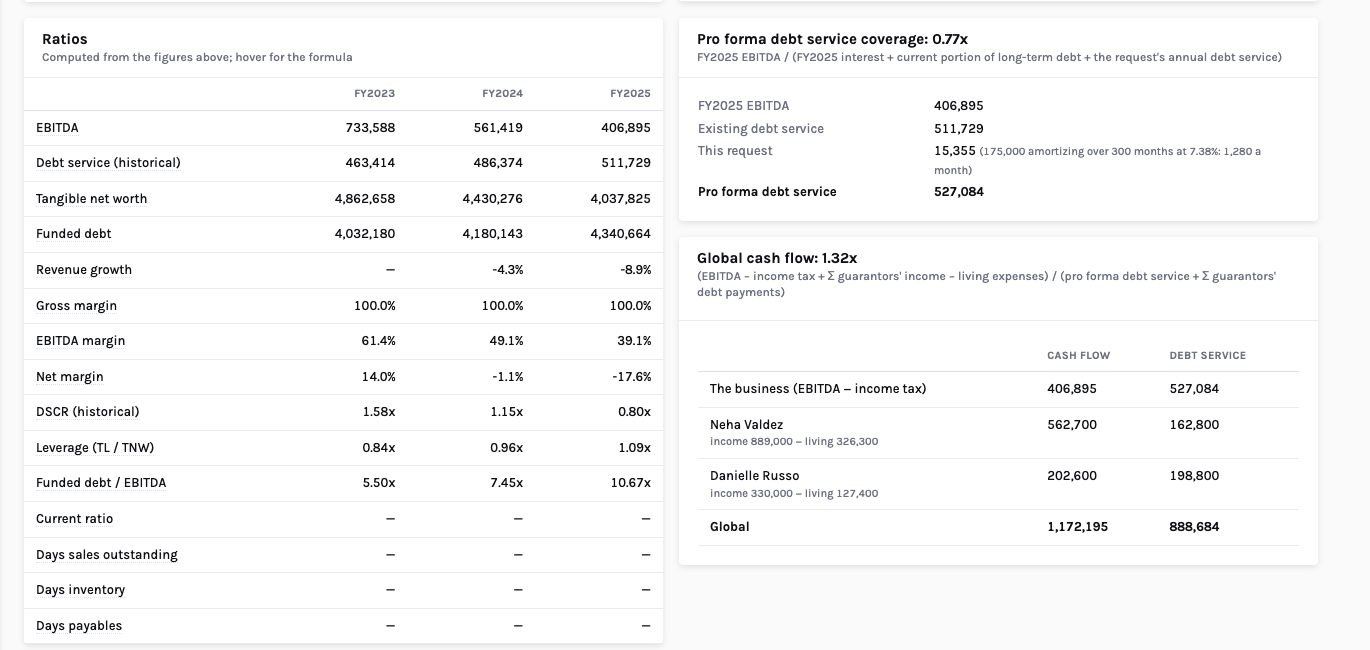
Once the lines are read, the derived figures are arithmetic, and the arithmetic is shown. There are no hidden cells. Each derived line and ratio on the screen carries its formula; hover and you see it. These are the definitions InsightCredit uses, with Tidewater’s FY2025 results:
| Figure | Formula | Tidewater FY2025 |
|---|---|---|
| EBITDA | operating income + D&A | 155,073 + 251,822 = 406,895 |
| Historical debt service | interest + current portion of LTD | 338,102 + 173,627 = 511,729 |
| Tangible net worth | equity − intangibles | 4,037,825 − 0 = 4,037,825 |
| Funded debt | LOC + CPLTD + LTD | 0 + 173,627 + 4,167,037 = 4,340,664 |
| Historical DSCR | EBITDA / (interest + CPLTD) | 0.80x |
| Leverage | TL / TNW (none if TNW ≤ 0) | 1.09x |
| Funded debt / EBITDA | funded debt / EBITDA | 10.67x |
| EBITDA margin | EBITDA / revenue | 39.1% |
| Revenue growth | revenue / prior-year revenue − 1 | −8.9% |
| Current ratio | total current assets / total current liabilities | not computed for a property owner |
| DSO | AR / revenue × 365 | not computed for a property owner |
| DIO and DPO | inventory / COGS × 365; AP / COGS × 365 | no cost of goods sold |
Two things in that table are policy, not arithmetic, and they are worth noticing. Leverage is not computed at all when tangible net worth is zero or negative, because a ratio over a negative denominator reads as a small number and looks healthy. And for a property owner (NAICS 5311) the current ratio and DSO are not computed and liquidity isn’t scored: the rent roll and the property carry that credit, not working capital.
The trend line summarises the three years: revenue compound annual growth of −6.6%, an EBITDA margin down 22.3 points from 61.4% to 39.1%, and historical DSCR of 1.58x, 1.15x and 0.80x. Nobody has to compute that path by hand to see the direction.
Pro forma and global: the numbers the decision turns on
Historical coverage says how the business serviced the debt it had. The approver needs to know how it will service the debt it is asking for. InsightCredit computes both pro forma measures from the spread and the request, and shows every term:
Pro forma DSCR = latest EBITDA / (latest historical debt service + the request’s annual debt service). An amortizing request is costed at its indicative rate and amortization as a level payment; a revolving line at its full commitment, interest only; an annual review adds nothing. Tidewater’s $175,000 amortizes over 300 months at 7.38%: $1,280 a month, $15,355 a year. So pro forma debt service is 511,729 + 15,355 = 527,084, and pro forma DSCR is 406,895 / 527,084 = 0.77x.
Global cash flow = (EBITDA − income tax + Σ guarantors’ (annual income − living expenses)) / (pro forma debt service + Σ guarantors’ annual debt payments), each guarantor’s figures taken from their personal financial statement.
| Cash flow | Debt service | From | |
|---|---|---|---|
| The business (EBITDA − income tax) | 406,895 | 527,084 | the spread and the request |
| Neha Valdez (income 889,000 − living 326,300) | 562,700 | 162,800 | her PFS |
| Danielle Russo (income 330,000 − living 127,400) | 202,600 | 198,800 | her PFS |
| Global | 1,172,195 | 888,684 | 1.32x |
One chain from the PDF to the decision. Each arrow is arithmetic you can see; nothing in it was typed.
Tidewater tells a story the spread makes plain in a minute: the property’s own cash flow no longer covers its debt, even before the new loan, while two guarantors with $2,163,000 of liquid assets between them bring global coverage to 1.32x. Whether that is enough is a credit judgement, and the other posts in this series follow it into the grade and the policy exceptions. The spread’s job is to make sure the judgement is made on numbers everyone can check.
Reconcile before you rely
A spread traced to the statements is only as good as the statements. Company-prepared and compiled statements aren’t audited, and receivables in particular are easy to overstate. So InsightCredit tests the spread against itself and against independent documents, and every test becomes a check on the case with its evidence quoted.
| Test | Compares | Outcome outside tolerance |
|---|---|---|
| Statements add up | total assets = liabilities + equity; revenue − COGS = gross profit; current + LTD + other liabilities = total liabilities | Fail |
| Returns agree with the statements | each year’s gross receipts on the return against statement revenue (10%) | Fail |
| Receivables agree with the aging | balance-sheet receivables against the aging total (10%) | Fail |
| Receivables over 90 days | share of the aging over 90 days (15%) | Warn; excluded from the borrowing base |
| Concentration | largest customer’s share of receivables (35%) | Warn |
| Payables agree with the aging | balance-sheet payables against the aging (10%) | Warn |
| Deposits support the revenue | annualized deposits against revenue (below 75%) | Warn |
| Returned items | NSF items on the bank statements | Warn |
| Rent roll supports rental revenue | annualized rent roll against revenue (15%) | Warn |
The tolerances in that table are illustrative settings for the demo, not a standard; a bank sets its
own (CREDIT_TOL_RECEIVABLES, CREDIT_TOL_TAX_REVENUE,
CREDIT_MIN_DEPOSIT_RATIO, CREDIT_TOL_RENT_ROLL and the rest).
Tidewater passes every one. Its three years tie. The 2025 Form 1065 shows gross receipts of $1,044,698 against statement revenue of $1,042,064, a 0.2% difference. Three months of deposits total $259,739, or $1,038,956 a year, 99.7% of revenue. The rent roll at 30 September 2026 shows $92,007 a month, $1,104,084 a year, at 85.4% occupancy. Each of those is a row on the checks tab with the quoted line it rests on.
Two other demo cases show what failing looks like. Driftwood Industrial Supply
(CR-2026-000003) reports receivables of $592,463 on its FY2025 balance sheet; its aging at
the same date totals $436,665, a 35.7% difference against a 10% tolerance. Hawthorne Bakeries
(CR-2026-000005) reports FY2025 revenue of $14,517,350; its 2025 Form 1120 shows gross
receipts of $11,560,905, 20.4% lower. Neither is an accusation. Both are questions that must be
answered before anyone approves.
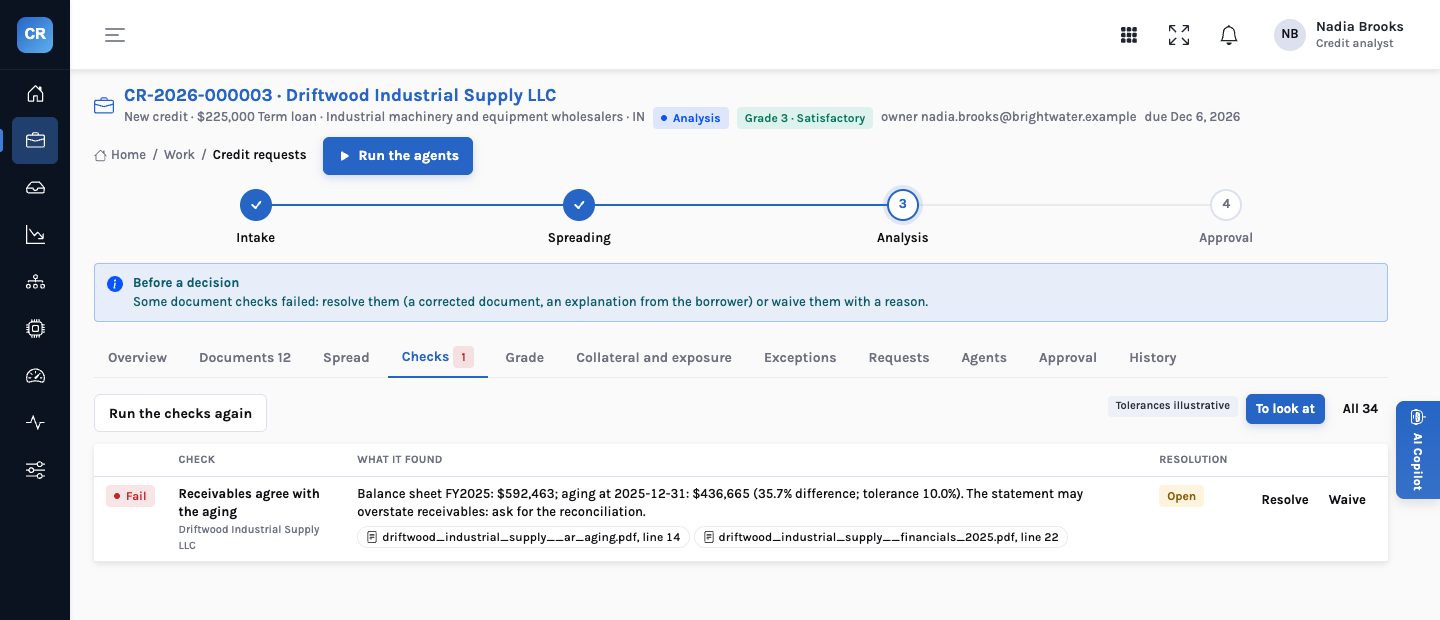
Reconciliations turn a doubtful figure into a check with evidence. Tolerances shown are the demo’s illustrative settings.
Who does what
The spreading agent builds the spread and runs the reconciliations, and when a difference needs an explanation it drafts the request to the borrower. It can’t send that request and it can’t clear a check. A failed check is resolved by a person (a corrected document, an explanation) or waived with a written reason, and a waived check shows as waived, never as passed.
Each PDF is read as it arrives. Missing documents become a drafted request to the borrower; scanned PDFs are refused in plain words.
The latest three fiscal years, derived lines, ratios, pro forma DSCR and global cash flow, all from what was read.
Ties, returns, agings, deposits and rent roll. A difference outside tolerance becomes a check with both sides quoted.
Hover the cells that matter, open the lines behind them, read the checks. The spread is reviewed, not re-keyed.
Accept, edit and send the drafted request for an explanation, or resolve or waive a check with a reason.
A borrower’s upload is read at once; the spread and checks run again on the new evidence.
What the spread will not do
It will not invent a figure the reader couldn’t find, and it will not smooth over a statement that doesn’t add up. Where the statement is wrong or incomplete, the remedy is a corrected document or an explanation from the borrower, recorded on the case, not an edit to a cell.
What it means for each audience
For the chief credit officer
Every number in a credit file can be traced to a page and a line, which is the first thing credit review and an examiner will test.
Formulas are fixed and visible, so a ratio means the same thing on every request in the book.
For the credit team lead
Analysts stop transcribing and start inspecting. Second reviews become a matter of opening the lines that matter, not re-keying three years.
Reconciliation failures arrive as checks with evidence, so the conversation with the borrower starts with a specific question.
For the board
Credit decisions rest on figures the bank can show came from the borrower’s own documents, tested against independent ones.
The quality of a file no longer depends on which analyst spread it.
What to be careful about
- Traceable is not true. A figure quoted exactly from a company-prepared statement can still be wrong. Traceability shows where a number came from; the reconciliations and the analyst’s judgement decide whether to believe it.
- Patterns read layouts they know. A statement in an unfamiliar format may be read partially. That is shown, not hidden, but it still needs a person to supply the right document.
- Definitions are choices. EBITDA as operating income plus D&A, debt service as interest plus current maturities: these are common conventions, not the only ones. A bank should make sure the formulas match its credit policy and its covenant definitions.
- Tolerances are policy. The demo’s 10% and 15% are illustrative. Set them deliberately, and know that a looser tolerance means fewer questions to borrowers and more risk that a real difference goes unasked.
A number in a credit file is a claim about a document. Make every claim checkable in one click.
Read the figures with their lines, show every formula, and test the statements against the returns, the agings and the bank before anyone relies on them.