Examiners rarely fault a bank for not having a credit policy. They fault it for files that don’t show the policy was followed: a coverage ratio in the memo that nobody can tie to the statements, a risk grade that doesn’t move when the borrower’s numbers do, an appraisal older than the bank’s own validity rules allow, an exception approved by someone without the authority to approve it. A commercial credit programme is judged less on what the policy says than on whether the files prove it was applied, the same way, every time.
In short
- The credit file is the evidence. Examiners and credit risk reviewers sample files. If the reasoning isn’t in the file, as far as the review is concerned it didn’t happen.
- Repayment capacity comes first. The question is whether the borrower’s own cash flow can service the debt, shown from documents, with secondary sources (collateral and guarantors) assessed separately.
- The grade has to be accurate and current. Supervisory guidance on rating credit risk expects grades that reflect the risk, change when it changes, and map to the regulatory classifications.
- Exceptions and authority must be visible. What fell outside policy, why it was accepted, and whether the person who approved it had the authority, all on the record.
The guidance a credit file is read against
There is no single rule for commercial credit files. An examiner at a US bank draws on several pieces of supervisory guidance, and each one ends up asking the file a question.
| Guidance | What it covers | What it asks of the file |
|---|---|---|
| OCC Comptroller’s Handbook, Commercial Loans | Underwriting, credit administration and the risks in commercial lending | A documented analysis of the primary source of repayment, the secondary sources, and the loan’s terms against policy |
| OCC Comptroller’s Handbook, Rating Credit Risk | Risk rating systems and the regulatory classifications | A grade that is accurate, timely and supported, and a clear mapping to special mention, substandard, doubtful and loss |
| Interagency Guidance on Credit Risk Review Systems (2020) | The independent review of credit risk and of risk ratings | Files a reviewer can test without the analyst in the room |
| Interagency Appraisal and Evaluation Guidelines (2010), and the appraisal rules in 12 CFR 34, 323 and 225 | When an appraisal or an evaluation is needed, its independence, review and continued validity | An appraisal or evaluation of the right kind, reviewed, and still valid for this transaction |
| Interagency guidance on concentrations in commercial real estate lending (2006) | Risk management for CRE concentrations | Exposure seen at the level of the relationship and the portfolio, not just the request |
| Interagency Policy Statement on Prudent Commercial Real Estate Loan Accommodations and Workouts (2023) | Renewals, restructurings and workouts of CRE loans | An analysis of the borrower’s current condition when terms are changed |
| Regulation B (ECOA) | Fair lending; it applies to business credit | Consistent treatment, and reasons when a request is declined |
| CECL (ASC 326) | The allowance for credit losses | Grades and data good enough to support how the bank estimates expected losses |
Read the current text, and your own regulator
This post describes the common shape of what US supervisory guidance asks of a commercial credit file. Handbook booklets are revised, thresholds change, and state and federal regulators differ in emphasis. Treat it as a map of the questions to expect, not a summary you can rely on in place of the guidance itself.
How a review moves through the book
Whether it is the bank’s own credit risk review or an examination, a review of commercial credit tends to move from the policy to a sample of files and back. The questions are predictable.
From the policy to the files and back: the shape of most commercial credit reviews.
1. Can the borrower repay, and does the file show it?
Commercial lending guidance puts the primary source of repayment first: the borrower’s cash flow from operations. Collateral and guarantors are secondary sources, assessed in their own right, and a file that leans on them to cover weak cash flow should say so plainly. In practice an examiner wants to see the historical debt service coverage, the coverage with the proposed loan added, and, where there are guarantors, a global view that brings in their income and obligations.
Primary source first, secondary sources second, and the file says which one the credit actually rests on.
What matters for the file is not only the ratio but how it was reached. Which year’s EBITDA? What was counted as debt service? Was the new loan’s payment worked out at its actual rate and amortization? A ratio in a memo with no derivation is a ratio a reviewer has to rebuild.
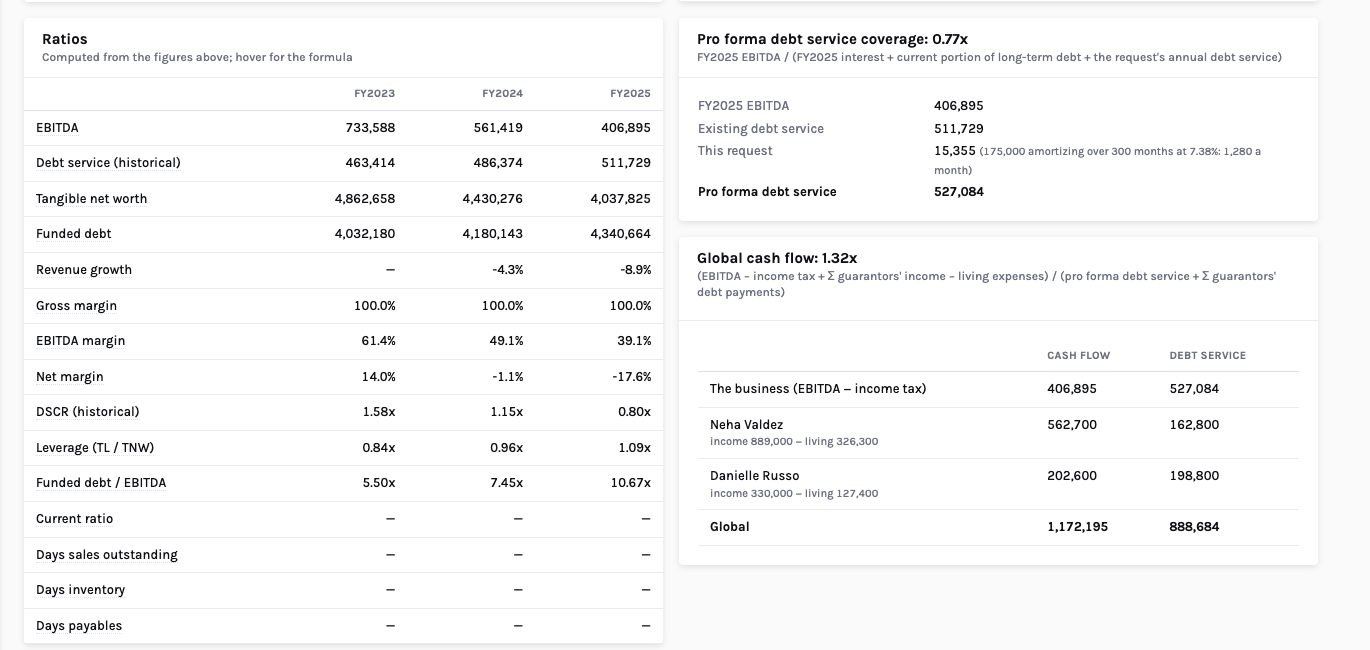
The example is from the demo bank we built, Brightwater Commercial Bank; it, its borrowers and every figure are fictional. Tidewater’s own cash flow doesn’t cover the debt with the new loan, while its guarantors’ does. In the demo’s illustrative policy, coverage below 1.00x is a block: the guarantors can’t mitigate it; the request has to be restructured or declined. A bank could set its policy differently. What an examiner will look for is that the bank’s own rule was applied and the file shows it.
2. Is the spread supported by the documents?
Repayment analysis is only as good as the spread under it. A reviewer will pick figures and ask where they came from, and whether anyone checked them against independent evidence: the tax return against the statements, the receivables aging against the balance sheet, bank deposits against revenue, the rent roll against rental income. Company-prepared statements deserve more of this than audited ones.
Revenue, EBITDA and debt service typed into a template. The analyst compared the return by eye; the file says “financials reviewed”.
Each cell links to the document and line it was read from. Each reconciliation is a check with both figures quoted, and its resolution or waiver has a reason and a name.
In InsightCredit every cell of the spread links to its document and line, and the reconciliations run as checks: receivables against the aging, each return against statement revenue, deposits against revenue, payables against their aging, the rent roll against rental income. A failed check stays open until a person resolves it or waives it with a reason; no agent can clear one. The tolerances in the demo are illustrative settings a bank configures.
3. Is the grade right, and does it move?
Supervisory guidance on rating credit risk expects a bank’s risk rating system to be accurate and timely: the grade should reflect the risk at origination and change when the borrower’s condition does, not at the next annual review. The bank’s pass grades are its own; the adverse grades are expected to line up with the regulatory classifications.
| Classification | In the guidance, broadly | What the file should show |
|---|---|---|
| Special mention | Potential weaknesses that deserve management’s close attention and, if uncorrected, may weaken repayment prospects | The weaknesses named, and what is being done about them |
| Substandard | Inadequately protected by the obligor’s current sound worth and paying capacity or by the collateral; a well-defined weakness, with a distinct possibility of loss if not corrected | The weakness, the source of repayment now relied on, and the plan |
| Doubtful | The weaknesses of substandard, with collection or liquidation in full highly questionable and improbable | Why full collection is improbable, and the expected recovery |
| Loss | Considered uncollectible and of so little value that carrying it as an asset isn’t warranted | The charge-off |
The hardest part of grading for a reviewer to test is consistency. If the grade is a judgement written in prose, the reviewer has to form their own view and compare. If it comes from a documented scorecard, with each factor’s points and the reason shown, the reviewer can recompute it and concentrate on whether the overrides were sensible.
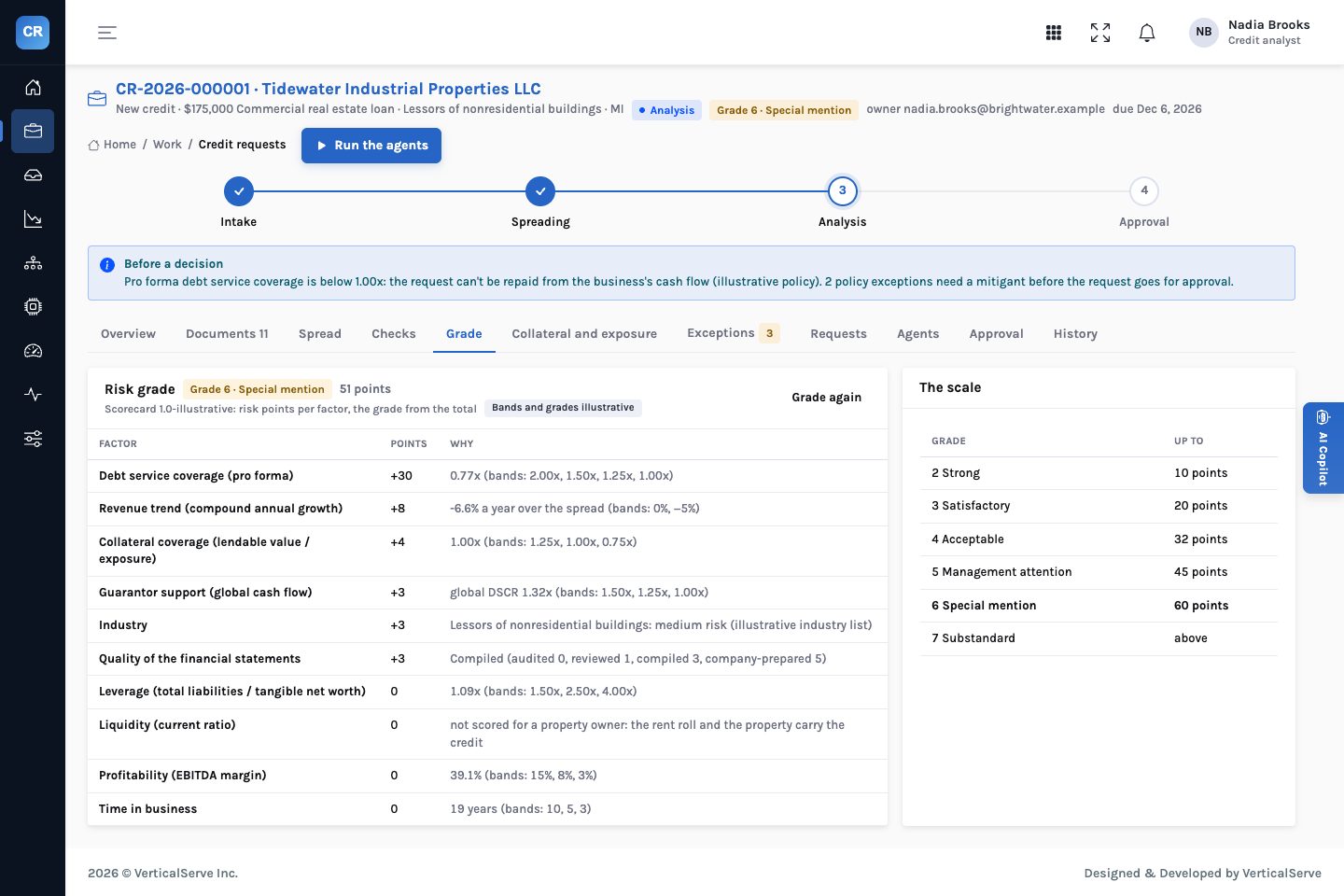
In InsightCredit the grade comes from a scorecard whose version is stored with every grade. A credit officer can override it, but only with a reason, and the override sits beside the computed grade rather than replacing it. That gives a reviewer both numbers to compare.
4. Is the collateral valued, and is the valuation still valid?
For real estate, the Interagency Appraisal and Evaluation Guidelines (2010) and the agencies’ appraisal rules set out when a transaction needs an appraisal by a certified or licensed appraiser and when an evaluation will do. Since 2018, commercial real estate transactions of $500,000 or less have been exempt from the appraisal requirement, with an evaluation required instead. The guidelines also expect a bank to engage appraisers independently of the loan production function, to review what comes back, and to have criteria for deciding whether an existing appraisal or evaluation is still valid for a new transaction, taking into account things like the time that has passed and changes in the market or the property.
That last expectation is where files most often struggle. An additional advance on a property appraised three years ago may or may not need a new appraisal; the bank’s policy decides, and the file should show the policy was applied.
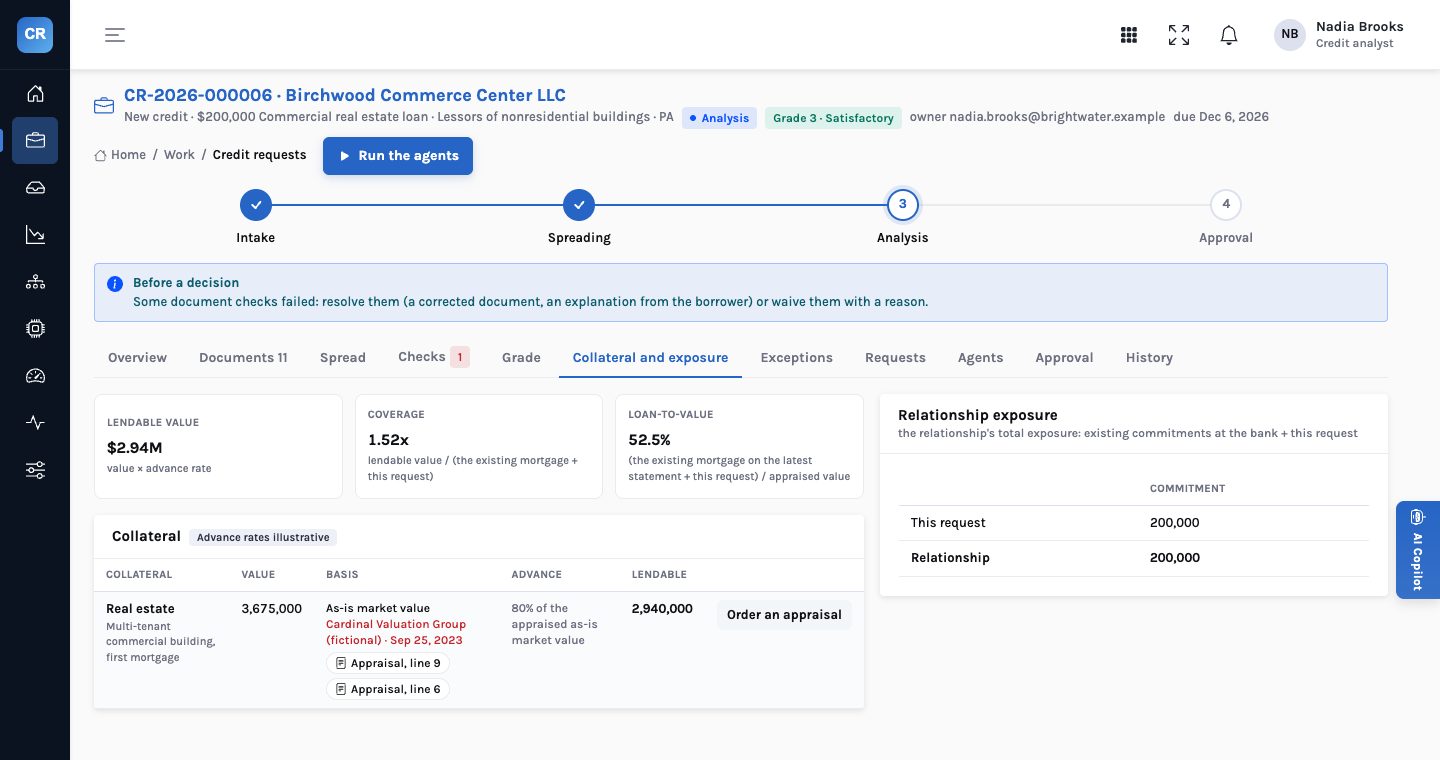
In InsightCredit, collateral values come from the appraisals and agings the reader took, never typed in, and advance rates are the bank’s. A check fails when the appraisal is older than the bank’s limit and new money is being advanced. The collateral agent prepares an appraisal order, but a person orders it.
5. Were exceptions identified, and approved by the right person?
Every credit policy allows exceptions. What examiners look for is that exceptions are identified consistently, that the reason they were accepted is written down, that they are tracked across the portfolio, and that whoever approved them held the authority to do so. The same goes for limits: a bank sets its own internal limits on single borrowers and related groups, typically below the legal lending limit (for national banks, 12 CFR Part 32), and the file should show when a request takes a group over one.
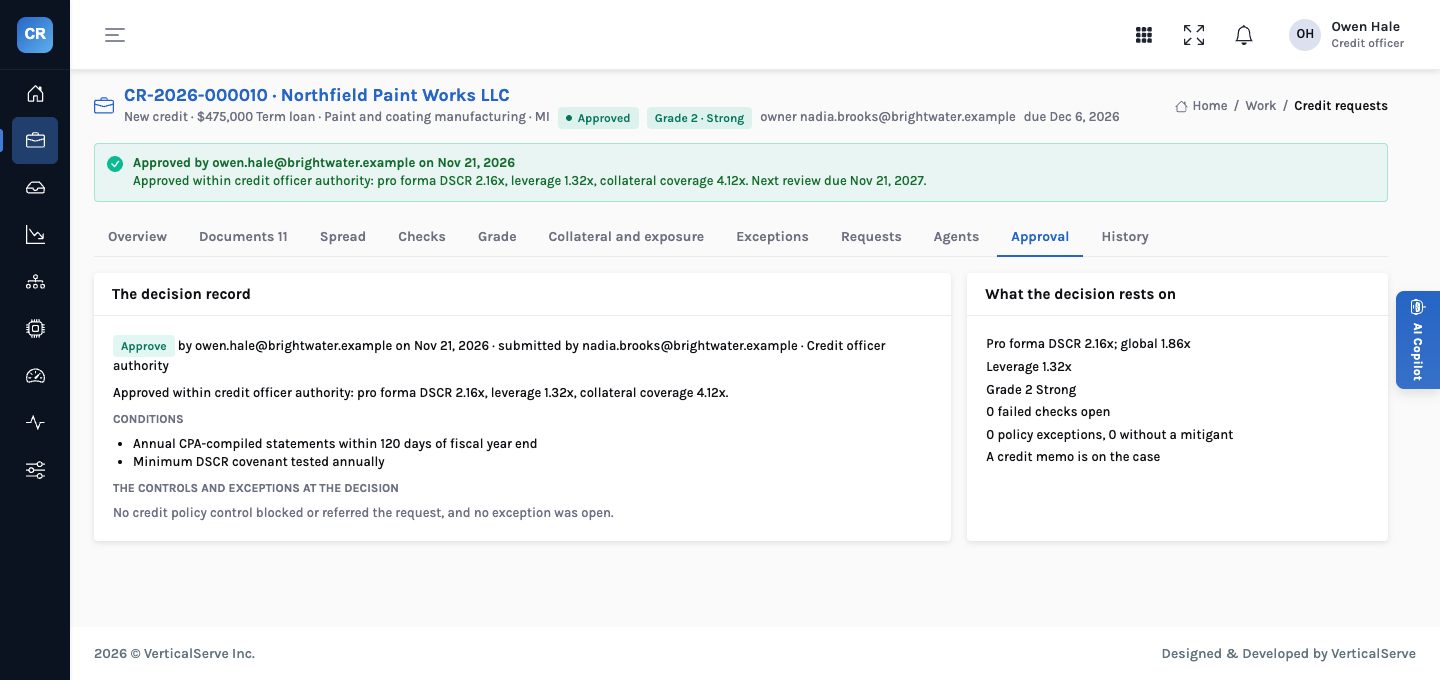
Twelve credit policy controls in Rules Studio test the request: coverage, global coverage, leverage, tangible net worth, liquidity, LTV, collateral shortfall, the group house limit and the grade.
A block can’t be justified: cure it or decline. A refer becomes a policy exception that needs a mitigant.
Drafted from the case’s own figures, such as global coverage, guarantors’ liquid assets or collateral coverage.
A person edits the draft and records it. Until then the request can’t be submitted.
By relationship exposure; any referred exception needs at least a senior credit officer; a group over the house limit needs the credit committee.
The person who submitted can never approve. A decline needs a reason.
On the fictional Ashford Engineering request, a $4,400,000 term loan brings the relationship to $10,277,000 and the Iyer related-companies group to $15,966,000 against the demo’s illustrative $15,000,000 house limit, so the credit committee decides and a senior credit officer records its decision with the meeting date and minute reference.
6. Is the credit still being watched?
Origination gets the attention; monitoring gets the findings. Examiners look at whether annual reviews happen on time, whether covenants are tested when the borrower reports, whether late reporting is chased, and whether grades move when coverage falls. The 2020 credit risk review guidance expects the review function to look at exactly this: whether ratings are accurate and timely across the book.
In InsightCredit the covenant monitor tests minimum coverage, maximum leverage and minimum current ratio on each borrower’s quarterly reporting, flags coverage that is still passing but falling, and lists packages that are late. It prepares watchlist additions; a person adds a borrower to the watchlist and clears it, with a reason. Annual reviews due within 60 days are listed; on the demo loan book that is 46 relationships, 13 of them overdue, and the agent prepares opening the overdue ones for a person to confirm.
What it means for each audience
For the chief credit officer
Make the credit policy executable: if the controls, the grade and the authority can be recomputed from the written rules, consistency stops being a matter of training.
Measure overrides, waivers, exceptions by type and overdue reviews as closely as you measure volume.
For the credit team lead
Every file should answer the reviewer’s question without the analyst in the room: what was read, what was checked against what, and why the outcome followed.
Treat a figure with no source, or a waiver with no reason, as a defect even when the credit turned out fine.
For the board
Credit findings cost more than the loans they are about: in remediation, in restrictions and in the time of senior people.
Ask management for three numbers: overdue annual reviews, open policy exceptions, and grade overrides. They say more than the size of the pipeline.
What to be careful about
- A complete file is not a good credit. Evidence makes the reasoning visible. It doesn’t make the reasoning right; that is still the credit officer’s job.
- Software doesn’t make a bank compliant. InsightCredit applies the policy a bank configures and records what happened. Whether the policy and the practice meet supervisory expectations is for the bank, its reviewers and its examiners.
- The thresholds in this post are ours, for a demo. The 1.25x coverage minimum, the 365-day appraisal limit, the advance rates, the authorities and the house limit were set for illustration. Set your own, and write down why.
Examiners don’t examine your credit policy. They examine whether your files prove you followed it.
Build files where every figure cites its document, every grade shows its points and every exception shows who accepted it, and a review becomes a reading exercise.