Ask a relationship manager why a straightforward term loan for a good customer took three weeks, and the answer is rarely “the analysis was hard”. It is that the 2025 return hadn’t come in, that the statements had to be typed into the spreading template, that the receivables on the balance sheet didn’t match the aging and nobody noticed until the memo was half written, and that the approver sent it back with a question the file already answered on page nine. The credit judgement at the centre of the request took an afternoon. Everything around it took the rest.
In short
- Every commercial request goes through the same steps, whatever its size. Gather the documents, spread three years, reconcile, grade, value the collateral, write the memo, approve. A $150,000 equipment loan and a $4.4 million acquisition loan walk the same path.
- Most of the elapsed time is not analysis. It is waiting for documents, re-keying figures, reconciling by hand and rewriting the same numbers into the memo and the approval summary.
- Problems are found late because checking comes last. A return that disagrees with the statements, or an appraisal that is three years old, usually surfaces when someone is writing, not when the document arrives.
- The fix is to separate preparation from decision. Let software read, spread, reconcile, grade and draft, citing every figure to its document and line, and keep the judgement, the exceptions and the approval with people.
The same steps at every size
Commercial and small-business credit has a well-worn shape. A request comes in from a relationship manager: new money, an increase, a renewal, or an annual review of an existing loan. Someone collects the borrower’s financial statements, tax returns, bank statements, agings, rent rolls, the guarantors’ personal financial statements and the appraisals. An analyst spreads three fiscal years into the bank’s template, works out the ratios and the debt service coverage with the new loan, and checks the figures against each other. The request is graded on the bank’s scale, the collateral is valued at the bank’s advance rates, the analyst writes a credit memo, and an officer with enough authority approves or declines.
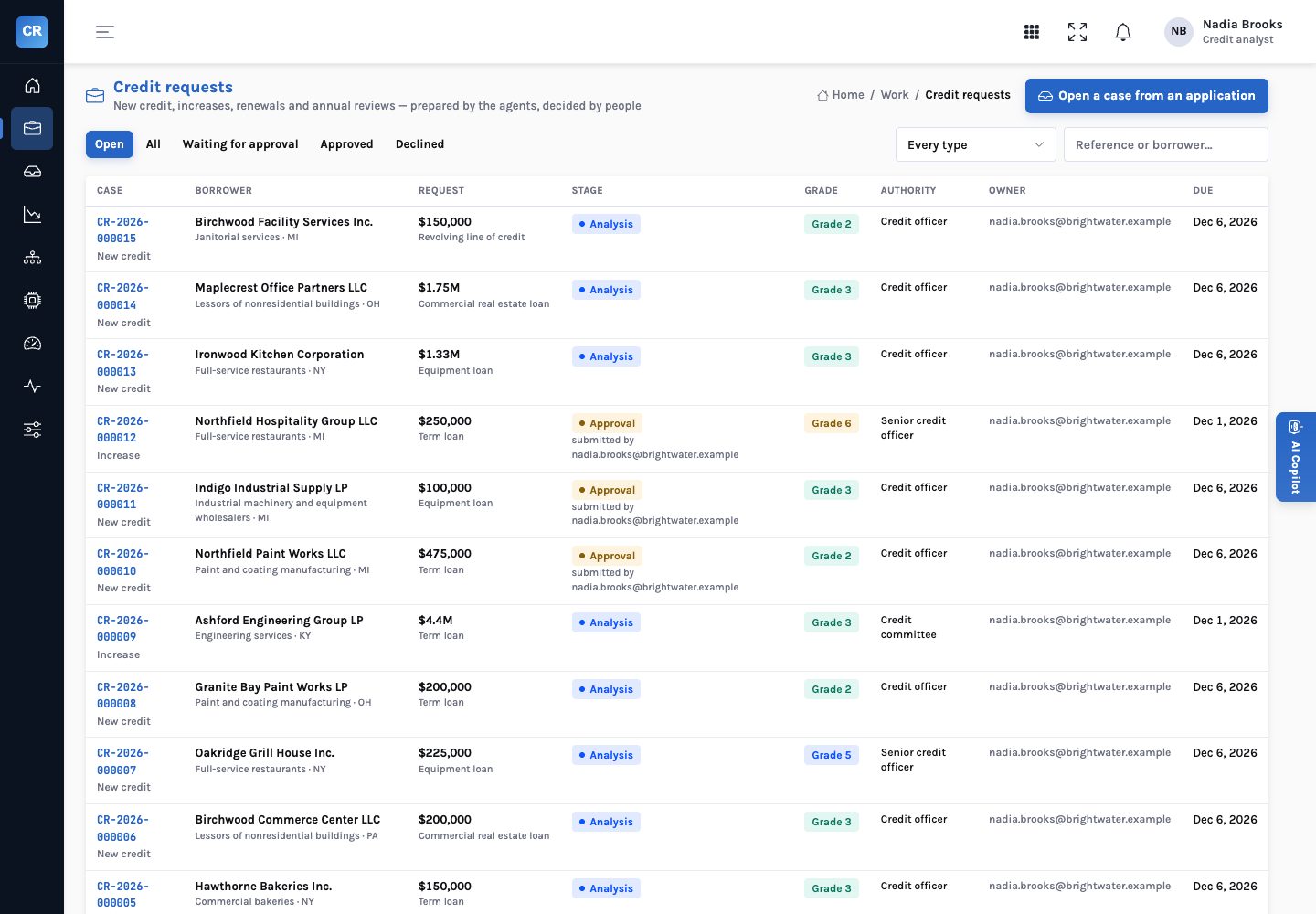
Banks differ in the template, the scale and the authorities, but very little in the steps. The request size changes how much is at stake and who approves it. It barely changes the work: a restaurant asking for $225,000 of kitchen equipment needs three years spread, its returns compared, its guarantors’ statements read and a memo written, just as an engineering firm buying a competitor’s contracts does. That is why small requests are so often uneconomic to underwrite properly, and why large ones queue behind them.
The traditional request: preparation done by hand, and three loops back that each add days.
Where the time goes
If you follow a request through a credit department with a stopwatch, the hours spent on judgement are a small share of the calendar. Nobody we have spoken to has measured the split precisely, and it varies with the bank and the request, but the shape is consistent. The bulk of the time goes on getting the numbers into one place, in a form someone trusts.
| Activity | What it involves | Needs judgement? |
|---|---|---|
| Chasing documents | Working out what is missing, asking the relationship manager to ask the borrower, waiting, then checking what arrives is the right year and the right entity | Rarely: the list of what is needed is known in advance |
| Re-keying the statements | Typing thirty-odd lines a year, for three years, from PDFs into a spreading template | No: it is transcription |
| Reconciling | Comparing revenue with the return, receivables with the aging, deposits with revenue, rent with the rent roll | Only when something disagrees |
| Working the ratios | Debt service coverage with the new loan, leverage, liquidity, global cash flow with the guarantors | Little: the formulas are the bank’s |
| Grading | Applying the scorecard or the grading guidance to the figures | Partly: the points are mechanical, an override is judgement |
| Writing the memo | Restating every figure from the spread in prose, plus the request, the collateral, the exposure and the exceptions | Partly: the recommendation is judgement, the restatement is not |
| Deciding | Approve, decline or approve with conditions, within the right authority | Always |
Two of these rows dominate the calendar for different reasons. Chasing documents is elapsed time: the analyst isn’t busy, the request just isn’t moving. Re-keying and rewriting is effort: the analyst is busy, typing the same numbers more than once. Neither needs a credit professional, and both are where a credit professional’s day goes.
The same number, typed four times
Follow one figure, last year’s EBITDA, through a typical file. The analyst types operating income and depreciation into the spread from the income statement. A formula adds them. The analyst copies the result into the debt service coverage calculation, then into the memo’s financial summary, then into the approval summary or the credit committee pack. If the borrower sends a corrected statement, the figure has to be changed in every place, and the places that aren’t changed are the ones an approver or a reviewer finds later.
Each copy is a chance for the figures to drift apart. The memo and the approval summary are where they usually do.
None of this is careless. It is what happens when the spread, the memo and the approval live in different tools and a person is the only thing joining them. The cost is not just the typing. It is that nobody reading the memo can tell, without opening the spread and then the PDF, whether a figure is right.
Three ways the model breaks
1. Problems surface late
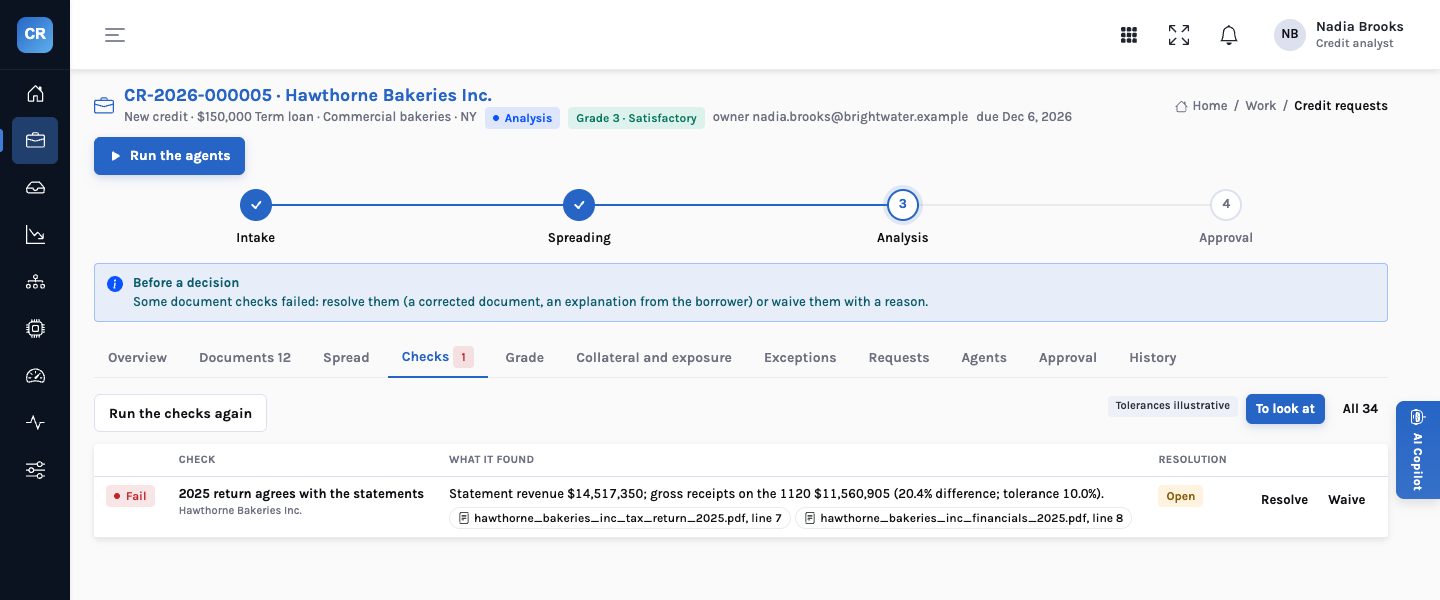
When reconciliation is done by eye, it gets done when someone has time, which is often while writing the memo. By then the borrower has been told the request is moving. In the demo bank we built (Brightwater Commercial Bank, fictional, as are every borrower and figure on it), Hawthorne Bakeries’ 2025 statements show revenue of $14,517,350, while the gross receipts on its 2025 Form 1120 are $11,560,905: a 20.4% difference. Found on the day the return arrives, that is a question to the borrower. Found while the memo is being written, it is a delay and an awkward phone call.
2. Quality depends on who picked it up
Two analysts spreading the same statements will usually agree on revenue. They are less likely to agree on what counts as current portion of long-term debt, whether to add back a one-off expense, or how hard to look at a receivables balance that seems high for the revenue. Grading guidance narrows the differences without removing them, because the inputs were assembled by hand and the reasoning was written up in free text.
3. The file is thinner than the work
An analyst may have compared every return with the statements and satisfied themselves that the aging explained the receivables. What survives is often a spread with no sources and a sentence in the memo. When the loan comes up for annual review, or a credit risk reviewer samples the file, the reasoning has to be rebuilt from the documents.
Documents arrive by email, are typed into a template, reconciled when there is time and restated in a memo. The approver trusts the memo or reopens the spread.
Documents are read as they arrive, every cell of the spread links to its line, reconciliations run at once and the memo is drafted from the same figures. The analyst reviews and decides what to do about what was found.
Why earlier automation didn’t fix it
Banks have had spreading software, loan origination systems and document capture for years. They helped, and they left the shape of the work largely alone.
- Spreading tools still needed the numbers typed in. A better template is still a template; the analyst was still the reader.
- Capture tools produced values without sources. A figure lifted from a PDF that can’t say which line it came from has to be checked by hand to be trusted, which puts the analyst back where they started.
- Workflow tools moved the file, not the facts. An origination system can route a request to the right approver. It usually can’t tell the approver that the appraisal is three years old or that the guarantor’s net worth is negative.
- The memo stayed a word-processing job. However good the spread, someone still rewrote it into prose, with every chance to transpose a digit.
What changed
None of the pieces is new on its own: reading a statement’s text layer, applying the bank’s formulas, comparing two documents within a tolerance, drafting prose from structured facts. What is new is doing all of them on one request, in order, the moment a document arrives, with every figure carrying the document and line it came from, so that a person opens a request that has already been prepared.
Separating preparation from decision
The change we argue for is organisational before it is technical. Treat each request as two jobs. Preparing it means reading the documents, spreading, reconciling, working the ratios, grading on the scorecard, valuing the collateral, testing the bank’s policy and drafting the memo and the requests to the borrower. Deciding it means judging what the findings mean, justifying or curing the exceptions, and approving within an authority. Preparation can be done by software, provided every figure carries its source and every conclusion its reasons. Decision stays with named people.
Two jobs, one request. Nothing on the left decides; everything on the right is a named person.
InsightCredit is built this way. A request arrives on the queue with its borrower, guarantors, documents and collateral copied from the bank’s systems. The document reader takes the figures from each PDF’s text layer, keeping the line and the exact text for every field, and says so plainly when it can’t find one rather than guessing. The spread is built only from what was read. The checks run at once. The memo writer drafts from the same figures the spread uses, so the memo and the spread can’t drift apart.
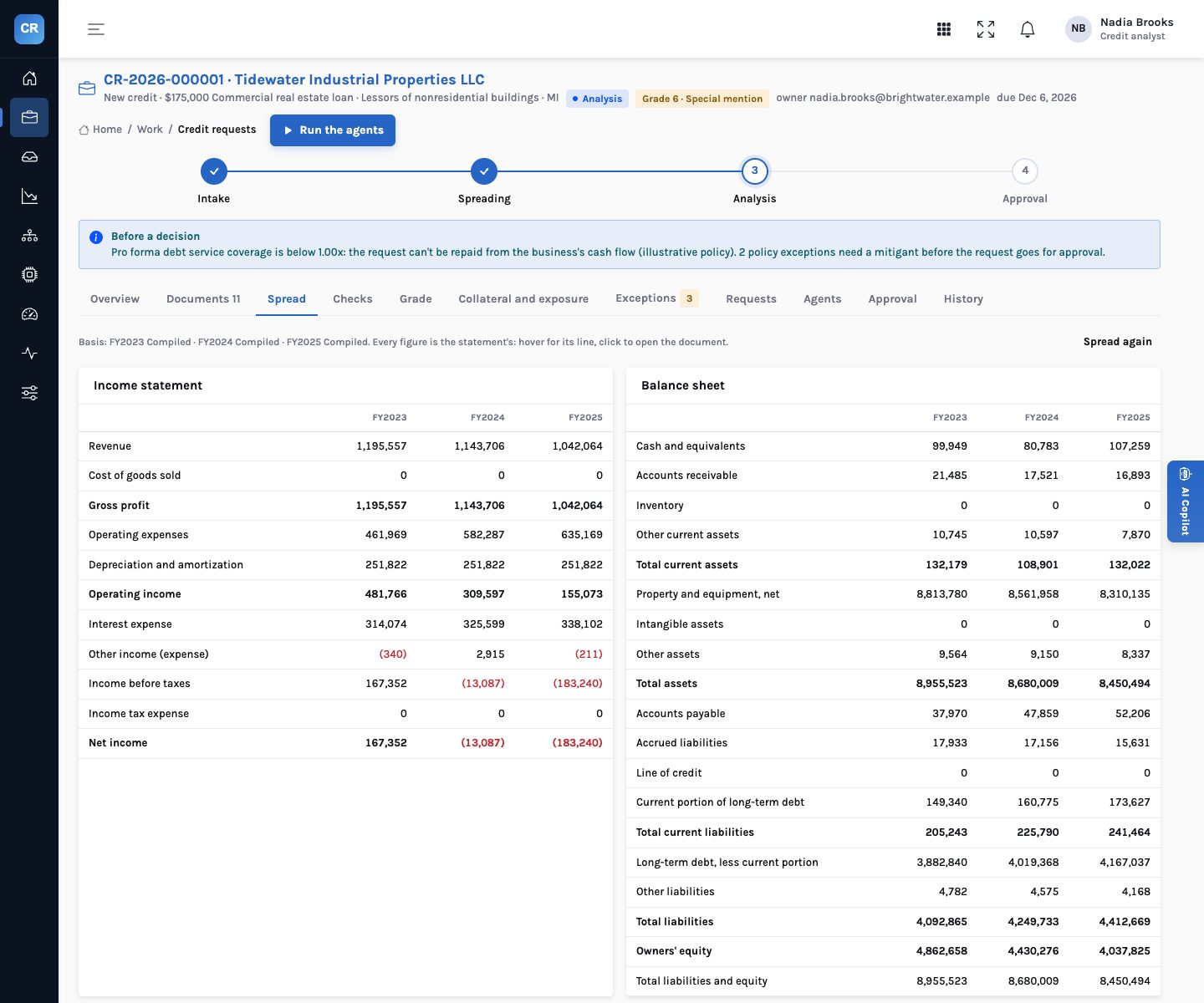
Open a request and the spread is already there: three fiscal years side by side, each cell linked to the document and line it came from. Hover for the line; click to open the document beside it. Derived figures such as EBITDA and debt service carry their formulas.
Where the time comes back
We are careful not to promise a number of days saved. That depends on the bank, its borrowers and how quickly they answer. What changes is where the time goes.
- Missing documents are known on day one. The checks list what the request needs (three years of statements, the two latest returns, the guarantors’ statements, an aging if there are receivables, an appraisal for real estate) and an agent drafts the request to the borrower. A person reviews it and sends it. The borrower uploads through a link with no login, and what they upload is read at once.
- Disagreements are questions, not surprises. When the receivables don’t agree with the aging or the return disagrees with the statements, the check fails with both figures quoted, and the spreading agent drafts a request for an explanation the same day.
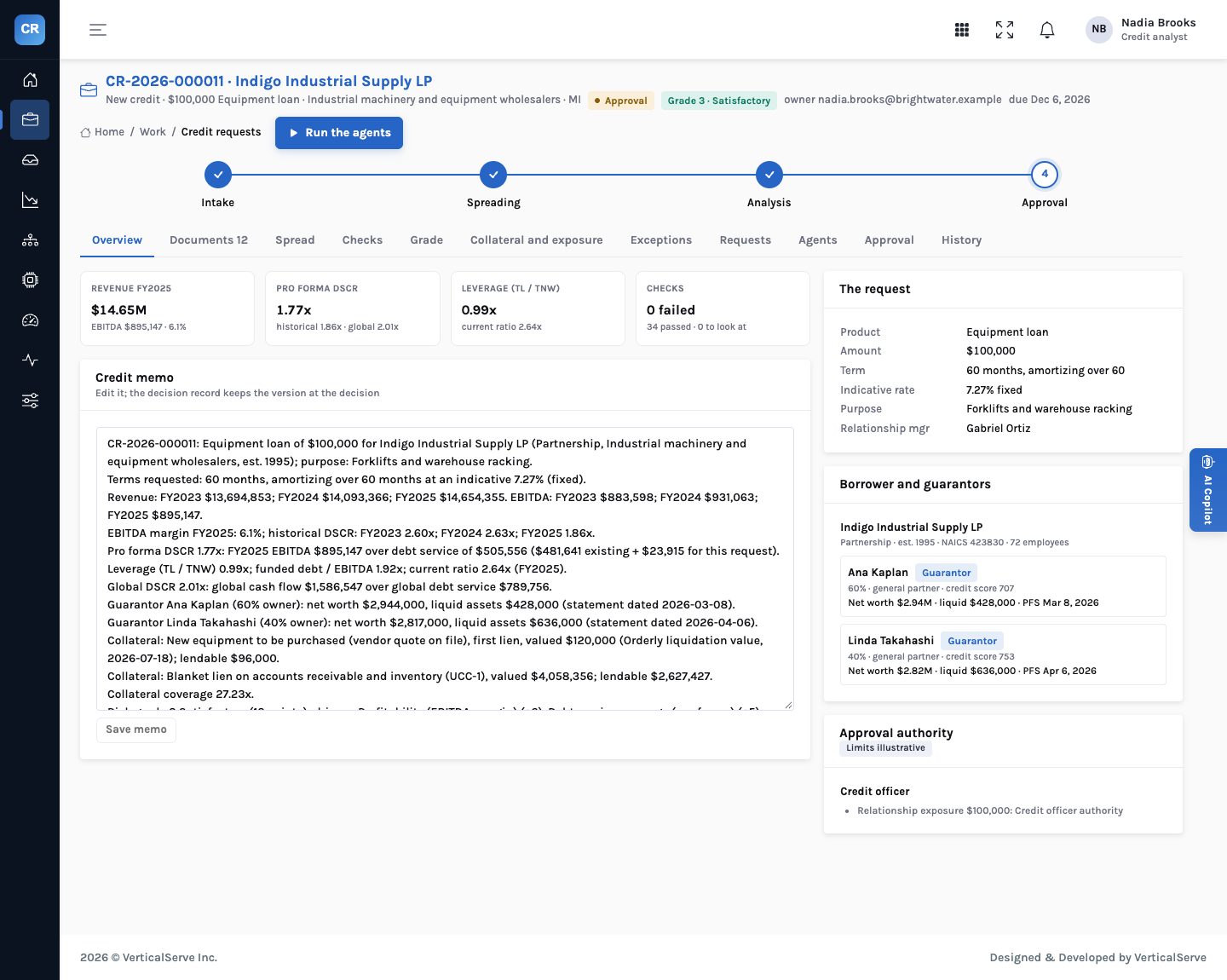
- The memo is reviewed, not written. The analyst edits a draft whose every figure came from the engines, instead of restating the spread from scratch.
- The approver reads one record. What blocks, what was referred and how it was mitigated, and which authority is needed, on one screen.
What it means for each audience
For the chief credit officer
The question shifts from “how many analysts do we need for this pipeline?” to “are the people deciding these requests seeing the right findings, early enough?”
Consistency improves because every request is spread, reconciled and graded the same way, with the bank’s own thresholds, and the file shows the evidence rather than a summary of it.
For the credit team lead
Analysts stop being typists between a PDF, a template and a memo. Their day becomes reviewing what was found and deciding what to ask the borrower.
Problems surface the day the document arrives, so the conversation with the relationship manager happens early, while it is still easy.
For the board
Turnaround on commercial credit becomes something the bank manages rather than accepts, without loosening the controls that protect it.
Small requests become cheaper to underwrite properly, which is where the old model was weakest.
What to be careful about
- Prepared is not decided. If analysts accept every prepared spread and memo without reading them, the bank has automated the credit decision by the back door. Track how often people change or reject what was prepared; a rate of zero is a warning, not a success.
- The reader only reads what is there. A scanned PDF with no text layer is refused, and a figure that isn’t on the page is marked missing. That is the right behaviour, but it means document quality still matters.
- The policy is still yours. Thresholds such as a 1.25x coverage minimum, the reconciliation tolerances and the advance rates in our demo are illustrative. Software applies the bank’s policy consistently; it doesn’t choose it.
- Speed should not outrun the borrower conversation. A faster file is only valuable if the questions it raises are still asked, and answered, by people.
Commercial credit doesn’t take weeks because the analysis is hard. It takes weeks because people are doing the preparation.
Give the reading, spreading, reconciling and drafting to software that shows its sources, and give your credit team back the decisions.